
Ressources
Explorez une large gamme de ressources sur le GCED afin d’approfondir votre compréhension et de renforcer vos activités de recherche, de plaidoyer, d’enseignement et d’apprentissage.
1,951 résultats trouvés
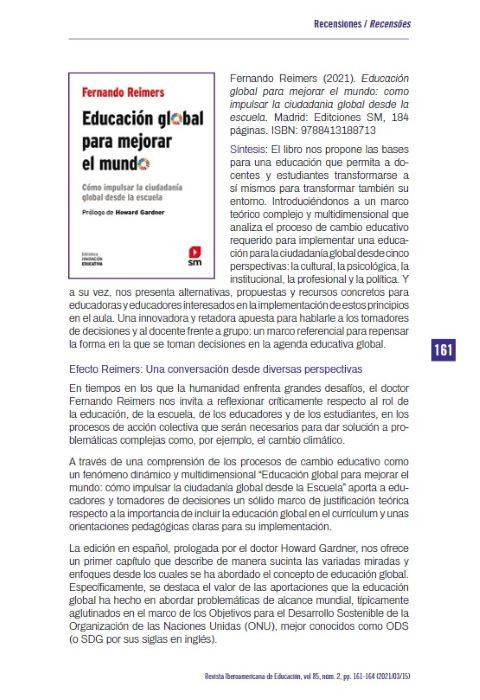 [Reseña de libro] Educación global para mejorar el mundo (Revista Iberoamericana De Educación; vol. 85, no.2) Année de publication: 2021 Auteur: Patricia Vasquez | Gustavo Rojas Reseña del libro "Educación global para mejorar el mundo: cómo impulsar la ciudadanía global desde la Escuela" en el que el doctor Fernando Reimers propone las bases para una educación que permita a docentes y estudiantes transformarse a sí mismos para transformar también su entorno. En esta obra, se presenta un marco teórico complejo y multidimensional que analiza el proceso de cambio educativo requerido para implementar una educación para la ciudadanía global desde cinco perspectivas: la cultural, la psicológica, la institucional, la profesional y la política.
  Global Citizenship Education, Year 2019-2020 Année de publication: 2020 Auteur institutionnel: CRÉDIL Joliette As part of our 2019-2020 Annual General Meeting, our colleague, Laura Vergara has created this video to keep you informed of the highlights of this year's Global Citizenship Education component! Discussion on living together, intercultural dialogue, recognition and respect for cultural diversity, migration issues in Quebec and around the world, climate change and social justice and gender equality. Éducation à la citoyenneté mondiale, année 2019-2020 Année de publication: 2020 Auteur institutionnel: CRÉDIL Joliette Dans le cadre de notre assemblée générale annuelle 2019-2020, notre collègue, Laura Vergara a créé cette vidéo pour vous tenir informer des aspects marquants du volet Éducation à la citoyenneté mondiale de cette année! Discussion sur le vivre-ensemble, le dialogue interculturel, la reconnaissance et le respect de la diversité culturelle, les enjeux migratoires au Québec et dans le monde, les changements climatiques et la justice sociale et l’égalité femme-homme.
  Citizenship and Civics: Learn From These Young Senegalese Leaders Année de publication: 2020 Auteur institutionnel: Vibe Radio Senegal This is a video of young Senegalese leaders presenting on Citizenship and civics. La citoyenneté et le civisme: Apprenez de ces jeunes leaders sénégalais Année de publication: 2020 Auteur institutionnel: Vibe Radio Senegal C'est une vidéo de jeunes leaders sénégalais présentant sur Citoyenneté et civisme.
  What Can Education Do to Prevent Violence? Année de publication: 2021 Auteur: Rafael Bisquerra Auteur institutionnel: BBVA We learn together 2030 In this video, the educator Rafael Bisquerra reflects on emotional management as a way to reduce the rates of violence in society, contributing to the improvement of conflict management. ¿Que puede hacer la educaciòn para prevenir la violencia? Année de publication: 2021 Auteur: Rafael Bisquerra Auteur institutionnel: BBVA We learn together 2030 En este vídeo, el educador Rafael Bisquerra reflexiona sobre la gestión emocional como forma de disminuir los índices de violencia en la sociedad contribuyendo a la mejora en el manejo de conflcitos.
 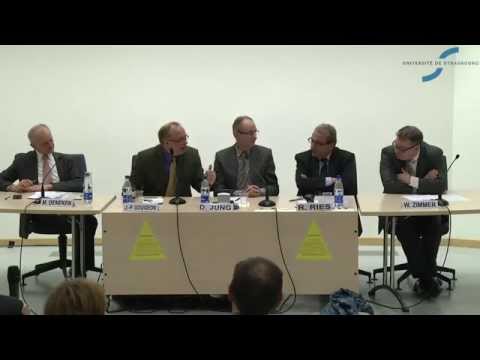 Conference-Debate: Can Citizenship Be Taught? Année de publication: 2015 Auteur institutionnel: University of Strasbourg At the initiative of the Faculty of Law, Political Science and Management, this conference/debate brings together: Roland Ries, Mayor of Strasbourg; Jacques-Pierre Gougeon, rector of the Academy of Strasbourg, chancellor of universities; Michel Deneken, 1st vice-president of the University of Strasbourg; Willy Zimmer, professor of public law;Dominique Jung, editor-in-chief of Latest News from Alsace (moderator). Conférence-débat: La citoyenneté peut-elle être enseignée? Année de publication: 2015 Auteur institutionnel: University of Strasbourg À l'initiative de la Faculté de droit, de sciences politiques et de gestion, cette conférence/débat réunit : Roland Ries, maire de Strasbourg ; Jacques-Pierre Gougeon, recteur de l'académie de Strasbourg, chancelier des universités ; Michel Deneken, 1er vice-président de l'Université de Strasbourg ; Willy Zimmer, professeur de droit public ; Dominique Jung, rédacteur en chef des Dernières nouvelles d’Alsace (modérateur).
 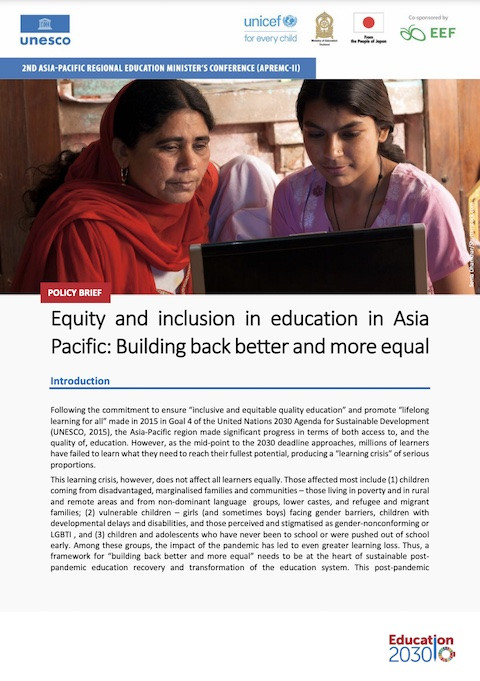 Equity and Inclusion in Education in Asia Pacific: Building Back Better and More Equal; Policy Brief Année de publication: 2022 Auteur institutionnel: UNESCO Bangkok Following the commitment to ensure “inclusive and equitable quality education” and promote “lifelong learning for all” made in 2015 in Goal 4 of the United Nations 2030 Agenda for Sustainable Development (UNESCO, 2015), the Asia-Pacific region made significant progress in terms of both access to, and the quality of, education. However, as the mid-point to the 2030 deadline approaches, millions of learners have failed to learn what they need to reach their fullest potential, producing a “learning crisis” of serious proportions. This learning crisis, however, does not affect all learners equally. Those affected most include (1) children coming from disadvantaged, marginalised families and communities – those living in poverty and in rural and remote areas and from non-dominant language groups, lower castes, and refugee and migrant families; (2) vulnerable children – girls (and sometimes boys) facing gender barriers, children with developmental delays and disabilities, and those perceived and stigmatised as gender-nonconforming or LGBTI , and (3) children and adolescents who have never been to school or were pushed out of school early. Among these groups, the impact of the pandemic has led to even greater learning loss. Thus, a framework for “building back better and more equal” needs to be at the heart of sustainable postpandemic education recovery and transformation of the education system. This post-pandemic framework calls for decisive action to protect the right to education of good quality and for measures – as spelled out below – to improve learning outcomes, especially for marginalized children made more vulnerable because of the pandemic.