
Ressources
Explorez une large gamme de ressources sur le GCED afin d’approfondir votre compréhension et de renforcer vos activités de recherche, de plaidoyer, d’enseignement et d’apprentissage.
1,951 résultats trouvés
 Citizen Code: What Is Citizenship? Année de publication: 2020 Auteur institutionnel: Radiodiffusion télévision ivoirienne (RTI) This is a video on citizenship in Ivory Coast. The discussion was focused on the values, actions, and ideas related to active citizenship. Citizen code: Qu'est ce que la citoyenneté? Année de publication: 2020 Auteur institutionnel: Radiodiffusion télévision ivoirienne (RTI) Il s'agit d'une vidéo sur la citoyenneté en Côte d'Ivoire. La discussion s'est centralisée sur les valeurs, les actions et les idées autour d'une citoyenneté active.
  Towards a National Strategy for Media Literacy: National Consultation Report Année de publication: 2021 Auteur: Michael Dezuanni | Tanya Notley | Luigi Di Martino Auteur institutionnel: Australian Media Literacy Alliance (AMLA) This report makes eight key recommendations for the development of a strategy, which centre around government, community, and technology sector collaboration to ensure every Australian, at every stage of life, is empowered as a citizen to confidently engage with and create media. A media literate citizen has the ability to critically engage with media in all aspects of life.The report draws on a national survey of 3510 adult Australians about their media use, attitudes, and abilities and includes insights from a consultation process, conducted in September 2021, involving six workshops with a diverse group of community and media organisations across Australia.
 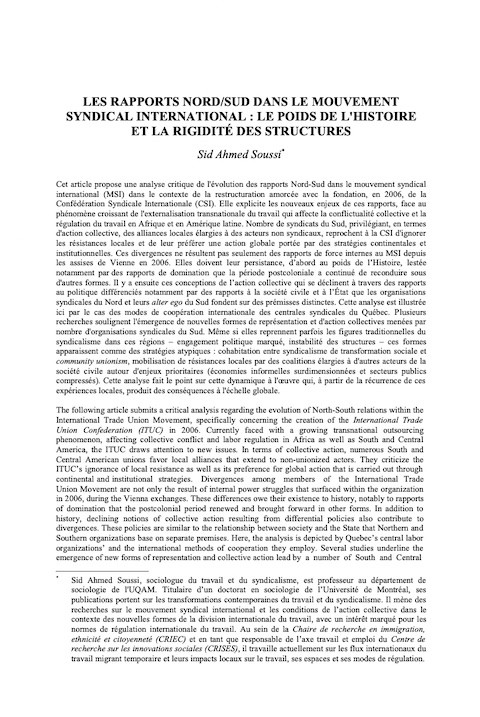 North/South Relationships in the International Trade Union Movement: The Weight of History and the Rigidity of Structures (Quebec Journal of International Law; Special Issue, Nov.) Année de publication: 2012 Auteur: Sid Ahmed Soussi Auteur institutionnel: Société québécoise de droit international (SQDI) The following article submits a critical analysis regarding the evolution of North-South relations within the International Trade Union Movement, specifically concerning the creation of the International Trade Union Confederation (ITUC) in 2006. Currently faced with a growing transnational outsourcing phenomenon, affecting collective conflict and labor regulation in Africa as well as South and Central America, the ITUC draws attention to new issues. In terms of collective action, numerous South and Central American unions favor local alliances that extend to non-unionized actors. They criticize the ITUC’s ignorance of local resistance as well as its preference for global action that is carried out through continental and institutional strategies. Divergences among members of the International Trade Union Movement are not only the result of internal power struggles that surfaced within the organization in 2006, during the Vienna exchanges. These differences owe their existence to history, notably to rapports of domination that the postcolonial period renewed and brought forward in other forms. In addition to history, declining notions of collective action resulting from differential policies also contribute to divergences. These policies are similar to the relationship between society and the State that Northern and Southern organizations base on separate premises. Here, the analysis is depicted by Quebec’s central labor organizations’ and the international methods of cooperation they employ. Several studies underline the emergence of new forms of representation and collective action lead by a number of South and Central American labor organizations. Even though, in some cases, these new types of representation take on traditional forms of unionism such as marked political involvement and organizational instability, they surface within atypical strategies. These unusual approaches include the coexistence of socially-generated unionism and community unionism, as well as the mobilization of local resistance movements through coalitions that extend to other community actors with prioritized issues (oversized informal economies and a compressed public sector). The analysis explores the underlying dynamic that, based on recurring local experiences, produces consequences on a global scale. Les rapports nord/sud dans le mouvement syndical international: Le poids de l’histoire et la rigidité des structures (Revue québécoise de droit international; Special Issue, Nov.) Année de publication: 2012 Auteur: Sid Ahmed Soussi Auteur institutionnel: Société québécoise de droit international (SQDI) Cet article propose une analyse critique de l’évolution des rapports Nord-Sud dans le mouvement syndical international (MSI) dans le contexte de la restructuration amorcée avec la fondation, en 2006, de la Confédération Syndicale Internationale (CSI). Elle explicite les nouveaux enjeux de ces rapports, face au phénomène croissant de l’externalisation transnationale du travail qui affecte la conflictualité collective et la régulation du travail en Afrique et en Amérique latine. Nombre de syndicats du Sud, privilégiant, en termes d’action collective, des alliances locales élargies à des acteurs non syndicaux, reprochent à la CSI d’ignorer les résistances locales et de leur préférer une action globale portée par des stratégies continentales et institutionnelles. Ces divergences ne résultent pas seulement des rapports de force internes au MSI depuis les assises de Vienne en 2006. Elles doivent leur persistance, d’abord au poids de l’Histoire, lestée notamment par des rapports de domination que la période postcoloniale a continué de reconduire sous d’autres formes. Il y a ensuite ces conceptions de l’action collective qui se déclinent à travers des rapports au politique différenciés notamment par des rapports à la société civile et à l’État que les organisations syndicales du Nord et leurs alter ego du Sud fondent sur des prémisses distinctes. Cette analyse est illustrée ici par le cas des modes de coopération internationale des centrales syndicales du Québec. Plusieurs recherches soulignent l’émergence de nouvelles formes de représentation et d’action collectives menées par nombre d’organisations syndicales du Sud. Même si elles reprennent parfois les figures traditionnelles du syndicalisme dans ces régions – engagement politique marqué, instabilité des structures – ces formes apparaissent comme des stratégies atypiques : cohabitation entre syndicalisme de transformation sociale et community unionism, mobilisation de résistances locales par des coalitions élargies à d’autres acteurs de la société civile autour d’enjeux prioritaires (économies informelles surdimensionnées et secteurs publics compressés). Cette analyse fait le point sur cette dynamique à l’oeuvre qui, à partir de la récurrence de ces expériences locales, produit des conséquences à l’échelle globale.
  톡(Talk)쏘는 다문화와 세계시민교육(세계시민교육은 무엇인가) Année de publication: 2022 Auteur institutionnel: 중앙선거관리위원회 톡(Talk)쏘는 다문화와 세계시민교육한국선거방송과 함께 알아보는 선거이야기'세계시민교육은 무엇인가?'
  Educate in Feminism: Why the Urgency? Année de publication: 2019 Auteur: Heydi Pastor A full-time feminist, Heydi Pastor, tells us the main reasons why in a society like ours feminism should be imparted through education to promote equal rights. Educar en feminismo: Porqué la urgencia? Année de publication: 2019 Auteur: Heydi Pastor Feminista a tiempo completo, Heydi Pastor, nos narra los principales motivos por los que en una sociedad como la nuestra debe impartir el feminismo a través de la educación para hacer promover la igualdad de derechos.
 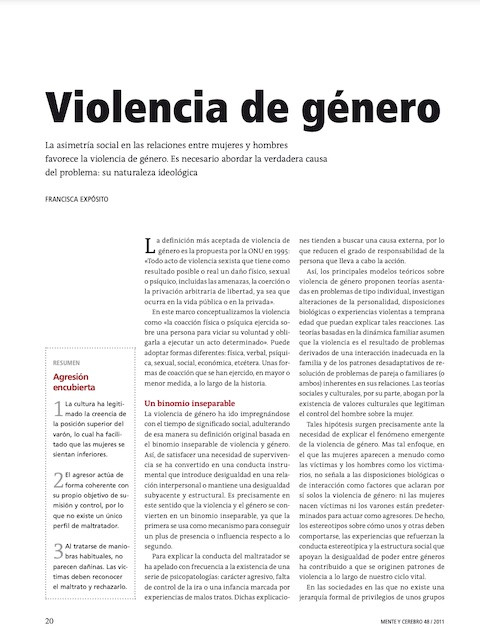 Gender Violence (Mente y Cerebro; no. 48) Année de publication: 2011 Auteur: Francisca Expósito Auteur institutionnel: Prensa Científica This article deals with the ideological nature of gender violence, favored by the social asymmetry between women and men. Violencia de género (Mente y Cerebro; no. 48) Année de publication: 2011 Auteur: Francisca Expósito Auteur institutionnel: Prensa Científica En este artículo se se aborda la naturaleza ideológica de la violencia de género, favorecida por la asimetría social entre mujeres y hombres.