
Ressources
Explorez une large gamme de ressources sur le GCED afin d’approfondir votre compréhension et de renforcer vos activités de recherche, de plaidoyer, d’enseignement et d’apprentissage.
1,983 résultats trouvés
 Récits du quotidien après la sortie de carrière: Quelles expériences du vieillir « actif » et quels enjeux de citoyenneté ? Année de publication: 2016 Auteur: Isabelle Marchand | Oscar Firbank Auteur institutionnel: Politique et Sociétés (Canada) | Société québécoise de science politique Dans le contexte mondial du vieillissement de la population, le vieillissement actif s’impose dorénavant comme cadre référentiel guidant l’action publique afin de susciter « l’activation » du citoyen-retraité face à sa trajectoire du vieillir. Celui-ci est de plus en plus enjoint, d’une part, à rester le plus longtemps possible sur le marché du travail et, d’autre part, à participer à la vie de la cité, surtout après la sortie de carrière. Pourtant, dans nos sociétés salariales, l’individu actif est généralement celui qui contribue au marché du travail. Au regard de la prédominance du travail rémunéré sur tout autre champ du social, comment pouvons-nous comprendre et interpréter le caractère actif de l’activité post-carrière des retraités, en l’occurrence celle des femmes, longtemps considérées comme « inactives » en raison du travail fantôme accompli dans le domaine du privé ? Au regard de résultats d’une recherche menée dans une perspective qualitative et privilégiant la méthode des récits de vie, nous nous sommes intéressés aux pratiques « actives » du vieillir dans la vie quotidienne de femmes ayant quitté le marché de l’emploi. Nous avons regroupé ces pratiques sous divers « pôles d’activation » et nous discuterons d’abord celles logées sous le pôle du care et, par la suite, les pratiques liées à la participation sociale, et ce, en tentant de cerner leur déplacement dans la transition biographique qu’amènent la sortie de carrière et l’entrée dans la retraite. Ces résultats nous amèneront, en conclusion, à réfléchir aux enjeux sociopolitiques, dont ceux liés aux rapports de genre que soulèvent les perspectives d’une citoyenneté « active » du vieillissement.
 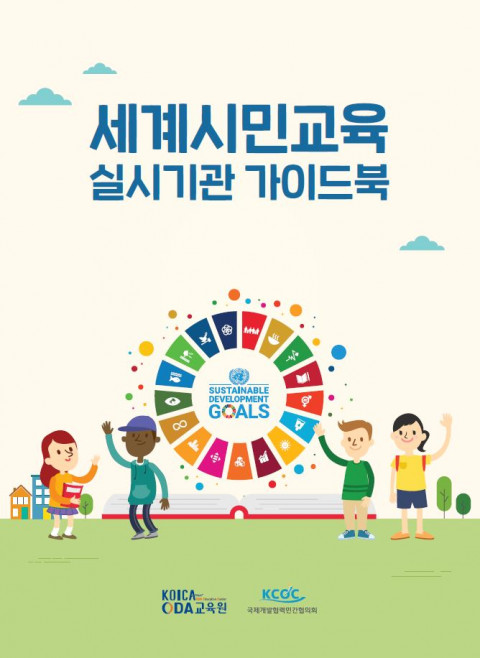 세계시민교육 실시기관 가이드북 Année de publication: 2019 Auteur institutionnel: KOICA ODA 교육원 | 국제개발협력민간협의회 다양한 기관과 NGO 등에서 운영하고 있는 다채로운 세계시민교육 프로그램과 각 기관에 대한 소개 및 교재와 교구 등 참고자료를 수록하고 있다.이 가이드북은 단순히 세계시민교육을 제공하는 기관의 리스트가 아니라 기관의 특성과 운영 프로그램 · 교육 대상을 담고 있다는 점에서 세계시민교육과 세계시민교육 프로그램에 관심 있는 이들에게 유용한 안내서가 될 것이다.
  Creativity, Resilience and Global Citizenship: Activity Toolkit Année de publication: 2015 Auteur institutionnel: CIT Crawford College of Art and Design | Youth Work Ireland This publication is a step by step guide to a range of activities exploring the themes of Creativity, Resilience & Global Citizenship through a wide range of workshops, sharing creative methods and tools. It has been co-developed by the Fast Forward training programme which brought together young people and youth workers from Ireland, Hungary, Italy and UK in Cork, Ireland in January 2015. It was developed with thirty young people: youth workers, artists and educators who are passionate about supporting young people to grow as global citizens. It is useful to provide a context for anyone engaging others in the creative activities presented in this toolkit.
  Citizens but Not Adults? Injunction to Be Responsible and Citizens in Official Coming of Age Rituals in Switzerland Année de publication: 2018 Auteur: Maxime Felder | Laurence Ossipow | Isabelle Csupor Auteur institutionnel: Lien social et Politiques Swiss municipalities organize ceremonies for their residents reaching the official age of full citizenship. In the six studied municipalities, local authorities invite them to a municipal council’s meeting, offer them a dinner or an aperitif, or organize them a show and a debate with role models. Speeches are central to these ceremonies, and authority representatives encourage their audience to be “good” citizens. Call to vote is the leitmotiv, but discourses reveal broader definitions of citizenship, insisting sometimes on a local commitment and volunteering, and sometimes on the necessity to fight climate change and inequalities. Comparing officials’ speeches to statements of young people participating in these events reveals “tensions”. Indeed, authority representatives address young citizens without considering them as fully adult, and they do not consider themselves as such neither. However, some of them are already involved in forms of vernacular citizenship, and are progressively leaving the municipality to study, work or travel. Ultimately, these ceremonies allow officials to stage their interest in the youth, which they consider as both uncompleted and essential to the renewal of democracy.
 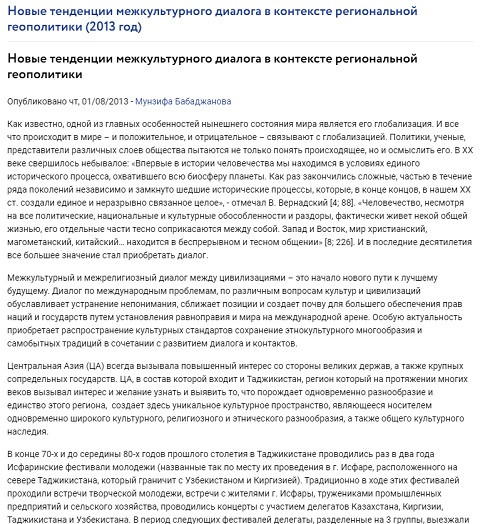 Новые тенденции межкультурного диалога в контексте региональной геополитики Année de publication: 2013 Auteur: Munzifa Babadjanova Межкультурный и межрелигиозный диалог между цивилизациями – это начало нового пути к лучшему будущему. Диалог по международным проблемам, по различным вопросам культур и цивилизаций обуславливает устранение непонимания, сближает позиции и создает почву для большего обеспечения прав наций и государств путем установления равноправия и мира на международной арене. Особую актуальность приобретает распространение культурных стандартов сохранение этнокультурного многообразия и самобытных традиций в сочетании с развитием диалога и контактов.
 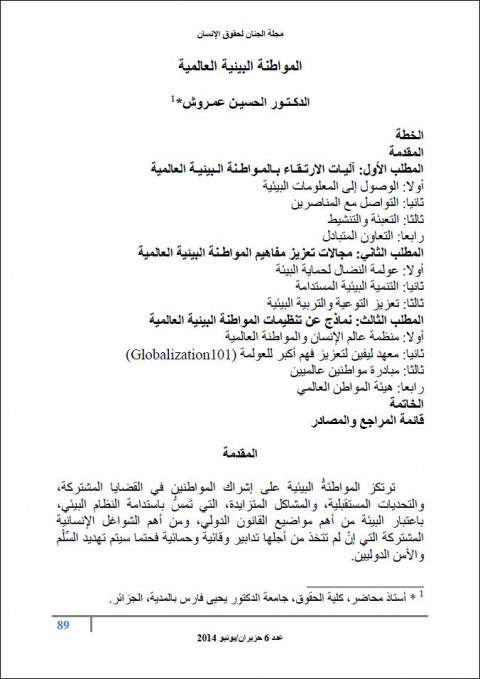 المواطنة البيئية العالمية Année de publication: 2014 Auteur: Al husain Amrosh Auteur institutionnel: Al-Jinan Journal هدفت الدراسة إلى التعرف على المواطنة البيئية العالمية، وقسمت الدراسة إلى ثلاثة مطالب، تناول المطلب الأول آليات الارتقاء بالمواطنة البيئية العالمية، وناقش المطلب الثاني مجالات تعزيز مفاهيم المواطنة البيئية العالمية، وتطرق المطلب الثالث إلى نماذج عن تنظيمات المواطنة البيئية العالمية. واختتمت الدراسة بالإشارة إلى عدة نقاط ومنها، تُعد المواطنة البيئية العالمية من المفاهيم الثورية التي عززت من المركز القانوني للأفراد، في إطار الفضاء الإلكتروني الذي زاد من فرصة التواصل غير المحدود، في عالم أرحب تتعزز فيه الديمقراطية والحرية، وتتكرس من خلاله قوة تنظيمات المجتمع المدني في الارتقاء بالمواطنة البيئية التي تستهدف تكوين إنسان له نفس الهموم والحقوق والواجبات والتطلعات في جميع أنحاء العالم دون أي تمييز، تجسيدًا لمفهوم الإنسانية العالمية، وأنه من الملاحظ أن الارتقاء بمفاهيم المواطنة البيئية على الصعيد العالمي، أصبح من أهم الآليات التي تحظى بأهمية بالغة في سياق تفعيل عالمية الحق في البيئة، باعتباره حقًا إنسانيًا لا يجوز بأي حال من الأحوال انتهاكه أو حتى الاتفاق على انتهاكه، بالإضافة لاعتباره تراثًا مشتركًا للإنسانية، وهذا الأمر يتطلب تضافر الجهود الوطنية والإقليمية والعالمية لتجسيده عمليًا. كُتب هذا المستخلص من قِبل دار المنظومة 2018 The Environmental, Global Citizenship Année de publication: 2014 Auteur: Al husain Amrosh Auteur institutionnel: Al-Jinan Journal The paper focuses on the concept of global environmental citizenship and its importance in preserving the world. The author discussed mechanisms for advancing global environmental citizenship, and areas for enhancing global environmental citizenship concepts. Finally, he reviewed examples of global environmental citizenship organizations.
  Building Cross-Sectoral Cooperation: Estonian Coalition for Sustainable Development Année de publication: 2020 Auteur institutionnel: Estonian Roundtable for Development Cooperation (AKÜ) | Bridge 47 | European Union (EU) This publication presents the members of Estonian Coalition for Sustainable Development, examples of their actions towards a more sustainable future and also some of the activities that the partnerships together have carried over the past few years. It is a great example of a cross-sectoral cooperation and a way of sharing knowledge.
  Stepping Stones for the Sustainable Development Goals: A Workbook for Community and Adult Education Practitioners Année de publication: 2020 Auteur: Jennifer Harris Auteur institutionnel: Development Perspectives | Irish Aid The aim of this workbook is to provide a tool for Adult and Community groups and their leaders to understand the Sustainable Development Goals (SDGs) and to take meaningful action on those Goals. It aims to support adult and community educators in integrating the SDGs into their work using the principles and methodologies embraced by Development Education (DE)and Global Citizenship Education (GCE).
 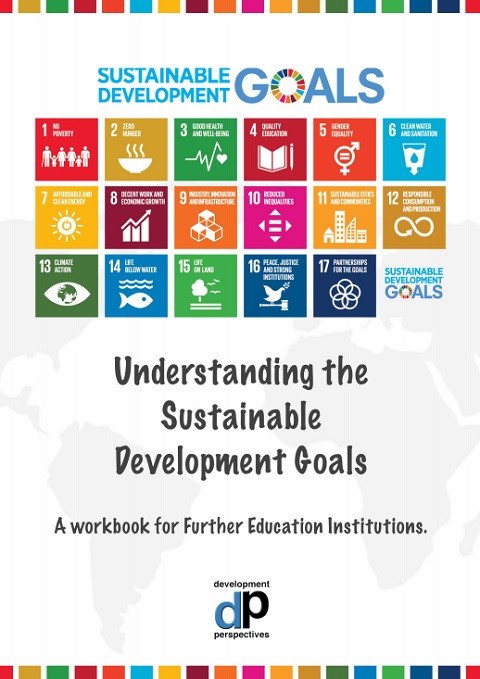 Understanding the Sustainable Development Goals: A Workbook for Further Education Institutions Année de publication: 2020 Auteur: Peggy Flanagan | Stephanie Kirwan Auteur institutionnel: Development Perspectives | Irish Aid This Sustainable Development Goals (SDG) workbook has been developed and produced specifically for the use of Further Education tutors. Through their partnerships, practitioners have requested that Development Perspectives develop a workbook with sessions on the SDGs specifically for adults in formal and non-formal learning contexts including groups in the community sector. This is an easy to use workbook with sessions for each of the 17 SDGs that could be delivered individually based on the interest of the adults and communities involved in each session.