
Ressources
Explorez une large gamme de ressources sur le GCED afin d’approfondir votre compréhension et de renforcer vos activités de recherche, de plaidoyer, d’enseignement et d’apprentissage.
948 résultats trouvés
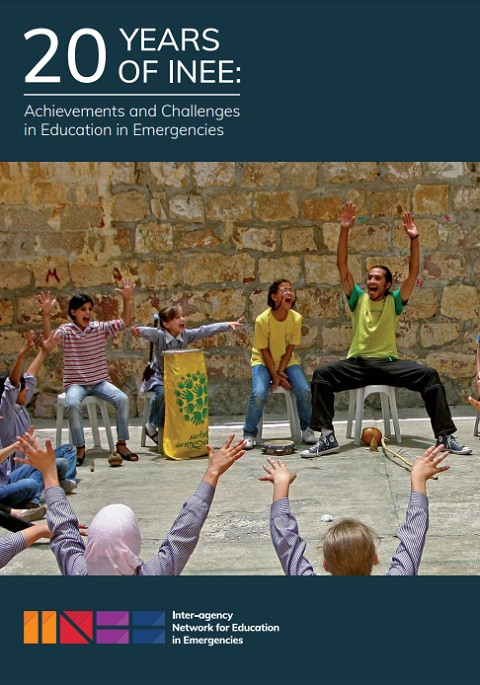 20 Years of INEE: Achievements and Challenges in Education in Emergencies Année de publication: 2020 Auteur institutionnel: Inter-agency Network for Education in Emergencies (INEE) This report highlights the continued relevance of INEE 20 years on. It presents new data that shows 127 million primary and secondary school-age children and young people living in crisis-affected countries were out of school in 2019. This is equivalent to almost half of the global out-of-school population, even though only around 29% of children and young people in this age group globally live in crisis-affected countries. These figures are based on new data provided by the UNESCO Institute for Statistics (UIS). The report also demonstrates the still urgent need to prioritize education and financing of education in emergencies, particularly in ‘forgotten’ crises. 20 ans de l’INEE : Réalisations et Défis dans l’Éducation en Situations d’Urgence Année de publication: 2020 Auteur institutionnel: Inter-agency Network for Education in Emergencies (INEE) Ce rapport, qui marque le 20e anniversaire de l’INEE, souligne les réalisations dans le domaine de l’ESU au cours des deux dernières décennies et identifie les défis permanents. Il retrace les changements qui ont amené l’ESU dans les programmes mondiaux de planification et d’action et note les étapes clés du développement de l’ESU en tant que domaine reconnu. Reconnaissant également les engagements énoncés dans l’Agenda 2030 pour le développement durable, notamment la promesse de veiller à ce que « personne ne soit laissé de côté » (ONU, 2015), ce rapport se tourne vers l’avenir en recommandant des actions immédiates et durables pour atteindre l’Objectif de Développement Durable 4 (ODD 4), une éducation de qualité et des possibilités de formations permanente inclusives et équitables pour tous - incluant les enfants et les jeunes dans les contextes de crise (ONU, 2015). 20º aniversario de la INEE: Logros y desafíos en la educación en situaciones de emergencia Année de publication: 2020 Auteur institutionnel: Inter-agency Network for Education in Emergencies (INEE) Este informe, con motivo del 20.º aniversario de la INEE, enfatiza los logros alcanzados en el ámbito de la EeE en las últimas dos décadas y señala los desafíos que siguen existiendo. Explora los cambios que facilitaron la inclusión de la EeE en los programas globales de planificación y acción, y señala los hitos principales en el desarrollo de la EeE como un campo reconocido. Asimismo, este informe reconoce los compromisos establecidos en la Agenda de Desarrollo Sostenible de 2030, incluido el compromiso de «no dejar a nadie atrás» (ONU, 2015), y enfrenta el futuro con la recomendación de acciones inmediatas y sostenidas para alcanzar el Objetivo de Desarrollo Sostenible 4 (ODS 4),una educación de calidad inclusiva y equitativa, y oportunidades de aprendizaje durante toda la vida para todos; incluidos los niños, niñas y jóvenes en contextos de crisis (UN, 2015).
  Media and Information Literacy: A Practical Guidebook for Trainers Année de publication: 2021 Auteur: Sylvia Braesel | Thorsten Karg Auteur institutionnel: DW Akademie Literacy is the ability to read and write. Media and information literacy (MIL) is the ability to understand how the media work and can be used to participate in public debate. MIL includes social media like Facebook, as well as traditional media like books, newspapers, radio and television.Media and information literacy - A practical guidebook for trainers provides MIL trainers with background information, training ideas, methods and worksheets. The book also provides sample training schedules to help you determine the length of time needed to teach individual aspects of media and information literacy.Download the Media and information literacy guidebook for trainers as well as the worksheets and guidelines.DW Akademie defines MIL as a composite of five core competencies:Access: The ability to find and access relevant media and information sources.Analyze: The ability to evaluate the credibility, accuracy and objectivity of media content, for example a news story.Create: The ability to create and produce media and information content, such as photos, texts, or videos.Reflect: The ability to think critically about media habits, experiences, trends, and technologies, and how they impact individuals and society.Act: The ability to use media to achieve specific goals, for example launching a social media campaign about health.Read more about DW Akademie's approach to Media and Information Literacy here.
  Envision 4.7 Event and Roadmap Année de publication: 2021 Auteur institutionnel: Bridge 47 Envision 4.7 took place in Helsinki in 2019, bringing together 200 education practitioners, civil society representatives and decision makes to create the Envision 4.7 Roadmap, a policy guideline to the future implementation of SDG Target 4.7 in Europe.
  Global Media and Information Literacy Assessment Framework: Country Readiness and Competencies Année de publication: 2013 Auteur institutionnel: UNESCO The MIL Assessment Framework can foster lifelong learning initiatives by building on the relationship between information, media, digital, and ICT literacies, along with societal transformations, education, workforce, policy and decision making processes, economic growth and democracy. The overall goal of the publication is to guide UNESCO’s Member States throughout the assessment of country readiness and competencies regarding the media and information literacy of citizens, in particular teachers in service and in training. The document is particularly aimed at the following stakeholders: policy makers and decision makers; national officers responsible for statistical data collection and analysis; educational policy makers and planners working in formal and informal education settings; teacher training institutions and teachers. It is also of relevance to the professional information and communication community, and has wide applicability for civil society at large.
  Humanistic Futures of Learning: Perspectives from UNESCO Chairs and UNITWIN Networks Année de publication: 2020 Auteur institutionnel: UNESCO UNESCO’s Futures of Education initiative aims to rethink education and shape the future. The initiative is catalyzing a global debate on how knowledge, education and learning need to be reimagined in a world of increasing complexity, uncertainty and precarity. This publication presents the first curated input to the Futures of Education initiative from the UNITWIN/UNESCO Chairs Programme, which now represents an extensive global network of more than 800 higher education institutions in over 115 countries. It features think pieces that highlight key dimensions to be considered in re-visioning and re-purposing education for the future of humanity and the planet. The collection of the pieces calls for greater focus on a number of critical areas such as: The role of culture in strengthening social and environmental sustainability; the values and attitudes that are needed to shape future generations; the importance of both robust public education, as well as of other learning spaces; the need to strengthen human creativity and capability in the digital era, as well as the role of higher education in generating the knowledge and driving the innovation required to transform our world. Les futurs humanistes de l’apprentissage: Perspectives des chaires UNESCO et des réseaux UNITWIN Année de publication: 2020 Auteur institutionnel: UNESCO L’initiative de l’UNESCO intitulée Les futurs de l’éducation vise à repenser l’éducation et à façonner l’avenir, en lançant un débat mondial sur la manière de réinventer le savoir, l’éducation et l’apprentissage dans un monde de plus en plus complexe, incertain et précaire. Le présent volume constitue la première collection de contributions soumises à l’initiative Les Futurs de l’éducation de l’UNESCO par le Programme des chaires UNESCO/UNITWIN, un vaste réseau mondial regroupant plus de 800 établissements d’enseignement supérieur dans plus de 115 pays. Les documents de réflexion qu’il contient mettent en évidence les dimensions essentielles à prendre en compte pour ré-imaginer et redéfinir l’éducation dans l’intérêt de l’avenir de l’humanité et de la planète. Cette collection appelle à insister davantage sur un certain nombre de domaines critiques tels que le rôle de la culture dans le renforcement de la durabilité sociale et environnementale, les valeurs et les attitudes nécessaires pour préparer les générations futures, l’importance d’une éducation publique et robuste, ainsi que d’autres espaces d’apprentissage, la nécessité de renforcer la créativité et les capacités humaines à l’ère numérique, ainsi que le rôle de l’enseignement supérieur concernant la génération des savoirs et la conduite de l’innovation nécessaire pour transformer notre monde. 학습의 인본주의적 미래: 유네스코 석좌와 유니트윈의 시각에서 Année de publication: 2020 Auteur institutionnel: 유네스코 유네스코의 ‘교육의 미래’(Futures of Education) 이니셔티브는 교육을 다시 생각해보고 교육의 미래를 만들어가는 것을 목표로 한다. 이 이니셔티브는 복잡성, 불확실성, 불안정성이 증가하는 세계에서 지식, 교육, 학습은 어떻게 재구상되어야 하는가라는 문제에 대한 전세계적 논의를 촉진하고 있다. 이 책은 현재 115개 이상의 국가의 800개 이상의 고등교육기관으로 구성된 광범위한 글로벌 네트워크를 대표하는 유니트윈/유네스코 석좌프로그램(UNITWIN/UNESCO Chairs Programme)이 교육의 미래 이니셔티브에 제출한 글들을 일차적으로 정리해 엮은 것이다. 이 책은 인류와 지구의 미래를 위해 교육의 비전과 목적을 재설정할 때 고려해야 할 핵심적 차원들을 조명하는 글들을 담고 있다. 이 글들은 사회적·환경적 지속가능성 강화에 있어 문화의 역할; 미래 세대 육성에 필요한 가치와 태도; 건실한 공교육 및 기타 학습공간의 중요성; 디지털 시대에 인간의 창의력과 역량을 강화할 필요성과 지식을 창출하고 세상을 변화시키는 데 필요한 혁신을 주도하는 고등교육의 역할 등 중요 영역에 더욱 초점을 맞출 것을 촉구한다.
  Leveraging Artificial Intelligence to Enhance Early Action towards the Kunming-Montreal Global Biodiversity Framework Année de publication: 2024 Auteur: Nicole DeSantis | Lea Phillips | Christina Supples | Julien Pigot | Jamison Ervin | Doley Tshering | Juan Calles Lopez | Dharshani Seneviratne | Enrique Paniagua | Monica Mora Auteur institutionnel: United Nations Development Programme (UNDP) This publication releases the methodology behind the National Biodiversity Strategies and Action Plans (NBSAP) Target Similarity Assessments and identifies key lessons learned and opportunities for future applications.