
Ressources
Explorez une large gamme de ressources sur le GCED afin d’approfondir votre compréhension et de renforcer vos activités de recherche, de plaidoyer, d’enseignement et d’apprentissage.
980 résultats trouvés
 국가 지속가능발전목표(K-SDGs) 수립보고서 2019 Année de publication: 2019 Auteur institutionnel: 대한민국 환경부 지속가능발전위원회 K-SDGs는 국제적 정세에 대응하여 수립한 한국형 SDGs이며, 경제, 사회, 환경 등 국정 전 분야를 아울러 대한민국이 가야 할 2030년까지 이정표를 설정한 것이다.
  SDG 4 on Ensuring Inclusive and Equitable Quality Education: A Toolkit of Legal & Institutional Practices Année de publication: 2019 Auteur institutionnel: Centre for International Sustainable Development Law (CISDL) CISDL, in cooperation with the Dalhousie Schulich School of Law, Balsillie School of International Affairs/University of Waterloo, McGill University Faculty of Law/ Faculté de droit Université de Montréal, University of Victoria Peter A. Allard School of Law, and a consortium of institutional partners, held a multisite symposium on March 14, 2019 convening legal experts across Canada to discuss areas of opportunity to inform Canada’s 2030 agenda. This toolkit is a part of a series, which builds upon legal research conducted in collaboration with UN Environment. The by-projects of this research looking at legal measures for achievement of the SDGs in Canada is intended to inform policy-making moving forward.
  Accountability from a Human Rights Perspective: The Incorporation and Enforcement of the Right to Education in the Domestic Legal Order Année de publication: 2017 Auteur institutionnel: ActionAid International | Right to Education Initiative (UK) The aim of this paper is to reframe States’ political commitment to education under Education 2030 as a legal commitment the vast majority of States have already made under international human rights law. By recasting the content of SDG Four as part of the right to education, the legal obligations owed to that content can be invoked. This renders various elements of SDG Four, ifthe State in question has legally committed to the right to education and incorporated the right to education in their domestic legal orders, amenable to adjudication by competent mechanisms, offering the possibility of legal accountability through legal enforcement.
  Gender in Education Network in Asia-Pacific (GENIA) Toolkit: Promoting Gender Equality in Education Année de publication: 2019 Auteur institutionnel: UNESCO Bangkok The GENIA Toolkit was originally designed in 2003 when the Gender in Education Network in Asia Pacific was established. The fifth edition of the GENIA Toolkit (25 tools) is designed for use by gender focal points and education planners and implementers. It introduces key concepts and theoretical debates, and outlines practical approaches for mainstreaming gender equality throughout the education system, and within education policy.The toolkit is designed to be used selectively, depending on the user’s needs. It can be used as a self-study tool. Readers can select topics that they have identified as priority learning areas to help them improve their own understanding and practical capacity. The toolkit can also be used by trainers to facilitate training sessions. Trainers can choose tools from the kit that best match the needs of their trainees.
 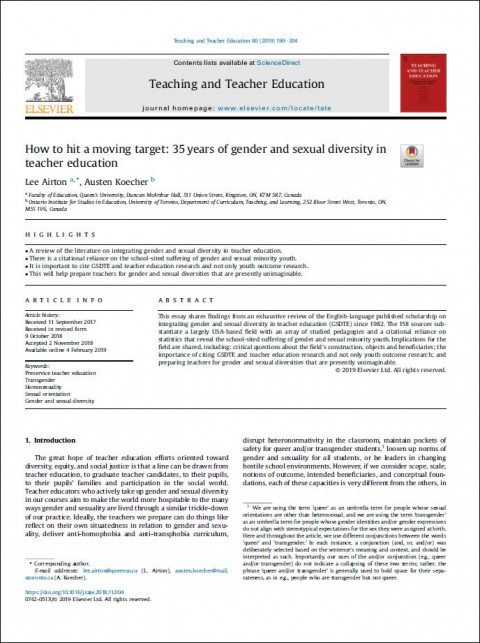 How to Hit a Moving Target: 35 Years of Gender and Sexual Diversity in Teacher Education Année de publication: 2019 Auteur: Lee Airton | Austen Koecher This essay shares findings from an exhaustive review of the English-language published scholarship on integrating gender and sexual diversity in teacher education (GSDTE) since 1982. The 158 sources substantiate a largely USA-based field with an array of studied pedagogies and a citational reliance on statistics that reveal the school-sited suffering of gender and sexual minority youth. Implications for the field are shared, including: critical questions about the field's construction, objects and beneficiaries; the importance of citing GSDTE and teacher education research and not only youth outcome research; and preparing teachers for gender and sexual diversities that are presently unimaginable. Highlights • A review of the literature on integrating gender and sexual diversity in teacher education.• There is a citational reliance on the school-sited suffering of gender and sexual minority youth.• It is important to cite GSDTE and teacher education research and not only youth outcome research.• This will help prepare teachers for gender and sexual diversities that are presently unimaginable.
  Entre el reloj y la brújula: desafíos en la garantía del derecho a la educación y al aprendizajede personas jóvenes y adultas en América Latina y el Caribe; documento de trabajo Année de publication: 2019 Auteur: Henry Renna Auteur institutionnel: UNESCO Santiago Este documento tiene por objetivo proporcionar una visión general de la educación y del aprendizaje de personas jóvenes y adultas como derecho humano y social. Los instrumentos de derecho vinculante y no vinculante que la sustentan son históricos y de larga data, como también contingentes, amplios y extensos en su alcance, con presencia regional e internacional. El documento muestra —sobre la base de los Indicadores del Objetivo de Desarrollo Sostenible 4 (ODS 4 Agenda 2030)— que los principales desafíos para los países de América Latina y el Caribe tienen relación con la lentitud de los progresos (el desafío del reloj) dejando a muchas y muchos jóvenes y adultos al margen de oportunidades educativas, de conocimientos, habilidades y aptitudes, y privados de alcanzar el bienestar integral. Este informe también sostiene —basado en los informes nacionales del Tercer Reporte Global de Educación y Aprendizaje de Adultos— que muchos desafíos están vinculados con la dirección de las políticas (el desafío de la brújula), con sentidos reduccionistas y homogeneizadores detrás de las instituciones y de la acción pública, lo que precariza y fragiliza la garantía del derecho a la educación y al aprendizaje de las personas jóvenes y adultas. Este documento es consistente con el llamado de la UNESCO a «repensar la educación» e invita a reconstruir en el siglo XXI un mundo y una educación sin muros, donde se difuminen las fronteras mentales e institucionales que reducen, dividen y aislan los sistemas educativos, con el fin de liberar su poder transformador para todos y todas.
  Citizenship Education at School in Europe, 2017: Eurydice Report Année de publication: 2017 Auteur institutionnel: European Commission | Education, Audiovisual and Culture Executive Agency (EACEA) | Eurydice The Eurydice Citizenship Education at School in Europe – 2017 report provides a comparative overview of national policies in the area of citizenship education across Europe, at a time when increasing demands are being made on education and training systems to promote this area of learning. It focuses on the curriculum content and organisation, the teaching and learning methods in and outside the classroom, the assessment of students, and the training and support for teachers. These issues are addressed in the four chapters, each of which is complemented by a case study on a recent policy initiative. The report is primarily based on qualitative data and covers 42 education systems. It draws on the existing regulations and recommendations regarding citizenship education in public sector schools and includes general education and school-based initial vocational education training programmes.
  2018년도 SDG4-교육2030 협의체 운영보고서 Année de publication: 2019 Auteur institutionnel: 유네스코한국위원회 2018년도 교육부, 유네스코한국위원회와 9개 교육전문기관(한국교육과정평가원, 유아정책연구소, 한국대학교육협의회, 한국직업능력개발원, 한국여성정책연구원, 국가평생교육진흥원, 유네스코 아시아태평양 국제이해교육원, 한국교육학술정보원, 한국교육개발원) 으로 구성된 SDG 4-교육2030 협의체 운영(회의, 포럼 등) 내용을 담은 보고서이다.
 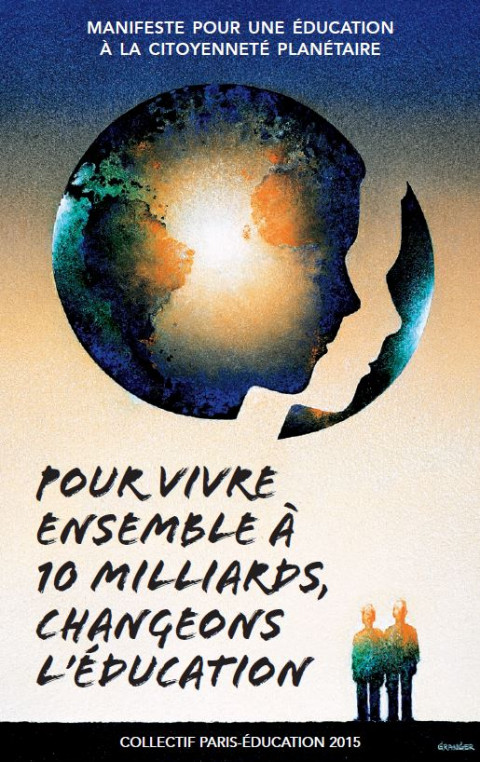 Manifeste pour une éducation à la citoyenneté planétaire: Pour vivre ensemble à 10 milliards, changeons l'éducation Année de publication: 2015 Auteur institutionnel: Collectif Paris-Education 2015 Face à l’ampleur, l’urgence, la diversité et la complexité des problématiques engendrées par le modèle de développement de nos sociétés contemporaines, nous sommes donc obligés, dans l’urgence, de nous pencher sur les questions d’éducation et de formation des générations futures qui devront affronter des réalités biophysiques, économiques et politiques inédites, dont nous commençons à peine à entrevoir l’ampleur. Ce qui est dès lors en jeu, avec l’avenir de l’homme et de la Terre, c’est l’humain, ce qu’il deviendra, ce qu’il sera capable de porter comme projet pour l’humanité.Quelles qualités d’humains devons-nous faire advenir pour que ces réalités inédites puissent être rencontrées demain, sans que l’humanité bascule dans la violence et le dépeçage égoïste de la planète? Quels enfants voulons-nous laisser à notre Terre?Cette urgence impose un changement d’échelle dans la transformation des systèmes éducatifs, des contenus et des méthodes d’enseignement. Malgré la volonté et la compétence de nombreux acteurs de l’école, force est de constater que les actions menées pour une éducation plus en cohérence avec les enjeux climatiques et, plus largement, sociétaux restent à la marge. Elles sont réalisées par des individus clairvoyants. Il est temps d’enclencher la vitesse supérieure.
  The SDGs and Cities INTERNATIONAL HUMAN MOBILITY Année de publication: 2018 Auteur institutionnel: International Centre for the Promotion of Human Rights | (ICPHR) The Handbook is to address new situations – and responses to these situations – generated by the global phenomenon of human mobility in urban spaces. Democracies are being threatened by the sustained growth of social gaps and the exclusion of vast sectors of the population from political systems and benefits of development, placing structural limits on the exercise of human rights. In this context, where new tensions and problems have arisen such as massive displacements of the population, the appearance of diverse types of extremism, of wars and conflicts and climate change in turn place these social sectors under conditions of structural inequality, exclusion and discrimination, as the main victims of human rights violations. This Handbook was prepared and published with the support and assistance of the UNESCO Sector for Social and Human Sciences through its Regional Science Bureau in Montevideo and the Latin American and Caribbean Coalition of Cities against Racism, Discrimination and Xenophobia.