
Ressources
Explorez une large gamme de ressources sur le GCED afin d’approfondir votre compréhension et de renforcer vos activités de recherche, de plaidoyer, d’enseignement et d’apprentissage.
2,275 résultats trouvés
 Citizen Participation, a Keystone of Social Change for the Public Library Année de publication: 2013 Auteur: Marie Désilets Auteur institutionnel: Revue Documentation et bibliothèques The concepts of "citizen participation" and "empowerment" are, at present, widely discussed. The authors begin this article by defining these concepts in order to link them to the social development of libraries. Thus, Montréal's public libraries, a knowledge city, adhere to the values associated with citizen participation such as openness, equality, inclusion, and innovation. Their activities help foster the citizen's autonomy and his or her participation in society. Examples of different types of clients will be put forward and the conditions necessary for citizen participation will be outlined. The authors will attempt to assess the impact of citizen participation from a sustainable development point of view. How can public libraries relate and contribute to the cultural component of Agenda 21 from a sustainable development perspective? Why is it relevant to invest and encourage citizen participation in libraries? What gains can be made in the long-term? Examples of social and urban development help further the analysis.
  The Concept of Citizenship for Immigrants and Members of the Host Society within the Minority Francophone Context: A Lexical Analyse Année de publication: 2014 Auteur: Aïcha Benimmas | Sylvia Kasparian Auteur institutionnel: Revue de l’Université de Moncton Given the changes and constant mutations which occur in societies at the social, political, economic, technological, and educational levels, the concept of citizenship must be continually redefined. While French-speaking citizens, immigrants and members of the host society can find common ground thanks to the French language, they can also find differences because of other characteristics linked to their identity, such as culture, ethnic background, religion, and history. This is why we must analyze the meaning that these groups give to the concepts of citizenship and citizen participation, interpreting the differences and similarities that surface in their discourse regarding these two concepts. The use of computerized tools and statistics has enabled us to find through a constant comparison between qualitative and quantitative analyses-the perceptions, similarities, and divergences in the discourse of four groups of participants involved in our study: immigrant youth, immigrant parents, host society youth, and host society parents. Le concept de citoyenneté chez des immigrants et des membres de la société d’accueil en milieu minoritaire francophone : une analyse lexicale Année de publication: 2014 Auteur: Aïcha Benimmas | Sylvia Kasparian Auteur institutionnel: Revue de l’Université de Moncton Étant donné les changements et les mutations constantes que connaissent les sociétés sur différents plans (social, politique, économique, technologique, etc.), le concept de citoyenneté nécessite une redéfinition d’une manière continue. Si les citoyens francophones, immigrants et membres de la société d’accueil, peuvent se rejoindre grâce à la langue française, ils peuvent différer à cause de leurs autres caractéristiques identitaires à savoir, la culture, l’ethnie, la religion et l’histoire. C’est dans ce sens qu’il importe d’explorer le sens que ces différents groupes donnent aux concepts de citoyen et de participation citoyenne. L’utilisation des outils informatisés et statistiques nous a permis de relever, par un aller-retour constant entre les analyses qualitatives et quantitatives, les ressemblances et les divergences dans le discours de quatre groupes de participants à notre étude : jeunes immigrants, parents immigrants, jeunes de la société d’accueil et parents de la société d’accueil. La participación ciudadana como pilar de un cambio social en la biblioteca pública Année de publication: 2013 Auteur: Marie Désilets Auteur institutionnel: Revue Documentation et bibliothèques Los conceptos de "participación ciudadana" y de "empoderamiento" se utilizan sin reserva en nuestras sociedades. En primer lugar, nos detendremos en la definición de estos conceptos para luego determinar la estrecha relación que existe entre estos términos y la función de desarrollo social de las bibliotecas. De hecho, las bibliotecas públicas de Montreal, ciudad culta, abrazan los valores inherentes a la participación ciudadana: apertura, igualdad, inclusión, innovación, etc. Asimismo, a través de sus actos, favorecen la autonomía del ciudadano y su participación activa en la vida en sociedad. Ofreceremos ejemplos concretos sobre los diferentes tipos de clientes y determinaremos cuales son las condiciones que favorecen la participación ciudadana. Por último, intentaremos evaluar los impactos que provocan estas acciones en una perspectiva de desarrollo sostenible: ¿Qué hacer para que las bibliotecas públicas se posicionen y colaboren con la Agenda 21 de la cultura en una perspectiva de desarrollo sostenible? ¿Por qué invertir en nuestras bibliotecas y alentar a nuestros ciudadanos a participar en ellas? ¿Cuál sería el resultado a largo plazo? La descripción de algunas experiencias, especialmente en el ámbito del desarrollo social y urbano, nos permitirá reflexionar sobre este tema. La participation citoyenne comme pilier de changement social en bibliothèque publique Année de publication: 2013 Auteur: Marie Désilets Auteur institutionnel: Revue Documentation et bibliothèques Les concepts de « participation citoyenne » et d’« empowerment » circulent allègrement dans nos sociétés. Nous souhaitons d’abord nous arrêter sur la définition de ces concepts pour établir ensuite le lien étroit entre ceux-ci et le rôle de développement social des bibliothèques. Ainsi, les Bibliothèques publiques de Montréal, ville de savoir, adhèrent aux valeurs inhérentes à la participation citoyenne : ouverture, égalité, inclusion, innovation, etc. Elles contribuent par leurs actions à favoriser l’autonomie du citoyen et sa participation active à la vie en société. Des exemples mettant en présence différentes clientèles seront apportés et les conditions favorables à la participation citoyenne seront ciblées. Enfin, nous tenterons d’évaluer les impacts de telles actions dans une perspective de développement durable : comment les bibliothèques publiques peuvent-elles se positionner et contribuer à l’Agenda 21 de la culture dans une perspective de développement durable ? Quelle est la pertinence d’investir et d’encourager la participation citoyenne dans nos bibliothèques ? Quelles retombées anticiper à long terme ? La description de quelques expériences, en développement social et urbain notamment, nous permettront d’y réfléchir.
  Education for Sustainable Development in Central Asia: Analysis of Achievements, Challenges and Outlook Année de publication: 2018 Auteur: Tatiana Shakirova Auteur institutionnel: Regional Environmental Centre for Central Asia (CAREC) The article of the manager of the CAREC programme "Education for Sustainable Development" (ESD), Dr of Biology Tatiana Shakirova is devoted to the review of ESD process from 2002 to 2018, analysis of experience, lessons learned and challenges and perspectives for ESD development in Central Asia. Taking into consideration all the global and regional challenges in ESD, today CAREC is reconsidering and rethinking its role in ESD process in Central Asia. The main objective of the ESD Programme today is to provide a regional platform for dialogue, exchange of knowledge, experience, innovations and best educational practices/tools implemented at local/national/regional levels, and support CAREC's inter-program activities on education and capacity building, as well as intersectoral, interagency, interregional cooperation on ESD in the region with the involvement of all stakeholders and international expertise. Образование в Интересах Устойчивого Развития в Центральной Азии: Анализ Достижений, Вызовы и Взгляд в Будущее Année de publication: 2018 Auteur: Tatiana Shakirova Auteur institutionnel: Regional Environmental Centre for Central Asia (CAREC) Статья менеджера программы «Образование для устойчивого развития» (ОУР) РЭЦЦА, кандидата биологических наук Татьяны Шакировой посвящена обзору процесса ОУР с 2002 по 2018 годы, анализу опыта, уроков, а также вызовам и перспективам развития ОУР в Центральной Азии.Принимая во внимание глобальные и региональные вызовы в ОУР, сегодня РЭЦЦА пересматривает и переосмысливает свою роль в процессе ОУР в Центральной Азии. Основная цель Программы ОУР сегодня – это предоставление региональной площадки для диалога, обмена знаниями, опытом, инновациями и наилучшими образовательными практиками/ инструментами, реализованными на местном/национальном/региональном уровнях, и поддержка межпрограммной деятельности РЭЦЦА по образованию и повышению потенциала, а также обеспечение межсекторального, межведомственного, межрегионального сотрудничества по ОУР в регионе с привлечением всех заинтересованных сторон и международной экспертизы.
  Publications Series within the CAREC Environment and Health Program Année de publication: 2018 Auteur: Irina Bekmirzaeva Auteur institutionnel: Regional Environmental Centre for Central Asia (CAREC) This publication was prepared by CAREC Environment and Health Program which aims to inform and raise awareness and knowledge among interested stakeholders on the interrelationship between environment and medicine. These publications are primarily developed to respond to numerous requests from representatives of Central Asian countries working on environmental and health issues in the region. The narrative style, language and terminology of the information have been designed for a wider audience. All information presented in these publications is based on the CAREC’s expertise and experience, as well as data from World Health Organization (WHO), the United Nations Development Program (UNDP) and the United Nations Environment Program (UNEP) and other international organizations.In the next issues of CAREC Environment and Health Program publications, we will focus on selected environmental health issues, including air quality and health, water and health, waste and health, sustainable development goals (SDGs), etc. Серия информационных публикаций в рамках программы "окружающая среда и здоровье" Année de publication: 2018 Auteur: Irina Bekmirzaeva Auteur institutionnel: Regional Environmental Centre for Central Asia (CAREC) РЭЦЦА представляет серию публикаций, подготовленную в рамках Программы «Окружающая среда и здоровье», целью которой является информирование и повышение осведомленности и знаний по вопросам взаимосвязи и взаимозависимости экологии и медицины. Данные публикации разрабатываются, в первую очередь, для стран Центральной Азии. Они являются ответом на многочисленные запросы представителей стран ЦА, интересующихся вопросами охраны окружающей среды и здоровья в регионе. Стиль, язык и терминология, а также детальность информации были подобраны специально для широкой категории читателей. Вся представленная в публикациях информация базируется на экспертизе и опыте РЭЦЦА и данных Всемирной организации здравоохранения (ВОЗ), Программы развития ООН (ПРООН) и Программы ООН по окружающей среде (ЮНЕП) и других международных организаций.
 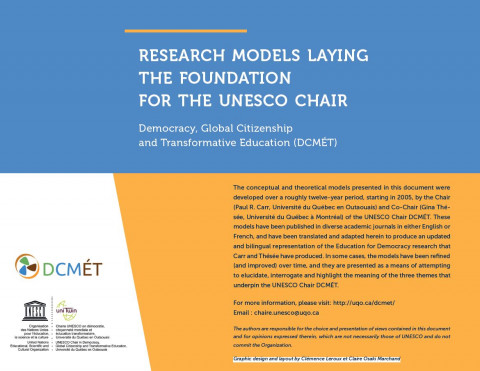 MODÈLES DE RECHERCHE: Démocratie, citoyenneté mondiale et éducation transformatoire Année de publication: 2018 Auteur: Paul R. Carr | Gina Thésée Auteur institutionnel: Chaire UNESCO Démocratie, citoyenneté mondiale et éducation transformatoire (DCMÉT) Les modèles conceptuels et théoriques présentés dans ce document ont été élaborés sur une période d’environ douze ans, commençant en 2005, par le titulaire (Paul R. Carr, Université du Québec en Outaouais) et la co-titulaire (Gina Thésée, Université du Québec à Montréal) de la Chaire UNESCO. Ces modèles ont été publiés dans diverses revues académiques, en anglais ou en français et ont été traduits et adaptés ici pour produire une représentation mise à jour et bilingue de la recherche sur l’éducation pour la démocratie que Carr et Thésée ont réalisée. Certains de ces modèles ont été affinés (et améliorés) avec le temps et sont des moyens qui aident à élucider, interroger et mettre en évidence le sens des trois thèmes qui sous-tendent la Chaire UNESCO DCMÉT.