
Ressources
Explorez une large gamme de ressources sur le GCED afin d’approfondir votre compréhension et de renforcer vos activités de recherche, de plaidoyer, d’enseignement et d’apprentissage.
2,275 résultats trouvés
 公民教育的审美之维 (教育学报; Vol. 12, No. 1) Année de publication: 2019 Auteur: Zheng Fuxing Auteur institutionnel: Beijing Normal University 公民情感是公民品质的重要内容。但是,今日公民教育的研究与实践对情感问题关注较少。公 民 品 质与公民教育中的情感缺陷减弱了公民参与的积极性,削弱了公民之间的共同情感。强调情感教育凸显了公民教 育的审美因素。公民情感首先表现为一种对公共事务或公共事物的情感认同,如 国 家 认 同 感;培育公民情感认同 的途径既有对国家文化的审美体验,也有公民参与实践中的情感联结。公民情感还表现为一种对公共事务或公共 事物的情感批判;培育公民情感批判的途径主要为培养公民基于审美正义的审美批判能力。
  Exploration of Civic Educational Thought of Gong Qichang (Journal of Tianjin Normal University: Social Science; No. 5) Année de publication: 2019 Auteur: Yu Lingling Auteur institutionnel: Tianjin Normal University Gong Qichang was one of the main representatives who advocated implementation of civic education during the Republic of China. He had a national rejuvenation ideal, advocated civic education and cultivated modern citizens. The main contents of his civic educational thoughts include :Civic education originated from educational consciousness during the Republic of China aiming at cultivating modern citizens; national traditional culture real social life, and national common ideals constitute the main educational content; the civic educational method of trinity of family, school and society is advocated. Research on civic educational thought of Gong Qichang has positive practical implications. 龚启昌公民教育思想研究 (天津师范大学学报:社会科学版; No 5) Année de publication: 2019 Auteur: Yu Lingling Auteur institutionnel: Tianjin Normal University 龚启昌是民国时期倡导实施公民教育的主要代表人物之一。他胸怀民族复兴理想,力倡公民 教育,培育现代公民。其公民教育思想的主要内容有:民国时期的公民教育源于教育自觉,旨在培育现代公 民;民族传统文化、现实社会生活、国家共同理想三者构成主要教育内容;倡导家庭、学校、社会三位一体 的公民教育方法。研究龚启昌的公民教育思想,仍具有一定的现实意义。
  االستراتيجية التعاونية لمجموعة العشرين فيما يخص الهدف 7.4 من النقطة رقم 4 من أهداف التنمية المستدامة: مراقبة التقدم نحو التعليم في مجال التنمية المستدامة والمواطنة العالمية ; موجز السياسة Année de publication: 2020 Auteur: Charlotte Holland | Dinah Bennett | Abdul Ghaffar Mughal | Huan NI Auteur institutionnel: Think 20 (T20) Saudi Arabia ان جائحة كوفيد-19 تلعب دورا مهما في التذكير بأن هناك حاجة إلى إيجاد حلول عالمية وتضمانية بين الأمم لمعالجة التحديات العالمية. ومن ضمن تلك التحديات المفصلية ضمن أهداف التنمية المستدامة السبعة عشر (17) وفقًا لأجندة 2030 للتنمية المستدامة. ويهدف ملخص السياسة هذا إلى استغلال خبرات وتجارب شراكة مجموعة العشرين من أجل تسريع المراقبة عالية الجودة للهدف 4.7 من النقطة رقم 4 من أهداف التنمية المستدامة. ويقترح إنشاء هياكل تنظيمية تسمح بالمزيد من التتبع الشامل لدمج التعليم التنموي المستدام والمواطنة العالمية ضمن السياسات وتعليم المعلمين والمناهج الدراسية وتقييم المتعلمين بجميع المستويات التعليمية. G20 Collaborative Strategy for SDG 4 Target 4.7: Monitoring Progress in Education for Sustainable Development and Global Citizenship Education; Policy Brief Année de publication: 2020 Auteur: Charlotte Holland | Dinah Bennett | Abdul Ghaffar Mughal | Huan NI Auteur institutionnel: Think 20 (T20) Saudi Arabia The COVID-19 pandemic serves as an important reminder for the need for global solutions and solidarity among nations to address global challenges. This includes the challenges articulated within the 17 sustainable development goals (SDGs) under the 2030 Agenda for Sustainable Development. This policy brief seeks to harness the expertise and experience of the Group of 20 (G20) partnership to accelerate the quality monitoring of Target 4.7 under SDG 4. It proposes the establishment of structures that enable more holistic tracking of the integration of education for sustainable development and global citizenship within policies, teacher education, curricula, and learner assessment at all levels of education.
  Discussion on Historical Film and Civic Education: Take the Korean Movie Taxi Driver as an Example (Proceedings of 2018 7th ICASS International Conference on Management, Leadership and Social Science) Année de publication: 2018 Auteur: Zhenxing Wang Auteur institutionnel: ICASS International Conference on Management, Leadership and Social Science Historical education is an important content and an effective way to achieve citizenship education. Historical films are an important form of historical education under modern technology conditions. The Korean film "Taxi Driver" recreated the "Gwangju tragedy", an important event in the process of democratization in Korea. The concept of freedom, equality, justice, and the rule of law runs through the entire film and is undoubtedly a very good civic education film. 历史题材影片与公民教育刍议: 以韩国电影《出租车司机》为例 (智能信息技术应用学会会议论文集) Année de publication: 2018 Auteur: Zhenxing Wang Auteur institutionnel: ICASS International Conference on Management, Leadership and Social Science 历史教育是公民教育的重要内容和有效实现途径,历史题材影片则是现代技术条件下历史教育的重要形式。韩国电影《出租车司机》再现了"光州惨案",这一韩国民主化进程中的重要事件。自由、平等、公正、法治的理念贯穿整部影片,无疑是一部很好的公民教育影片。
 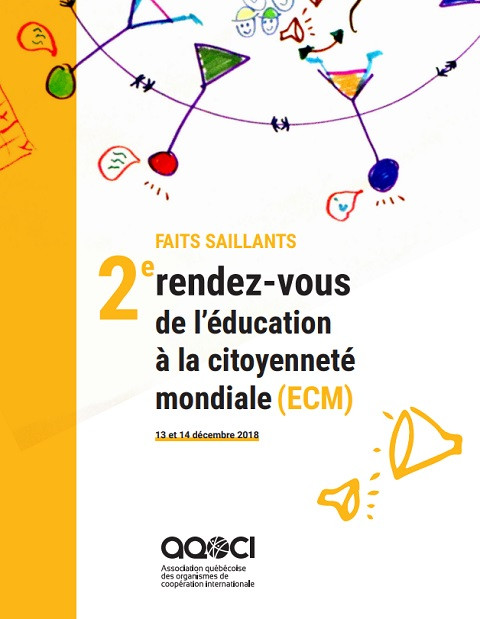 2e rendez-vous de l’éducation à la citoyenneté mondiale (ECM) : 13 et 14 décembre 2018 Année de publication: 2019 Auteur institutionnel: Association québécoise des organismes de coopération internationale (AQOCI) Dans la suite du 1er rendez-vous de l’ECM (24 et 25 janvier 2017) portant sur l’élaboration d’un plan d’action concerté en éducation à la citoyenneté mondiale (ECM), le 2e rendez-vous a pour objectif principal d’échanger sur la mise en œuvre de ce plan d’action. Deux comités ont piloté les travaux de l’AQOCI en ECM depuis le dernier rendez-vous, soit le Comité de coordination (COCO) en ECM et le Comité de l’élaboration d’un cadre de référence en ECM. Ce 2e rendez-vous mobilise, en plus des diverses personnes-ressources, 47 personnes représentant 32 membres de l’AQOCI autour des enjeux suivants :- la construction d’une définition de l’éducation à la citoyenneté mondiale pour l’AQOCI;- la détermination des prochaines étapes dans la mise en œuvre des chantiers en ECM identifiés au 1er Rendez-vous;- la formation sur les enjeux et défis du suivi, de l’évaluation, de l’apprentissage et de la redevabilité (SEAR) en ECM, et l’orientation du travail d’un nouveau comité SEAR-ECM;- la contribution à la consultation pour le choix d’une thématique annuelle de l’AQOCI (2019-2020)
 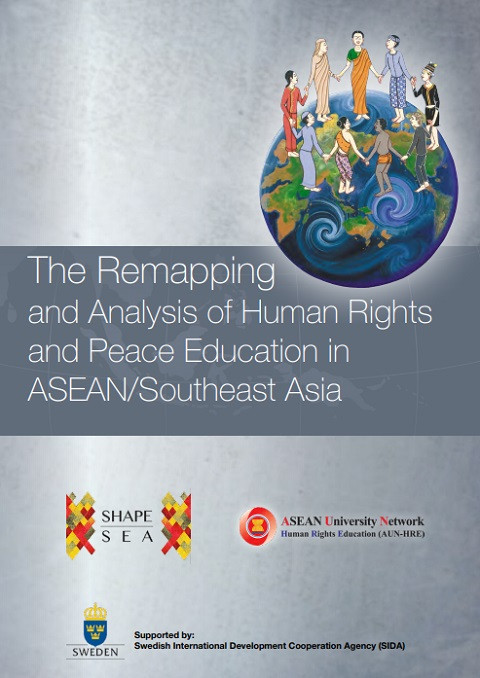 The Remapping and Analysis of Human Rights and Peace Education in ASEAN/Southeast Asia Année de publication: 2019 Auteur institutionnel: Strengthening Human Rights and Peace Research/Education in ASEAN/Southeast Asia (SHAPE-SEA) | AUN Human Rights Education Network (AUN-HRE) This book is the result of SHAPE-SEA’s Research Project on “The Remapping and Analysis of Human Rights and Peace Education in ASEAN/Southeast Asia.” It is a follow-up to the 2013 report on “The Mapping and Analysis of Human Rights and Peace Education in Southeast Asia.” It aimed at establishing a systematic updating of developments in human rights and peace education/studies in ASEAN/Southeast Asia. The study investigated courses and programmes on human rights and peace & conflict being undertaken by higher education institutions in all ASEAN member countries and Timor Leste. It had also identified new developments and/or setbacks in human rights and peace education. Researchers located existing academic institutions that have been running programmes and courses on human rights and/or peace. The analysis of existing course syllabi and curriculum in the region was also conducted. To a certain extent, materials being used by instructors were also examined.
 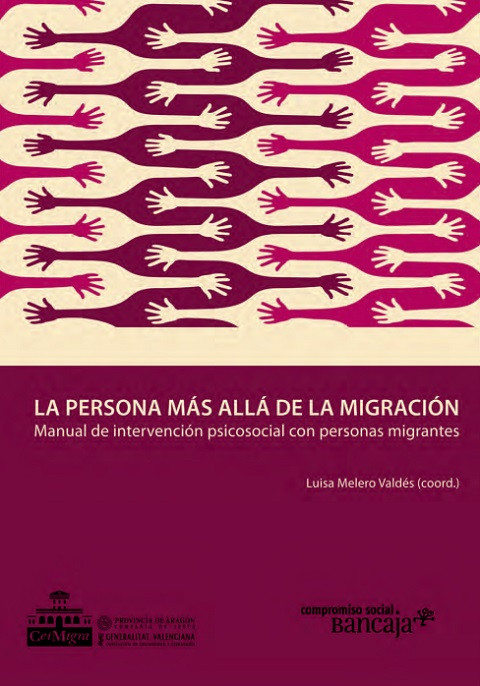 La persona más allá de la migración: Manual de intervención psicosocial con personas migrantes Année de publication: 2010 Auteur: Luisa Melero Valdéz Auteur institutionnel: Compromiso Social Bancaja Este libro recoge diferentes miradas sobre la intervención psicosocial alrededor del tema de la migración y brinda herramientas teóricas y prácticas para trabajar sobre este tópico.