
Ressources
Explorez une large gamme de ressources sur le GCED afin d’approfondir votre compréhension et de renforcer vos activités de recherche, de plaidoyer, d’enseignement et d’apprentissage.
2,255 résultats trouvés
 Glocal Education in Practice: Teaching, Researching, and Citizenship (BCES Conference Books; Vol. 17) Année de publication: 2019 Auteur: Nikolay Popov | Charl Wolhuter | Louw de Beer | Gillian Hilton | James Ogunleye | Elizabeth Achinewhu-Nworgu | Ewelina Niemczyk Auteur institutionnel: Bulgarian Comparative Education Society (BCES) This volume contains selected papers submitted to the XVII Annual International Conference of the Bulgarian Comparative Education Society (BCES) held in June 2019 in Pomorie, Bulgaria. The XVII BCES Conference theme is Glocal Education in Practice: Teaching, Researching, and Citizenship. The book includes 34 papers written by 69 authors from 20 countries.
  Mapping of Media Literacy Practices and Actions in EU-28 Année de publication: 2016 Auteur institutionnel: European Audiovisual Observatory | Council of Europe A project conducted by the European Audiovisual Observatory and financed by the European Commission This study aims at analysing the various media literacy initiatives on a national or regional level in order to provide an overview of what is currently being undertaken. This is the first major mapping exercise to survey the field in Europe. Although this study does not aim at covering the entire media literacy initiatives, it provides a detailed overview of the main trends, coming out of a selection of 547 featured projects involving 939 stakeholders across the European Union, which were identified through a questionnaire addressed at national experts from the different EU-28 member states. So what is Europe doing to encourage our media literacy? What measures are being taken at national and European levels to foster our critical appreciation and understanding of the mass media? The results of this study can be found in a general report accompanied by 4 annexes: Annex 1 provides national summaries showing the findings of the responses concerning each of the 28 EU member states; Annex 2 contains the list of the 547 featured projects; Annex 3 summarises the 145 case-study projects; Annex 4 contains the original responses from the 29 national experts, which are accessible in separate files available on the website of the European Commission.
  The Role of Education in Addressing Future Challenges Année de publication: 2020 Auteur institutionnel: Bridge 47 In response to UNESCO’s Futures of Education consultation, Bridge 47 has released the following report on the power that transformative education has to address future challenges, including those linked to inequalities, climate change and health.Through the consultation process UNESCO raises questions about the importance and purpose of education by 2050. In a fast-evolving world, Bridge 47 supports the idea that education should foster the kind of education that helps learners of all ages to become active global citizens and thus contribute to building a more just and sustainable report world for all.The report, ‘The Role of Education in Addressing Future Challenges’, further emphasises the importance of measuring and monitoring the progress towards achieving the transformative vision of education as outlined in Sustainable Development Goal Target 4.7. It is hoped that the overall Future of Education report will encourage a measuring framework for SDG 4.7 that acknowledges the connection between non-formal and formal education as well as supporting dialogue between key actors that the reflect any conceptual shifts within the fields of Education for Sustainable Development and Global Citizenship Education.
  The Global Citizen's Journey: A Resource for Global Citizenship Education Année de publication: 2021 Auteur institutionnel: GOAL Global This resource for Global Citizenship Education is designed by our Global Youth Programme for educators and leaders of 14–18-year-olds all over the world. Centring on the themes of interconnectedness, development, power and inequality this free, downloadable booklet of activities encourages critical thinking, reflection, and empower the pursuit of positive change.To find out more, watch our introductory video here.
  The White Paper of EKOME on Media & Information Literacy Année de publication: 2018 Auteur institutionnel: EKOME S.A. EKOME is concluding 2018 Global UNESCO Media and Information Literacy Week celebrations with the launch of the White Paper on Media & Information Literacy available in Greek & English.The White Paper is EKOME’s viewpoint on the third pillar, Education, setting out a paradigm for a national infrastructure on media and information literacy. By highlighting the main priorities in the field, the White Paper of EKOME aims to contribute to a national strategic plan and build a constructive relationship with the creative industry.
  A Journey to Media Literacy Année de publication: 2013 Auteur: Paolo Celot | Susie Jones Auteur institutionnel: European Association for Viewers Interests (ENVI) “A Journey to Media Literacy” is EAVI’s seven minute cartoon, designed to explain, in a fun and simple way, what Media Literacy is all about and why it is essential in order to live freely and participate fully in society. It was born thanks to a suggestion by Paolo's 3 kids, who being unable to understand what their father did at work, came up with the idea of making an adventure cartoon to explain ML. Un voyage dans l'éducation aux médias Année de publication: 2013 Auteur: Paolo Celot | Susie Jones Auteur institutionnel: European Association for Viewers Interests (ENVI) Le dessin animé de EAVI « Un voyage dans l'éducation aux media » a été créé à fin d'expliquer de façon simple et amusante ce qu'est l'éducation aux medias, une notion importante que pour vivre plus librement et de participer pleinement à la société. Notre héro Jack est né grâce à la suggestion des enfants de Paolo, qui, ne comprenant pas ce que leur père faisait au travail, lui ont donné l'idée de créer un dessin animé pour expliquer à eux ce que c'est l'éducation aux medias. Un viaje a la Alfabetización Mediatica Année de publication: 2013 Auteur: Paolo Celot | Susie Jones Auteur institutionnel: European Association for Viewers Interests (ENVI) El videoclip "Un viaje a la Alfabetización mediática" es un dibujo animado de 7 minutos diseñado para explicar, de una manera divertida y sencilla, lo que es la alfabetización mediática y todo alrededor, y por qué es esencial para poder vivir libremente y participar plenamente en la sociedad. Nació gracias a la sugerencia de los 3 niños de Paolo, que al no poder entender lo que su padre hacia en el trabajo, se le ocurrió la idea de hacer una historieta de aventuras para explicar que es la Media Literacy.
 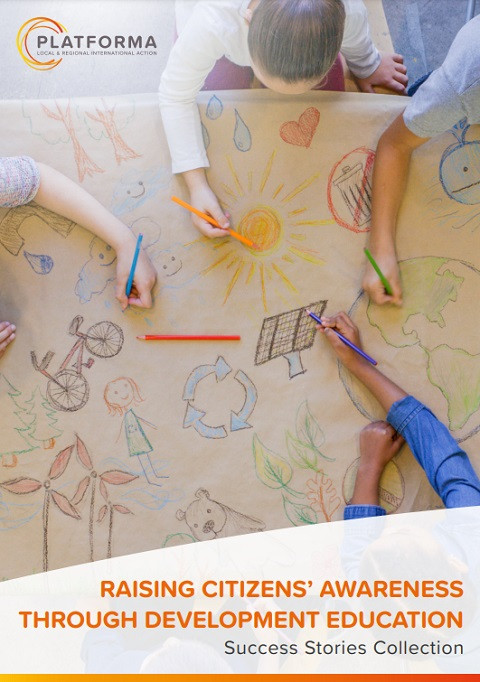 Raising Citizens' Awareness Through Development Education: Success Stories Collection Année de publication: 2020 Auteur: Lur Fernandez Salinas Auteur institutionnel: PLATFORMA Development Education and Awareness Raising (DEAR) are natural lines of action for local and regional governments active in development cooperation and tie in perfectly with their territorial strategies.Awareness-raising among citizens, through the action of municipalities and regions, remains a core component of the co-responsibility, solidarity, mutual knowledge and mutual understanding needed to mobilise and unite communities.Discover this Success Stories Collection which aims to showcase concrete, impactful and transformative experiences of local and regional governments and their associations actively engaged in DEAR projects and decentralised cooperation strategies. Sensibiliser les citoyens par l’éducation au développement : Exemples de réussites Année de publication: 2020 Auteur: Lur Fernandez Salinas Auteur institutionnel: PLATFORMA Le programme DEAR constitue une ligne d’action tout à fait naturelle pour les collectivités territoriales actives dans la coopération au développement et s’inscrit parfaitement dans leurs stratégies territoriales.La sensibilisation des citoyens, par l’action des municipalités et régions, reste une composante essentielle de la coresponsabilité, de la solidarité, de la connaissance et de la compréhension mutuelles nécessaires pour mobiliser et fédérer les communautés.Le présent recueil d’histoires de réussite vise à montrer les expériences concrètes, percutantes et transformatrices des collectivités territoriales et de leurs associations activement engagées dans des projets DEAR et des stratégies de coopération décentralisé