
Ressources
Explorez une large gamme de ressources sur le GCED afin d’approfondir votre compréhension et de renforcer vos activités de recherche, de plaidoyer, d’enseignement et d’apprentissage.
2,255 résultats trouvés
 La citoyenneté et le civisme: Apprenez de ces jeunes leaders sénégalais Année de publication: 2020 Auteur institutionnel: Vibe Radio Senegal C'est une vidéo de jeunes leaders sénégalais présentant sur Citoyenneté et civisme.
 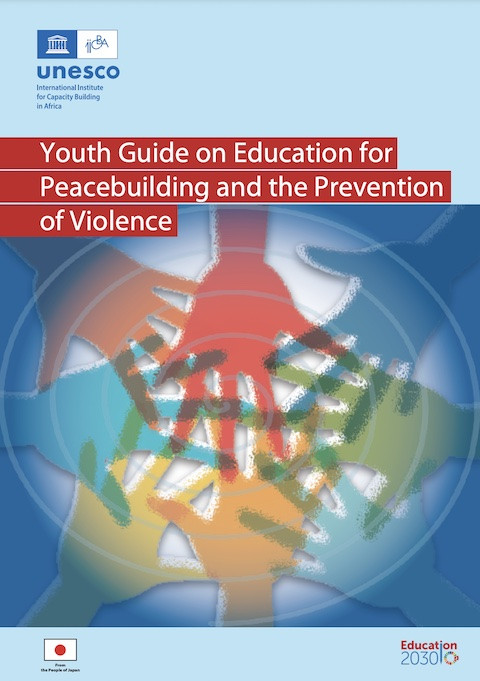 Youth Guide on Education for Peacebuilding and the Prevention of Violence Année de publication: 2022 Auteur institutionnel: UNESCO International Institute for Capacity-Building in Africa (IICBA) This publication is a training guide for the youth in both formal or non-formal education. It is a resource to work with children and young people in various settings, including schools, non-formal educational program, community activities and other settings. The goal of the training guide is therefore the youth to become a facilitator with the disposition, knowledge, skills and commitment to support other youth in developing their full potential as peace-builders. It provides a foundation of conflict analysis, peacebuilding and describes a learner centered approach to peace education and community engagement. Guide jeunesse sur l’éducation pour la consolidation de la paix et de la prévention de la violence Année de publication: 2022 Auteur institutionnel: UNESCO International Institute for Capacity-Building in Africa (IICBA) Cette publication est un guide de formation pour les jeunes de l’éducation formelle ou non formelle. Il s’agit d’une ressource pour travailler avec les enfants et les jeunes dans différents contextes, notamment dans les écoles, les programmes d’éducation non formelle, les activités communautaires et autres. L’objectif de ce guide de formation est donc de permettre aux jeunes de devenir des animateurs dotés de la disposition, des connaissances, des compétences et de l’engagement nécessaires pour aider d’autres jeunes à développer pleinement leur potentiel de bâtisseurs de paix. Il fournit les bases de l’analyse des conflits et de la construction de la paix et décrit une approache de l’éducation à la paix et de l’engagement communautaire centrée sur l’apprenant.
  What Can Education Do to Prevent Violence? Année de publication: 2021 Auteur: Rafael Bisquerra Auteur institutionnel: BBVA We learn together 2030 In this video, the educator Rafael Bisquerra reflects on emotional management as a way to reduce the rates of violence in society, contributing to the improvement of conflict management. ¿Que puede hacer la educaciòn para prevenir la violencia? Année de publication: 2021 Auteur: Rafael Bisquerra Auteur institutionnel: BBVA We learn together 2030 En este vídeo, el educador Rafael Bisquerra reflexiona sobre la gestión emocional como forma de disminuir los índices de violencia en la sociedad contribuyendo a la mejora en el manejo de conflcitos.
 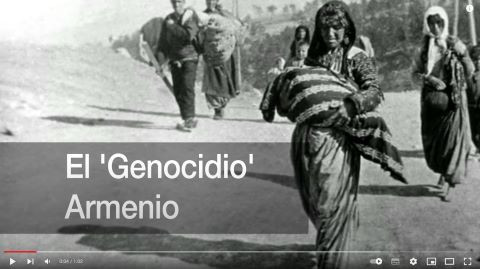 What is the Armenian "Genocide"? Année de publication: 2015 Auteur institutionnel: BBC News World This video recounts how tens of thousands of Armenians died when the rulers of the then Ottoman Turkish Empire deported them en masse from the eastern Anatolia region to the Syrian desert and elsewhere in 1915-16. The Armenians were described as collaborators with Russia, a country that was facing the Ottomans in the Caucasus region. The total number of victims is in dispute. ¿Qué es el genocidio Armenio? Année de publication: 2015 Auteur institutionnel: BBC News World En este video se narra cómo decenas de miles de armenios murieron cuando los responsables del entonces Imperio Turco Otomano los deportaron en masa desde la región de Anatolia oriental hacia el desierto de Siria y otras partes, entre 1915-16. Los armenios fueron calificados como colaboradores de Rusia, país que enfrentaba a los otomanos en la región del Cáucaso. El número total de víctimas está en discusión.
 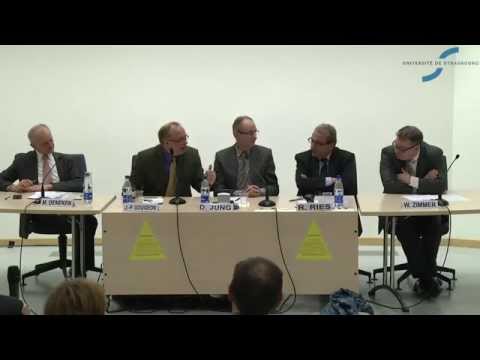 Conference-Debate: Can Citizenship Be Taught? Année de publication: 2015 Auteur institutionnel: University of Strasbourg At the initiative of the Faculty of Law, Political Science and Management, this conference/debate brings together: Roland Ries, Mayor of Strasbourg; Jacques-Pierre Gougeon, rector of the Academy of Strasbourg, chancellor of universities; Michel Deneken, 1st vice-president of the University of Strasbourg; Willy Zimmer, professor of public law;Dominique Jung, editor-in-chief of Latest News from Alsace (moderator). Conférence-débat: La citoyenneté peut-elle être enseignée? Année de publication: 2015 Auteur institutionnel: University of Strasbourg À l'initiative de la Faculté de droit, de sciences politiques et de gestion, cette conférence/débat réunit : Roland Ries, maire de Strasbourg ; Jacques-Pierre Gougeon, recteur de l'académie de Strasbourg, chancelier des universités ; Michel Deneken, 1er vice-président de l'Université de Strasbourg ; Willy Zimmer, professeur de droit public ; Dominique Jung, rédacteur en chef des Dernières nouvelles d’Alsace (modérateur).
 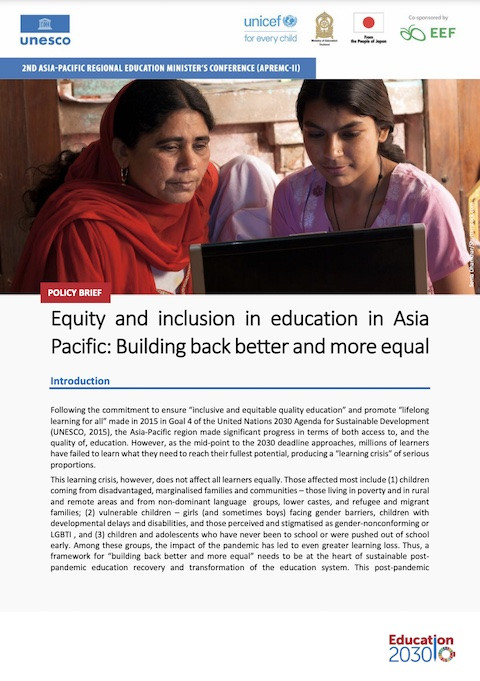 Equity and Inclusion in Education in Asia Pacific: Building Back Better and More Equal; Policy Brief Année de publication: 2022 Auteur institutionnel: UNESCO Bangkok Following the commitment to ensure “inclusive and equitable quality education” and promote “lifelong learning for all” made in 2015 in Goal 4 of the United Nations 2030 Agenda for Sustainable Development (UNESCO, 2015), the Asia-Pacific region made significant progress in terms of both access to, and the quality of, education. However, as the mid-point to the 2030 deadline approaches, millions of learners have failed to learn what they need to reach their fullest potential, producing a “learning crisis” of serious proportions. This learning crisis, however, does not affect all learners equally. Those affected most include (1) children coming from disadvantaged, marginalised families and communities – those living in poverty and in rural and remote areas and from non-dominant language groups, lower castes, and refugee and migrant families; (2) vulnerable children – girls (and sometimes boys) facing gender barriers, children with developmental delays and disabilities, and those perceived and stigmatised as gender-nonconforming or LGBTI , and (3) children and adolescents who have never been to school or were pushed out of school early. Among these groups, the impact of the pandemic has led to even greater learning loss. Thus, a framework for “building back better and more equal” needs to be at the heart of sustainable postpandemic education recovery and transformation of the education system. This post-pandemic framework calls for decisive action to protect the right to education of good quality and for measures – as spelled out below – to improve learning outcomes, especially for marginalized children made more vulnerable because of the pandemic.