
Ressources
Explorez une large gamme de ressources sur le GCED afin d’approfondir votre compréhension et de renforcer vos activités de recherche, de plaidoyer, d’enseignement et d’apprentissage.
2,275 résultats trouvés
 Migration: la solidarité internationale contre le nationalisme xénophobe Année de publication: 2018 Auteur: Tina Robiolle Moul Le sommet qui vient de se tenir à Bruxelles les 28 et 29 juin, confirme l’entêtement des dirigeant·e·s européen·ne·s dans une politique du pire qui, loin d’être le fruit de maladresses face à l’idée d’une invasion imaginaire de personnes étrangères, s’apparente à une stratégie explicite de coercition des populations en adoptant sans réserve les positions de l’extrême droite. La politique migratoire européenne, à l’image de celle des pays membres, reste aveugle à une compréhension plus globale des migrations qui est celle de la solidarité internationale.
 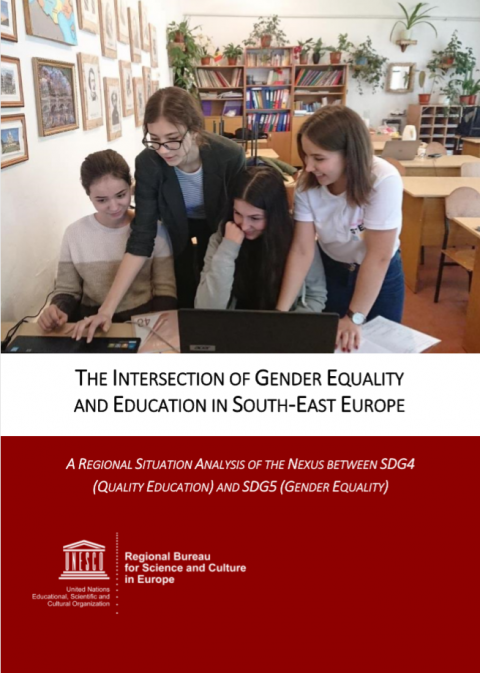 The Intersection of gender equality and education in South-East Europe: a regional situation analysis of the Nexus between SDG4 (Quality Education) and SDG5 (Gender Equality) Année de publication: 2019 Auteur institutionnel: UNESCO Venice This report focuses on highlighting both progress and persistent challenges.It does so by analyzing the current situation of gender equality in education, including gender parity in participation, education quality, and outcomes, aswell as issues related to gender equality in which education plays an important role, suchas policies that disproportionately affect women, early and unintended pregnancy, child marriage, and human trafficking. It relies on the most recent available data from the UNESCO Institute of Statistics (UIS), as well as supplemental data including from UNICEF, UN Women, and theOrganization for Economic Cooperation and Development(OECD), to descriptively analyze the rates for females and males, considering also progress over the last decade, and to identify where progress in gender equality has been made and whereactions are needed to ensure gender equality in and through education.
 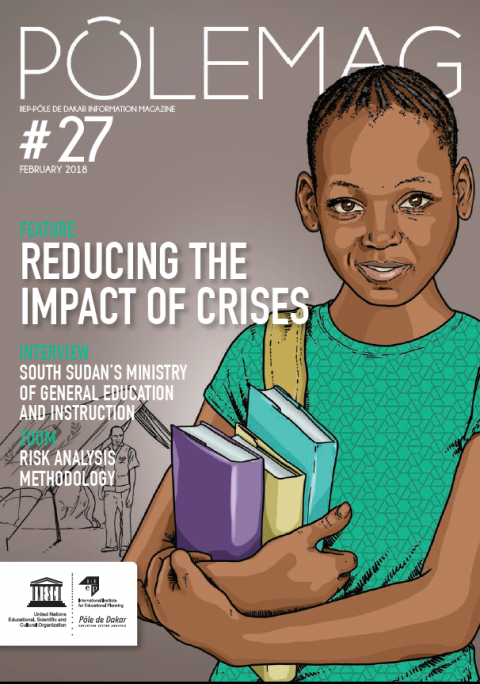 PôleMag n° 27: IIEP Pôle de Dakar information magazine, February 2018 Année de publication: 2018 Auteur institutionnel: UNESCO IIEP Regional Office for Africa Strengthening the resilience of education systems through planning that is adapted for crisis situations is a priority for IIEP. Together with our main partners, the institute has developed strategic orientations and tools dedicated to educational planning that is adapted to crisis situations. Based on our experience on this theme in Africa, we are also working with UNICEF to develop a new methodology to analyse risks and vulnerabilities. Mitigating the impact of crises calls for strengthening relationships with partners. Planning adapted to vulnerabilities should facilitate dialogue between development and humanitarian actors so that intervention plans are coordinated and aligned with government priorities. A dollar invested in risk reduction could save up to seven dollars in rebuilding costs. Taking the risks into account in the analysis and planning of education systems is therefore a wise investment. PôleMag: la lettre d'information du Pôle de Dakar Année de publication: 2018 Auteur institutionnel: UNESCO IIEP Regional Office for Africa Crise politique, crise sanitaire, crise climatique, les systèmes éducatifs sont rarement suffisamment préparés à faire face aux situations d’urgence.Et si la fréquence des menaces est inconnue, les effets sont généralement dévastateurs pour l’école, conduisant à une rupture des apprentissages, voire à l’abandon scolaire pur et simple. Dans le monde, 75 millions d’enfants vivant dans un pays affecté par une crise ont besoin d’un soutien éducatif1.Comment faire face aux crises ? Comment améliorer les capacités des systèmes à réduire leurs impacts ? Renforcer la résilience des systèmes éducatifs par une planification adaptée aux situations de crise est une priorité de l’IIPE. Notre institut a développé, avec ses principaux partenaires, des orientations stratégiques et des outils dédiés à la planification de l’éducation adaptés aux situations de crises. Forts de notre expérience sur cette thématique en Afrique, nous travaillons également en collaboration avec l’UNICEF au développement d’une nouvelle méthodologie dédiée à l’analyse des risques et vulnérabilités.Atténuer l’impact des crises appelle à renforcer les relations avec les partenaires. Une planification adaptée aux vulnérabilités doit faciliter le dialogue entre les acteurs du développement et ceux de l’humanitaire afin que les plans d’interventions soient coordonnés et alignés sur les priorités gouvernementales des plans sectoriels. Un dollar investi dans la réduction des risques pourrait épargner jusqu’à 7 dollars en coût de reconstruction. Prendre en compte les risques dans l’analyse et la planification des systèmes éducatifs est donc un investissement judicieux.
 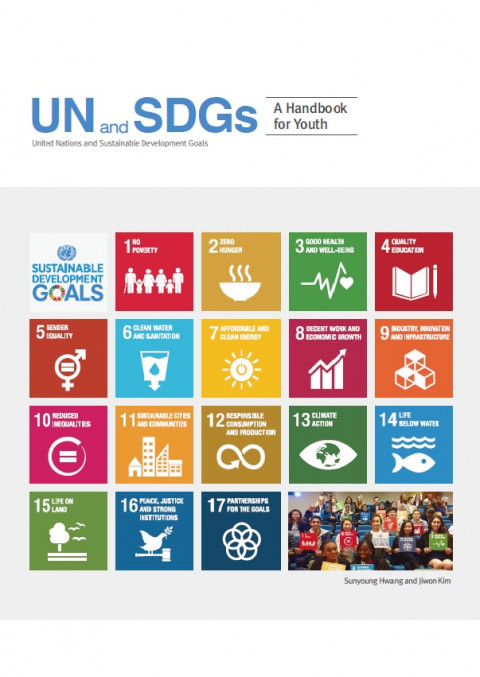 UN and SDGs: A Handbook for Youth Année de publication: 2017 Auteur: Sunyoung Hwang | Jiwon Kim Auteur institutionnel: UN. Economic and Social Commission for Asia and the Pacific (UN. ESCAP) | Asian Development Bank (ADB) | United Nations Development Programme (UNDP) "UN and SDGs: A Handbook for Youth" is an outcome of ESCAP East and North-East Asia’s internship program that brings young people closer to the work of the United Nations, as well as to the achievement of the ambitious set of Sustainable Development Goals (SDGs). As young leaders of tomorrow, it is pivotal that youth are informed and engaged with the global vision for the future. Over the next fifteen years, youth will not only directly experience the outcome of SDGs and plans, but will also be the key driver for their successful implementation. For this reason, it is vital to raise awareness about the recently adopted 17 SDGs and the 2030 Agenda for Sustainable Development among youth, build a platform for discussion, and create the conditions for active engagement. This Handbook explores SDGs and the 2030 Agenda from a youth perspective. In the first chapter, it introduces the concept of sustainable development and outlines its historical development through the transition from Millennium Development Goals (MDGs) to SDGs. The second chapter discusses how youth can be harnessed as a major agent of change in achieving sustainable development, focusing on several pertinent youth issues in Asia and the Pacific. The final chapter introduces the UN system and its regional arm, ESCAP, explaining their role in the successful implementation of SDGs. 청년을 위한 UN과 SDGs 핸드북 Année de publication: 2017 Auteur: Sunyoung Hwang | Jiwon Kim Auteur institutionnel: UN. Economic and Social Commission for Asia and the Pacific (UN. ESCAP) | Asian Development Bank (ADB) | United Nations Development Programme (UNDP) 이 핸드북은 유엔의 업무와 지속가능발전목표(SDGs)에 대해 배울 수 있는 유엔 인턴십 프로그램을 통해 만들어졌습니다. 청년들이 내일의 리더로써 미래 글로벌 비전을 인식하고, 이에 적극 동참하는 일은 매우 중요합니다. 그들은 향후 15년간 SDGs의 결과를 체험하고, 목표를 성공적으로 이행할 핵심 주체가 될 것입니다. 그러므로 지속가능발전을 위한 2030 의제와 SDGs에 대한 청년들의 인식을 함양하고, 논의의 장을 늘리고, 적극적인 참여를 유도하기 위한 환경을 조성하는 것이 중요합니다. '청년을 위한 UN과 SDGs 핸드북'은 청년들의 관점에서 2030 의제와 SDGs를 개괄합니다. 제1장에서는 지속가능발전에 대한 개념을 소개하고 새천년개발목표 (MDGs)에서 SDGs로의 이행을 통한 역사적인 발전에 대해 알아보며, 제2장에서는 아시아태평양지역 내 청년과 관련된 여러가지 사안에 초점을 맞춰 청년들이 지속가능발전을 실현하기 위해 어떤 역할을 할 수 있는지에 대해 논의합니다. 제3장에서는 유엔 시스템과 지역기구인 ESCAP에 대해 소개하면서 SDGs의 성공적 이행 과정에 있어서의 청년들의 역할에 대해 알아봅니다.
  한국교육과 SDG4-교육2030 Année de publication: 2018 Auteur: 김광호 Auteur institutionnel: 유네스코한국위원회 영유아 교육부터 성인교육에 이르기까지 교육의 모든 분야를 망라하고 있는 SDG4는 매우 야심 찬 목표다. 세계 각국은 이를 달성하기 위해 여러 논의도 벌이고 교육 정책 에 반영도 하는 등 다각도로 노력하고 있다. 이러한 국제사회의 노력에 비해 국내의 SDG4 관련 움직임은 아직 그리 크지 않은 것 같다. 이에 유네스코한국위원회는 교육부와 함께 한국의 SDG4 달성 현황을 파악하고 앞으로 어떤 과제에 집중해야 하는지 점검하기 위하여 2017년 11월에 ‘제1회 SDG4-교육 2030 포럼: 한국교육과 SDG4-교육 2030’을 개최한 바가 있다. 이 책은 포럼 발표문과 토론문의 저자들이 포럼에서의 논의를 반영하여 수정한 원고를 한데 묶은 것이다. 일차적으로 교육 정책 담당자, 교육 연구자, 교육기관 종사자, 시민단체 활동가를 위한 내용을 담고 있지만, 일반 시민의 SDG4에 대한 관심과 이해를 높이는 데에도 유용할 것이다.
  Guide rapide des indicateurs de l'éducation pour l'ODD 4 Année de publication: 2018 Auteur institutionnel: UNESCO Institute for Statistics (UIS) Ce guide sert de référence rapide sur la manière de suivre les progrès accomplis vers la réalisation de l’Objectif de développement durable 4 (ODD 4) sur une éducation de qualité. Il fournit les explications essentielles sur les cibles de l’ODD 4, leurs indicateurs, le mode d’élaboration des indicateurs et où trouver les données nécessaires à ces indicateurs.
 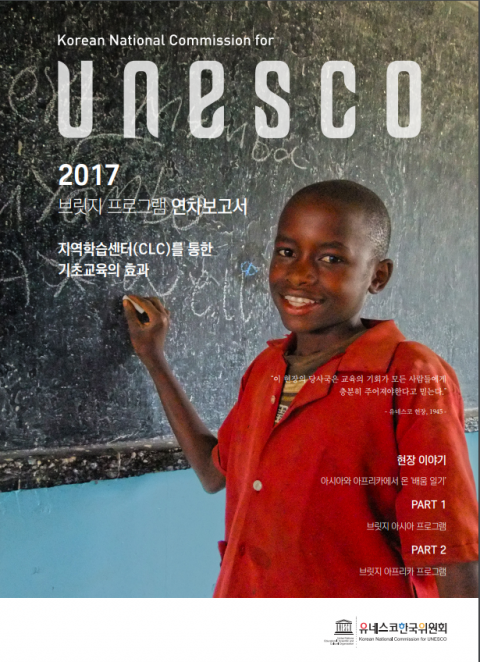 2017-18 브릿지 프로그램 연차보고서 Année de publication: 2018 Auteur institutionnel: 유네스코한국위원회 브릿지 프로그램은 유네스코한국위원회가 교육부의 지원과 후원 모금을 통해 남아시아 지역과 사하라 이남 아프리카 지역에 거주하는 비문해자를 포함한 교육소외계층을 대상으로 교육의 기회를 제공하는 사업이다. 이 보고서는 2017년도부터 2018년도 상반기까지 유네스코한국위원회가 아시아 6개국과 아프리카 6개국에서 각국의 정부기관, 시민사회단체 및 유네스코국가위원회 등과 협력하여 추진한 사업들의 세부 활동과 성과를 보여준다. 아울러, 브릿지 프로그램을 통해 삶의 변화를 맞이한 사람들의 이야기도 확인할 수 있다. Quick guide to education indicators for SDG 4 Année de publication: 2018 Auteur institutionnel: UNESCO Institute for Statistics (UIS) This guide serves as a quick reference on how to monitor progress towards Sustainable Development Goal 4 (SDG 4) on quality education. It provides basic explanations of SDG 4 targets, their indicators, how they are created and where to find the information needed for these indicators.