
Ressources
Explorez une large gamme de ressources sur le GCED afin d’approfondir votre compréhension et de renforcer vos activités de recherche, de plaidoyer, d’enseignement et d’apprentissage.
1,852 résultats trouvés
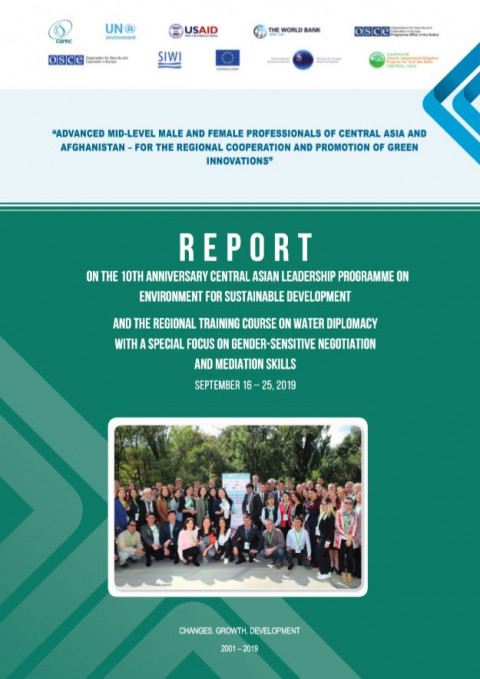 Report on the 10th Anniversary Central Asian Leadership Programme on Environment for Sustainable Development and the Regional Training Course on Water Diplomacy with a Special Focus on Gender-Sensitive Negotiation and Mediation Skills; September16–25,2019 Année de publication: 2019 Auteur institutionnel: Regional Environmental Centre for Central Asia (CAREC) The publication is a report on the 10th anniversary of the Central Asian Environment Leadership Program for Sustainable Development (September 16-22, 2019) and the OSCE regional water diplomacy training, with a special focus on gender-sensitive negotiation and mediation skills (23-25 September 2019), prepared by CAREC in cooperation with regional and international partners. Отчет о 10-й Юбилейной Центрально-Азиатской Программе Лидерства по окружающей среде для устойчивого развития;16-22 сентября 2019 года и Региональном тренинге ОБСЕ по водной дипломатии с особым акцентом на навыки ведения переговоров и медиацию с учетом ген Année de publication: 2019 Auteur institutionnel: Regional Environmental Centre for Central Asia (CAREC) Публикация является отчетом о 10-й юбилейной центральноазиатской программе лидерства по окружающей среде для устойчивого развития (16-22 сентября 2019 г.) и региональном тренинге ОБСЕ по водной дипломатии с особым акцентом на навыки ведения переговоров и медиацию с учетом гендерных факторов (23-25 сентября 2019 г.), подготовленной РЭЦЦА в сотрудничестве с региональными и международными партнерами.
  Social Media to P/CVE: Toolkit for Practitioners Année de publication: 2017 Auteur institutionnel: Search for Common Ground This Toolkit has been created on the basis of the key findings obtained in the framework of the Search for Common Ground (Search) “Social Media for De-Radicalization in Kyrgyzstan: A Model for Central Asia’s” pilot project funded by the Bureau of Counterterrorism, US Department of State. The project is based on two parts: a participatory approach, focused on UN Resolution 2250, and a professional approach aimed at creating and conducting social media campaigns in Kyrgyzstan.Extremist and terrorist groups use the Internet to radicalize and recruit young people through social media and instant messaging applications. Therefore, it is important to create new methods to combat online extremist propaganda, focusing not only on measures such as blocking and filtering content, or counter-narratives which are very popular and come naturally in response to radicalization and violent extremism, but also offering a positive alternative to extremist propaganda, while challenging their ideology and messages. Социальные медиа для профилактики/предотвращения насильственного экстремизма: практическое руководство Année de publication: 2017 Auteur institutionnel: Search for Common Ground Данный инструментарий был создан на основе ключевых результатов, полученных в рамках пилотного проекта «Поиск социальных сетей (Кыргызстан: модель для Центральной Азии)« Поиск в социальных сетях для Кыргызстана: модель для Центральной Азии », финансируемого Бюро по борьбе с терроризмом, Госдеп США. Проект основан на двух частях: совместный подход, ориентированный на Резолюцию ООН 2250, и профессиональный подход, направленный на создание и проведение кампаний в социальных сетях в Кыргызстане.Экстремистские и террористические группы используют Интернет для радикализации и вербовки молодых людей через социальные сети и приложения для обмена мгновенными сообщениями. Поэтому важно создать новые методы для борьбы с экстремистской пропагандой в Интернете, сосредоточив внимание не только на таких мерах, как блокировка и фильтрация контента, либо контррассказах, которые очень популярны и появляются естественным образом в ответ на радикализацию и насильственный экстремизм, но также предлагая Позитивная альтернатива экстремистской пропаганде, бросая вызов их идеологии и сообщениям.
  The 29th Arab Scout Conference Année de publication: 2019 Auteur institutionnel: Arab Scout Organization The conference book reviews scouting and the sustainable development goals. The book deals with a range of issues in the field of Scouting and its role in achieving the Sustainable Development Goals. الموؤتمر الكشفي العربي ال 29 Année de publication: 2019 Auteur institutionnel: Arab Scout Organization يستعرض كتاب المؤتمر الكشفية وأهداف التنمية المستدامة. ويعالج الكتاب مجموعة من القضايا في مجال الكشفية ودورها في تحقيق أهداف التنمية المستدامة.
  Key Challenges of Youth in OIC Countries Année de publication: 2015 Auteur institutionnel: Organization of Islamic Cooperation (OIC) | Statistical, Economic and Social Research and Training Centre for Islamic Countries (SESRIC) The report contains four main sections, with the exception of the introductory and concluding sections. The first section briefly reviews some of the main educational outcomes in OIC countries. Literacy and participation rates in tertiary schools and international student mobility are the main indicators reviewed in this section. The second section highlights some important labor market indicators related to the young population in order to identify the main challenges and obstacles in the OIC countries. The third section deals with some social problems of young people. The fourth section deals with mental health issues. The last section is devoted to recommendations. التحديات الرئيسية للشباب في دول منظمة التعاون اإلسالمي Année de publication: 2015 Auteur institutionnel: Organization of Islamic Cooperation (OIC) | Statistical, Economic and Social Research and Training Centre for Islamic Countries (SESRIC) ويحتوي التقرير على أربعة أقسام رئيسية، باستثناء الأقسام التمهيدية والختامية. يستعرض القسم الأول بإيجاز بعض النتائج التعليمية الرئيسية في دول المنظمة. وتشكل معدلات الإلمام بالقراءة والكتابة والمشاركة في مدارس التعليم العالي والحراك الطلابي الدولي المؤشرات الرئيسية المستعرضة في هذا القسم. يبرز القسم الثاني بعض المؤشرات الهامة لسوق العمل المتعلقة بالسكان الشباب بهدف التعرف على التحديات والعقبات الرئيسية في دول المنظمة. ويتناول القسم الثالث بعض المشاكل الاجتماعية للشباب. أما القسم الرابع فيتناول قضايا الصحة النفسية. والقسم الأخير مخصص للتوصيات.
  Installations of the Youth of Modern Kazakhstan to Implement Social Activity Année de publication: 2018 Auteur: O.V. Kaldybayeva | F.M. Mussataeva | G.Ye. Okasova The article discusses the issues related to the study of social activity among modern youth, which largely determines the implementation effeciency of a number of national programs. The conclusions in this article are based on the results of sociological study by Scientific Research Center “Youth”, carried out in the second half of 2017 in the Republic of Kazakhstan.
  The Role of UNESCO in the Search for Peace Année de publication: 2019 Auteur: Inuk Kang | Sunghae Kim | Jihon KIM | Jieun Seong | Seongsang YOO | Dongjoon Jo | Dongju Choi | Kyungkoo Han Auteur institutionnel: Korean National Commission for UNESCO UNESCO's international intellectual cooperation for peace has achieved substantive tangible results in education and culture. Though some problems have been politicized and have produced limitations along the way, UNESCO has played a leading role in education and culture while setting the direction of international cooperation and activities in this regard.UNESCO has regretfully not played an active role in fostering broader, more diverse, and more extensive new research and practices related to peace, even with the international Cold War realities. While UNESCO was an international organization created explicitly for peace, it has neither led to momentous peace-related academic discourse nor does it lead to theoretical development in this regard. The concept of a "Culture of Peace," for example, was first mentioned in the Ivory Coast (Cote d'Ivoire) in 1989. However, it was not until 1997 that UNESCO started its "Toward a Culture of Peace Program" and the U.N. General Assembly declaring 2000 as the "Year of Peace."UNESCO's situation provides an opportunity for South Korea to play a more active role. South Korea needs to break with its history of taking a passive stance focused on short-term national interests and its preoccupation with "situational tracking" responses aimed at fostering national prestige when such opportunities present themselves. Instead, while prioritizing a "global community" founded on world peace and the well-being of humanity-as long-term shared benefits to all nations-and by sharing the financial burdens involved, the country can increase its international status and become a moral leader raising a "global citizenship power."