
Ressources
Explorez une large gamme de ressources sur le GCED afin d’approfondir votre compréhension et de renforcer vos activités de recherche, de plaidoyer, d’enseignement et d’apprentissage.
1,852 résultats trouvés
 可持续发展教育校长培训手册 Année de publication: 2012 Auteur institutionnel: 联合国教科文组织 (UNESCO) | Beijing Sustainable Development Education Association | China National Council for Sustainable Development Education Secretariat 文章旨在解释可持续发展在中国的应用
  UNESCO Associated Schools Network: guide for national coordinators Année de publication: 2018 Auteur institutionnel: UNESCO This document describes in detail the history of the UNESCO Associated Schools Network, its mission, goals, management, membership, and other information. It is a guide for National Coordinators who are the link between the schools in their country, their National Commission and other national authorities, and the International Coordinator at UNESCO. Сеть ассоциированных школ ЮНЕСКО: Руководство для национальных координаторов Année de publication: 2018 Auteur institutionnel: UNESCO В данной работе подробно описывается история Сети ассоциированных школ ЮНЕСКО (Сеть ПАШ), ее миссия, цели, управление, членство и др. информация. Она является руководством для национальных координаторов, которые осуществляют взаимосвязь между школами своей страны, ее национальной комиссией по делам ЮНЕСКО и другими национальными властями18, а также международным координатором в Штаб-квартире ЮНЕСКО.
  Culture: Urban Future; Global Report on Culture for Sustainable Urban Development Année de publication: 2016 Auteur institutionnel: UNESCO As the cornerstone of society, culture must lie at the heart of sustainable policies and strategies. Yet, despite its vital importance, key questions such as: ‘How has culture influenced urban development across the world?’ and ‘How can culture make a difference to our urban future?’ have often remained unexplored.This report, the first of its kind, explores the role of culture for sustainable urban development. It is intended as a policy framework document to support governments in the implementation of the 2030 Agenda for Sustainable Urban Development and the New Urban Agenda.In search of a common thread between the past and the future, the report examines the contribution of culture to urban sustainability from two analytical angles: a global survey implemented with nine regional partners across the world; and key thematic insights. The report thus analyses the situation, trends, threats and existing opportunities in different regional contexts, and presents a global picture of urban heritage safeguarding, conservation and management, as well as the promotion of cultural and creative industries, as resources for sustainable urban development. The report also includes a set of maps and a section on UNESCO’s strategic networks reflecting the Organization’s various fields of competence.Building on the findings of this global research and thematic reflection, the report presents new guidelines and recommendations, rooted in culture, to ensure that the cities of tomorrow are safe, inclusive, resilient and sustainable.
 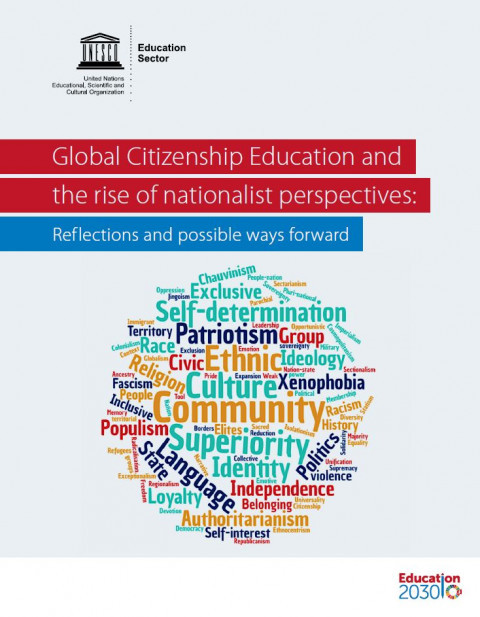 Global Citizenship Education and the Rise of Nationalist Perspectives: Reflections and Possible Ways Forward Année de publication: 2018 Auteur institutionnel: UNESCO | APCEIU Over the past few years, many have observed a rise in nationalist perspectives across the world. These trends raise questions about the role of education and, in particular, one of UNESCO’s key areas of work in the field of education, namely Global Citizenship Education (GCED), which seeks to equip learners with the skills, values and attitudes needed to contribute to the development of peaceful and just societies. This paper seeks to clarify the evidence of the rise of nationalist perspectives and its causes, and to lay out how GCED is challenged by this phenomenon. It recommends ways forward for education stakeholders in promoting GCED, in order to strengthen ‘learning to live together’ by embedding GCED meaningfully in local and country contexts. 세계시민교육과 민족주의적 관점의 부상: 성찰과 나아갈 길 Année de publication: 2018 Auteur institutionnel: 유네스코 | 유네스코 아시아태평양 국제이해교육원 지난 몇 년간 많은 이들이 전 세계에서 민족주의적 관점의 부상을 목도해왔다. 이에 관해 평론가들은 배타성과 외국인 공포증, 때로 인종주의적 주장과 공공장소 내 폭력적 행위가 증가하고 있는 것뿐만 아니라, 일부 국가에서 경제적 보호주의에 더욱 중점을 두는 현상에 대해 언급해왔다. 이러한 추세는 교육의 역할에 대해 많은 의문을 불러일으키고 있으며, 특히 평화롭고 공정한 사회의 발전에 필요한 능력·가치·태도 함양을 목적으로 하는, 유네스코 교육 분야의 핵심 사업인 세계시민교육(GCED, Global Citizenship Education)에 있어 심각한 도전이 되고 있다. 이 책에서는 민족주의적 관점이 부상하고 있다는 증거 및 그 원인을 규명하고, 이러한 현상으로부터 세계시민교육이 어떠한 도전을 받고 있는지를 보여주고자 한다. 이 책은 유네스코의 사업과 더불어 세계시민교육을 추진하는 다른 교육 종사자들에게 앞으로 나아갈 수 있는 방안을 권고하고자 한다.
 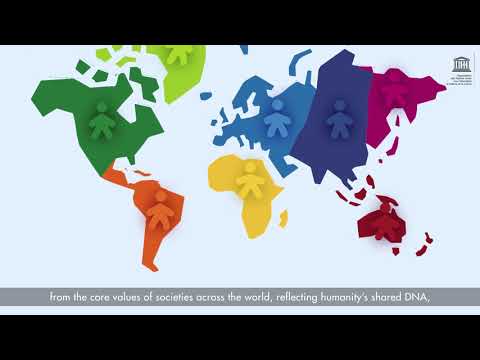 Éducation à la citoyenneté mondiale: Pour une approche locale Année de publication: 2018 Auteur institutionnel: Organisation des Nations Unies pour l'éducation, la science et la culture (UNESCO) Les sociétés à travers le monde ont longtemps vécu selon les principes de la solidarité, le dialogue et le respect de la diversité. Le programme d’éducation à la citoyenneté mondiale (ECM) de l’UNESCO est inspiré de ces savoirs, en inculquant aux apprenants les compétences, les valeurs et les attitudes pour vivre ensemble et construire un monde plus durable et pacifique. L’ECM n’est pas un nouveau concept, mais une aspiration de longue date à travers les continents.
  Outcome Document of the Technical Consultation on Global Citizenship Education: Global Citizenship Education: An Emerging Perspective Année de publication: 2013 Auteur institutionnel: UNESCO This document draws on inputs to, and common perspectives emerging from, a Technical Consultation on Global Citizenship Education organized by UNESCO and the Republic of Korea (i.e., the Ministries of Foreign Affairs and of Education, and the Asia-Pacific Centre of Education for International Understanding) in Seoul on 9-10 September 2013 . Informing this draft document are: a) responses from the expert participants to a questionnaire circulated by UNESCO in advance of the consultation; b) presentations from experts during the consultation; c) discussions during the consultation; and d) reference material contributing to, and prepared for, the consultation. The final draft of this document was prepared by UNESCO’s Division of Education for Peace and Sustainable Development at Headquarters in Paris, with the assistance of a drafting team. Document final de la Consultation technique sur l’éducation à la citoyenneté mondiale: Éducation à la citoyenneté mondiale : Une nouvelle vision Année de publication: 2013 Auteur institutionnel: UNESCO Le présent document s’inspire des contributions et des perspectives communes issues d’une Consultation technique sur l’éducation à la citoyenneté mondiale organisée par l’UNESCO et la République de Corée (à savoir, par les ministères des Affaires étrangères et de l’Éducation et le Centre Asie-Pacifique d'éducation pour la compréhension internationale) à Séoul, les 9 et 10 septembre 20131. Ce projet de document s’appuie sur : (a) les réponses des experts participants à un questionnaire envoyé par l’UNESCO avant la consultation ; (b) les présentations des experts durant la consultation; (c) les débats qui ont eu lieu pendant la consultation ; et sur (d) les documents de référence préparés pour la consultation. Le projet final du présent document a été préparé par la Division de l'éducation pour la paix et le développement durable, au Siège de l’UNESCO, à Paris, avec le soutien d’une équipe de rédaction. Documento Final de la Consulta técnica Sobre Educación para la Ciudadanía Mundial - Educación para la Ciudadanía Mundial: una Perspectiva Emergente Année de publication: 2013 Auteur institutionnel: Organización de las Naciones Unidas para la Educación, la Ciencia y la Cultura (UNESCO) En el presente documento se toman como base los aportes y las perspectivas comunes que surgen de la consulta técnica sobre la educación para la ciudadanía mundial, organizada por la UNESCO y la República de Corea (los Ministerios de Relaciones Exteriores y de Educación y el Centro de Asia y el Pacífico de Educación para el Entendimiento Internacional) en Seúl los días 9 y 10 de septiembre de 2013.A lo largo de la elaboración del borrador de este documento se utilizaron: a) las respuestas de expertos a un cuestionario circulado por la UNESCO previo a la consulta; b) las ponencias realizadas por los expertos durante la consulta; c) las discusiones que se efectuaron durante la consulta; y d) el material de referencia que respaldó y fue preparado para la consulta. El borrador final del presente documento fue preparado por la División de la Educación para la Paz y el Desarrollo Sostenible en la sede de la UNESCO en París, con la asistencia de un equipo de redacción. En este documento se presentan las perspectivas comunes que emanaron de la consulta.