
Ressources
Explorez une large gamme de ressources sur le GCED afin d’approfondir votre compréhension et de renforcer vos activités de recherche, de plaidoyer, d’enseignement et d’apprentissage.
1,851 résultats trouvés
 Reunión mundial sobre la educación: Declaración de Fortaleza; Aprovechar el poder transformador de la educación para forjar futuros pacíficos, equitativos y sostenibles Année de publication: 2024 Auteur institutionnel: UNESCO | Brazil. Ministry of Education Este documento recoge la declaración de los ministros, los jefes y los miembros de las delegaciones nacionales, los representantes de los organismos de las Naciones Unidas, los asociados humanitarios y para el desarrollo, las organizaciones internacionales y regionales, las organizaciones de la sociedad civil, la profesión docente, los jóvenes y los estudiantes, el sector privado y las fundaciones, a partir de su participación en la Reunión Global sobre Educación (GEM) 2024, llevada a cabo los días 31 de octubre y 1° de noviembre. Esta reunión, organizada por la UNESCO y con sede en Brasil, tuvo el propósito de trazar la ruta para que la educación sea la prioridad de las naciones, las regiones y el mundo como un elemento clave para alcanzar todos los ODS, adoptando un enfoque integrado y de aprendizaje permanente, centrado en el fortalecimiento y la transformación de la educación.
  Youth Report 2024: Technology in Education; A Tool on Our Terms! Année de publication: 2024 Auteur institutionnel: UNESCO | Global Education Monitoring Report Team | Restless Development The 2024 Youth Report on technology in education is the result of an extensive consultation process in partnership with Restless Development involving +1500 youth and students across 8 regions. The consultations invited participants to reflect on the key challenges and opportunities for the use of technology in education in their regions through the lenses of the recommendations in the global 2023 Global Education Monitoring Report on technology in education: Technology on our terms. The discussions centred on the need for the use of technology in education to be appropriate for national and local contexts and to be equitable and leave no one behind. The report calls for decisions about technology in education to keep learners at the centre when deciding whether the use of technology in education would be appropriate, equitable, evidence-based, and sustainable. Through this report, young people have described what technology on their terms would look like. It concludes with a call to action calling which highlights concrete recommendations that governments can follow to ensure that technology in education is on youth terms.
  Mainstreaming Social and Emotional Learning in Education Systems: Policy Guide; Highlights Année de publication: 2024 Auteur institutionnel: UNESCO UNESCO’s policy guide unpacks social and emotional learning (SEL) as a broadening of the educational process, from a focus on cognitive aspects to a balance between cognitive, social and emotional, and behavioural dimensions of learning, putting forward initial action ideas to guide its systematic mainstreaming in education. It builds on and extends previous work undertaken by UNESCO on SEL from the perspective of Global Citizenship Education (GCED) and Education for Sustainable Development (ESD), Building Strong Foundations for Health and Well-being Education, the Happy Schools Framework, and in multiple UNESCO Offices and Institutes.
  3rd Global Forum Against Racism and Discrimination: Final Document Année de publication: 2024 Auteur institutionnel: UNESCO The third edition of the Global Forum against Racism and Discrimination with the theme “Race to the top: putting racial equity and justice at the forefront of development agendas” was held in São Paulo, Brazil, on 29 November 2023 and 1 December 2023. At the invitation of Brazil, in partnership with the Ford Foundation, the Open Society Foundations, the Mover Foundation, Instituto Ibirapitanga, the Global Forum highlighted the importance of placing racial issues at the core of development and implementation strategies, with a view to socioeconomic development. The Global Forum welcomed Ministers, high-ranking officials of national bodies responsible for combating discrimination and promoting equality, mayors of the International Coalition of Inclusive and Sustainable Cities - ICCAR, academics, scientists, civil society actors, NGOs, artists and digital influencers to share good practices, strengthen commitments and discuss effective strategies to combat racism and various forms of discriminations, including recommendations on how to proceed. The Global Forum’s agenda covered several topics, such as co-creating inclusive policies with impacted communities’ inputs; increasing awareness-raising on historical systems such as transatlantic enslavement to better comprehend and dismantle their contemporary legacies such as racism; progress towards gender equality; enhancing the capacities of civil society to be an agent of change; addressing artificial intelligence and its role in perpetuating racism; protecting the rights of indigenous peoples; establishing legal and policy frameworks prioritizing anti-racism and anti-discrimination on a local and global scale; strengthening the roles of cities, civic spaces, artistic and academic communities; enhancing the importance of informed data baseline on equality for governments; and promoting social philanthropy to address racial inequality. The 2023 edition was also marked by the launch of new initiatives. One of the main outcomes of the Global Forum is the establishment of the UNESCO Network of Anti-Racism and Anti-Discrimination Officials aiming to strengthen the development of innovative and inclusive policy solutions for peace, equity and non-discrimination. UNESCO has launched the new UNESCO Anti-Racism Toolkit, the Gender-Based Resilience Framework, the ‘Let’s Talk‘ project with Harvard University to combat prejudice against migrants, and the development of a new joint OECD-UNESCO briefing on combating discrimination against migrants. Volume X of the UNESCO General History of Africa, entitled Africa and its Diasporas, was also launched during the Global Forum. The publication offers a mapping of African diasporas throughout the world, valorizing their contributions to modern societies.
  Hydro Resilience: Citizen and Open Science for Climate Adaptation Année de publication: 2024 Auteur institutionnel: UNESCO Human-induced climate change is affecting weather and climate extremes worldwide and causing changes in the atmosphere, ocean, cryosphere and biosphere leading to widespread adverse impacts on people and nature. These conditions have exposed people to reduced water security and negatively affected food security and ecosystem services. Despite advances in climate and water sciences, there is still a significant gap between information availability and its uptake by stakeholders. Although there is abundant data and information available on the potential impacts of climate change, there is a lack of expert knowledge on the user side, which limits the development and implementation of effective adaptation strategies at the local level. There is also an opportunity to bring communities more on board to manage their climate risk through citizen engagement and to ensure that vulnerable communities can benefit from climate science foresight. To address these challenges, a new project was developed called ‘Hydro Resilience: Citizen and Open Science for Climate Adaptation’ to pilot citizen and open science applications for climate risk management and to support water management under climate change uncertainty.
  Assessment for Advocacy to Transform Communities, Programmes and Policies in the Global South Année de publication: 2024 Auteur institutionnel: UNESCO | Global Education Monitoring Report Team | PAL Network This paper was commissioned by the Global Education Monitoring Report as background information to assist in drafting the 2024 Spotlight Report on basic education completion and foundational learning in Africa. It has not been edited by the team. The views and opinions expressed in this paper are those of the author(s) and should not be attributed to the Global Education Monitoring Report or to UNESCO. The papers can be cited with the following reference: “Paper commissioned for the 2024 Spotlight Report on basic education completion and foundational learning in Africa”.
 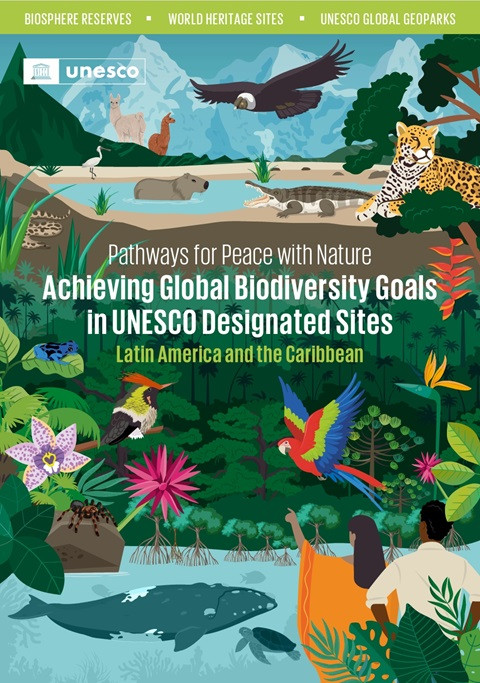 Pathways for Peace with Nature: Achieving Global Biodiversity Goals in UNESCO Designated Sites; Latin America and the Caribbean Année de publication: 2024 Auteur institutionnel: UNESCO UNESCO designated sites in Latin America and the Caribbean harbour over 60% of the region’s mapped species richness, i.e. over 14,000 species of mammals, reptiles, amphibians, birds, and fishes. They are also important for strengthening culture and nature linkages. However, biodiversity in these sites is threatened by human pressures and climate change and countries should take urgent action to halt and reverse biodiversity loss.This publication provides a regional overview of the status and trends of species in UNESCO designated sites, as well as key information to facilitate dialogue among all stakeholders. Additionally, it promotes the development of effective actions aimed at achieving global biodiversity goals.
  Directives opérationnelles : Vers la création de villes UNESCO pour l’éducation aux médias et à l’information Année de publication: 2024 Auteur institutionnel: UNESCO Pour soutenir l’intégration de l’éducation aux médias et à l’information dans les espaces urbains, l’UNESCO publie des lignes directrices opérationnelles à l’intention des acteurs de la gouvernance des villes.Ces lignes directrices ont pour objectif d’aider les villes à aligner leurs objectifs sur les avantages de l’intégration de l’éducation aux médias et à l’information dans les espaces physiques et virtuels.Les lignes directrices proposent des actions à titre d’exemple aux villes désireuses d’être parmi les pionnières Villes EMI. Les villes sont encouragées à partager leurs progrès et leurs réalisations avec l’UNESCO dans la perspective d’initiatives futures. Как создавать города медийной и информационной грамотности ЮНЕСКО Année de publication: 2024 Auteur institutionnel: UNESCO Чтобы содействовать интеграции медийной и информационной грамотности в городские пространства, ЮНЕСКО выпускает практическое руководство для участников процесса управления городами. Это руководство призвано помочь городам формировать цели своего развития с учетом преимуществ интеграции МИГ в физические и виртуальные пространства.В руководстве приводятся примеры действий для населенных пунктов, которые заинтересованы в том, чтобы стать первопроходцами в деле создания городов медийной и информационной грамотности. ЮНЕСКО будет рада узнать об их успехах и достижениях для будущих проектов.К инициативе могут присоединиться любые города и населенные пункты независимо от размера, уровня проникновения интернета или использования технологий. Задача данного руководства — содействовать развитию сотрудничества на муниципальном уровне для реализации мероприятий и программ в сфере МИГ.
 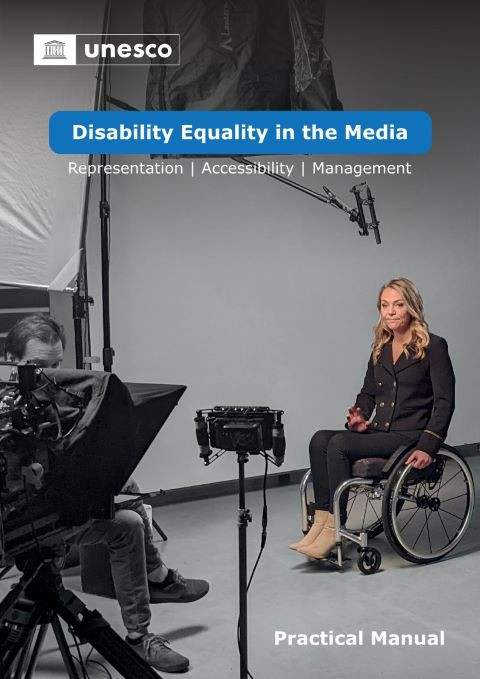 Igualdad para las personas con discapacidad en los medios: representación, accesibilidad, gestión : manual práctico Année de publication: 2025 Auteur institutionnel: UNESCO Promover la igualdad para las personas con discapacidad en los mediosA pesar de todos los cambios positivos que suceden en las salas de prensa y con los roles de liderazgo, la diversidad en los medios continúa presentando un desafío. Cuando se excluyen ciertos grupos, los medios omiten mostrar todos los ángulos de una historia, las distintas perspectivas y las ideas innovadoras. Por lo tanto, la audiencia no recibe la información completa y las promesas de una representación certera, generalmente, no son suficientes, lo que afecta nuestra percepción del otro en la sociedad. Es el caso de las personas con discapacidad, que constituyen un dieciséis por ciento de la población global, pero aún es uno de los grupos más marginados. La cobertura de los medios con frecuencia los ignora y cuando se cuentan sus historias, por lo general, se enmarcan en un estereotipo. Esto no solo crea obstáculos, sino que además les niega el ejercicio de sus derechos. A fin de abordar esta situación, los medios deben ampliar las políticas editoriales y aumentar la representación, mejorar las condiciones de empleo y promover un entorno más inclusivo para profesionales con discapacidad.El Manual Práctico y la Master Class brindan consejos útiles para los equipos editoriales sobre el modo de asegurar que la cobertura de las personas con discapacidad sea justa y no esté sesgada. Para los generadores de contenido, se detalla de qué manera hacer que el contenido y los servicios mediáticos sean accesibles. Para gerentes y quienes estén a cargo de tomar decisiones, este material alienta a realizar cambios, demostrando cómo la igualdad de las personas con discapacidad puede contribuir al crecimiento de la industriaz mediática y generar nuevas fuentes de ingreso.Este trabajo contribuye a implementar la Convención Internacional de las Naciones Unidas sobre los Derechos de las Personas con Discapacidad de 2006 y promueve la libertad de expresión, el desarrollo de los medios y el acceso a la información, a fin de que las personas con discapacidad participen significativamente en el debate público.