
Ressources
Explorez une large gamme de ressources sur le GCED afin d’approfondir votre compréhension et de renforcer vos activités de recherche, de plaidoyer, d’enseignement et d’apprentissage.
1,851 résultats trouvés
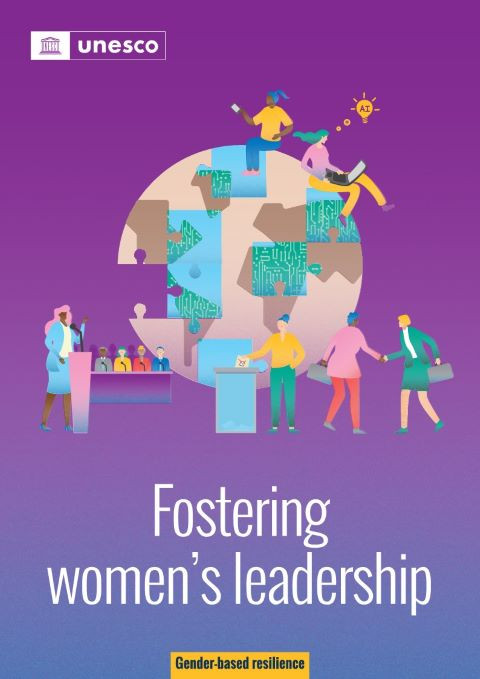 Fostering Women's Leadership Année de publication: 2024 Auteur: Mariagrazia Squicciarini | Anna Rita Manca | Garance Sarlat Auteur institutionnel: UNESCO No (leadership) share no gain (for societies and economies)! Leveraging UNESCO’s unique Gender-Based Resilience Framework, this report explores the role of women in leadership positions in both decision-making and high-tech, including in artificial intelligence-related innovations. It further highlights progress towards the G20 Brisbane Target, aimed to accelerate progress on gender equality by reducing the gender gap in labour market participation rates by 25% by 2025. Women remain underrepresented in decision-making, holding only about 26% of seats in national parliaments worldwide on average. In the world of work, female labour participation continues to lag behind men’s, at 47% for women against 72% for men on average. Despite progress by G20 members towards the Brisbane Target, a 2% average gap in absolute terms remained to be filled in 2022. In the high-tech world, women make up only 30% of AI professionals, and even less of leaders. Female inventors in AI account for about 37% of patents filed in 2022-23.
  파리협정 함께 보기 Année de publication: 2022 Auteur institutionnel: 대한민국 환경부 기후변화국제협력팀 | 한국환경공단 기후정책지원부 이 책자는 ‘파리협정(Paris Agreement)’에 대한 우리 국민의 이해를 높이고, 모든 사회 주체가 함께하는 파리협정 이행 체계를 조성하는데 도움이 되고자 제작되었습니다.이 책자는 환경부와 한국환경공단이 공동으로 발간한 「파리협정 길라잡이(’16.5)」와 「파리협정 이행규칙 안내서(’19.6)」를 통합·개정·증보한 것으로, 기존 발간 자료는 환경부 누리집(me.go.kr)>발행물>환경책자>알기쉬운 소책자에서 받아볼 수 있습니다. 발행처: 환경부 기후변화국제협력팀 (044-201-6601)발행일: 2022.3.31
 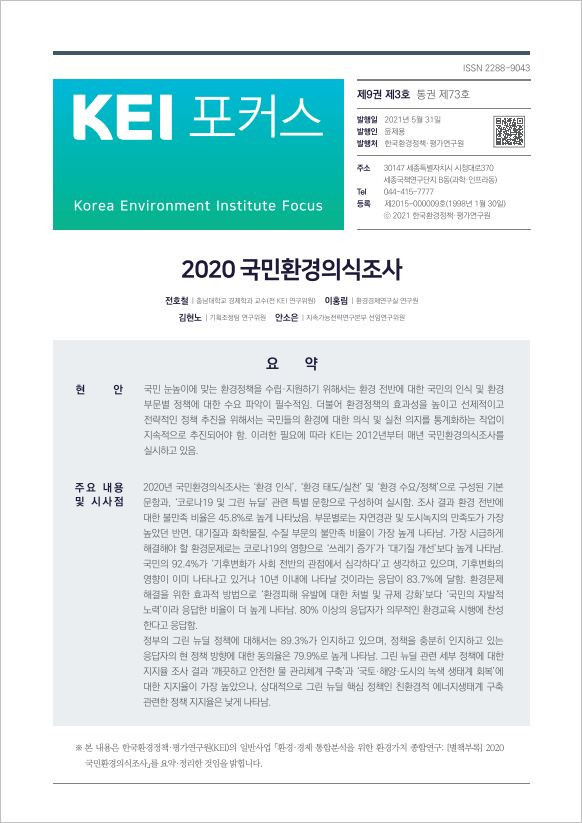 2020 국민환경의식조사 (KEI 포커스 제9권 통권 73호) Année de publication: 2021 Auteur: 전호철 | 이홍림 | 김현노 | 안소은 Auteur institutionnel: 한국환경정책·평가연구원 2020년 국민환경의식 조사는 '환경인식', '환경태도/실천' 및 '환경수요/정책/으로 구성된 기본 문항과 '코로나19 및 그린 뉴딜' 관련 특별 문항으로 구성하여 실시하였다. 조사 결과 환경 전반에 대한 불만족 비율은 45.8%로 높게 나타났으며 부문별로는 자연경관 및 도시녹지의 만족도가 가장 높았던 반면 대기질과 화학물질, 수질 부문의 불만족 비율이 가장 높게 나타났다. 가장 시급하게 해결해야 할 환경문제로는 코로나19의 영향으로 '쓰레기 증가'가 '대기질 개선' 보다 높게 나타났다. 본 저작물은 한국환경정책·평가연구원에서 2021년 작성하여 공공누리 제4유형으로 개방한 '2020 국민환경의식조사(작성자: 전호철)'을 이용하였으며, 해당 저작물은 한국환경연구원 홈페이지(https://www.kei.re.kr/)에서 무료로 내려받으실 수 있습니다.
 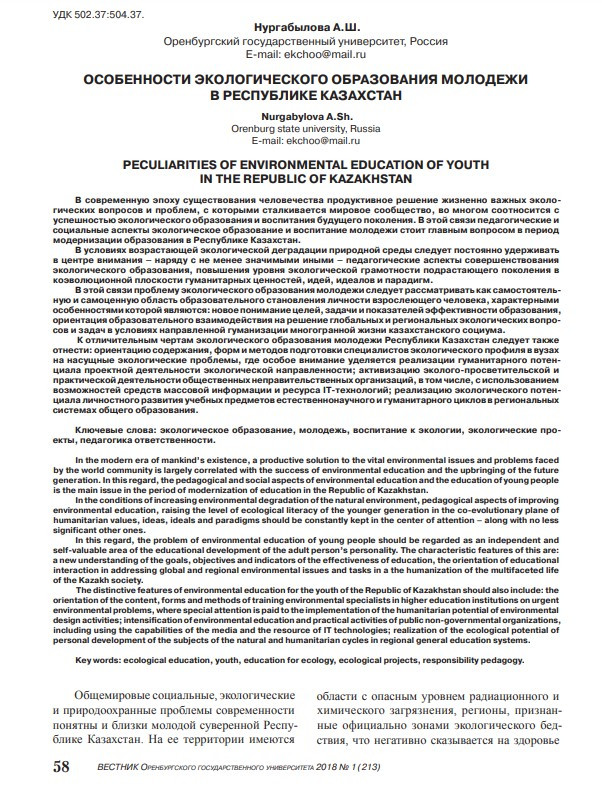 Peculiarities of Environmental Education of Youth in the Republic of Kazakhstan Année de publication: 2018 Auteur: Agila Sh. Nurgabylova In the modern era of mankind’s existence, a productive solution to the vital environmental issues and problems faced by the world community is largely correlated with the success of environmental education and the upbringing of the future generation. In this regard, the pedagogical and social aspects of environmental education and the education of young people is the main issue in the period of modernization of education in the Republic of Kazakhstan. Особенности экологического образования молодежи в республике Казахстан Année de publication: 2018 Auteur: Agila Sh. Nurgabylova В современную эпоху существования человечества продуктивное решение жизненно важных экологических вопросов и проблем, с которыми сталкивается мировое сообщество, во многом соотносится с успешностью экологического образования и воспитания будущего поколения. В этой связи педагогические и социальные аспекты экологическое образование и воспитание молодежи стоит главным вопросом в период модернизации образования в Республике Казахстан.
  Экологическое образование как составная часть содержания высшего образования (Международный журнал гуманитарных и естественных наук; № 5-2 (92), 2024) Année de publication: 2024 Auteur: Жээнбек Сейталиевич Абдиев В статье автор особо подчеркивает, что экологическое образование и воспитание не может быть эффективным, не формируя соответствующим образом экологического мировоззрения. В этом контексте главной парадигмой экологического образования и воспитания в Кыргызстане является формирование экологической культуры населения.
  Asia-Pacific Digital Transformation Report 2024: Digital Innovation for Smarter Climate Action Année de publication: 2024 Auteur institutionnel: UN. Economic and Social Commission for Asia and the Pacific (UN. ESCAP) In Asia and the Pacific, the climate crisis intersects with digital transformations through a complex mix of challenges and opportunities, creating a series of vicious but also potentially virtuous cycles. The Asia-Pacific Digital Transformation Report 2024 considers how digital transformations will structurally and irreversibly affect the trajectory of climate change. It presents a digital-growth-climate nexus to better understand the diverse and dynamic picture and considers ways in which the region can follow the most positive trajectory to avert a climate catastrophe. The Report showcases good practices and country examples of digital applications in addressing climate change, in terms of mitigation and adaptation. These can involve the use of artificial intelligence, the Internet of Things, big data, digital twins, geospatial technologies and others, which have been employed in infrastructure, government, mobility, industry and trade, digital data centres, disaster risk reduction, agriculture and biodiversity ecosystems. The Report then explores key drivers of digital transformation for climate change and outlines three future scenarios. It concludes with the key findings of the Report and proposes policy actions aligned with the five actors of the Digital Transformation Index Framework.
 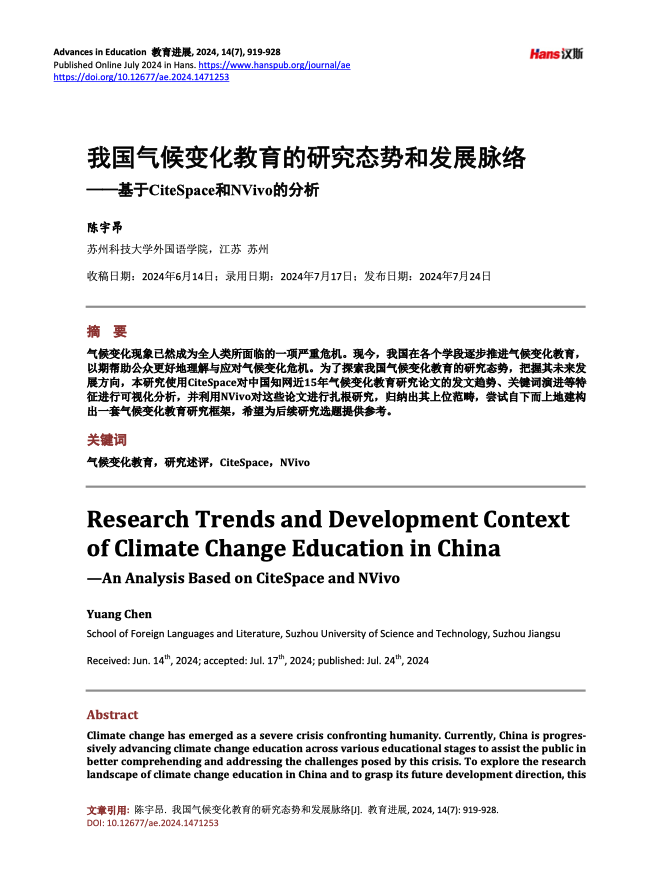 我国气候变化教育的研究态势和发展脉络 : 基于CiteSpace和NVivo的分析 (教育进展 第14卷 第7期) Année de publication: 2024 Auteur: 陈宇昂 气候变化现象已然成为全人类所面临的一项严重危机。现今,我国在各个学段逐步推进气候变化教育,以期帮助公众更好地理解与应对气候变化危机。为了探索我国气候变化教育的研究态势,把握其未来发展方向,本研究使用CiteSpace对中国知网近15年气候变化教育研究论文的发文趋势、关键词演进等特征进行可视化分析,并利用NVivo对这些论文进行扎根研究,归纳出其上位范畴,尝试自下而上地建构出一套气候变化教育研究框架,希望为后续研究选题提供参考。
  People's Climate Vote 2024 Année de publication: 2024 Auteur: Cassie Flynn | Silvia Tovar Jardon | Stephen Fisher | Matthew Blayney | Albert Ward | Hunter Smith | Paula Struthoff | Zoë Fillingham Auteur institutionnel: United Nations Development Programme (UNDP) | University of Oxford The Peoples’ Climate Vote is the world’s largest standalone public opinion survey on climate change. It serves as a platform for people to express their concerns and needs on climate change to world leaders. This initiative, carried out by UNDP and the University of Oxford, was launched in 2021 with a first poll that surveyed people across 50 countries through adverts in popular mobile gaming apps. The 2024 survey is bigger in terms of scope: 77 countries, representing 87 percent of the world’s population, were asked their views on climate change. The 15 questions in the 2024 edition have never been put to people in any survey before. They asked how people’s day-to-day lives are impacted by climate change, how they feel it is being addressed in their countries and what they would like the world to do about it. The results give the most comprehensive public account yet of how people feel and respond to climate change. The Peoples’ Climate Vote 2024 results come at a crucial time. Leading scientific bodies warn that climate change is accelerating faster than expected. Meanwhile, global GHG emission levels continue to rise, and international tensions and conflicts are similarly on the increase. With more than half of the world’s population potentially voting in 2024, understanding how citizens are thinking about climate change is more important than ever. The survey’s results can help decision makers navigate this challenging context, and beyond. To explore the data and country results in more detail, please visit: https://peoplesclimate.vote/
 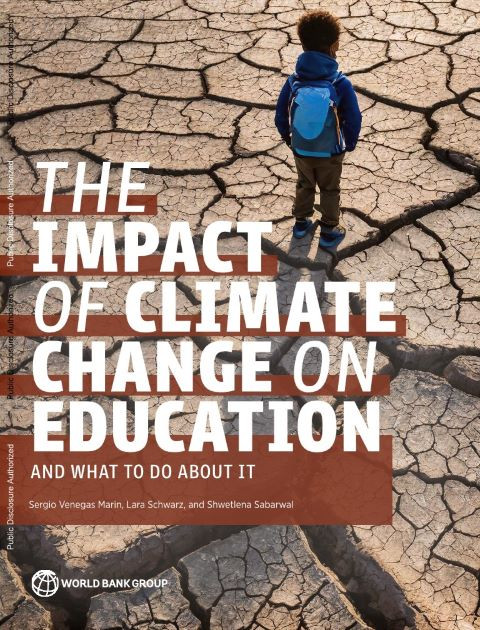 The Impact of Climate Change on Education and What to Do about It Année de publication: 2024 Auteur: Sergio Venegas Marin | Lara Schwarz | Shwetlena Sabarwal Auteur institutionnel: International Bank for Reconstruction and Development | World Bank Education can be the key to ending poverty in a livable planet, but governments must act now to protect it. Climate change is increasing the frequency and intensity of extreme weather events such as cyclones, floods, droughts, heatwaves and wildfires. These extreme weather events are in turn disrupting schooling; precipitating learning losses, dropouts, and long-term impacts. Even if the most drastic climate mitigation strategies were implemented, extreme weather events will continue to have detrimental impacts on education outcomes.