
Ressources
Explorez une large gamme de ressources sur le GCED afin d’approfondir votre compréhension et de renforcer vos activités de recherche, de plaidoyer, d’enseignement et d’apprentissage.
1,852 résultats trouvés
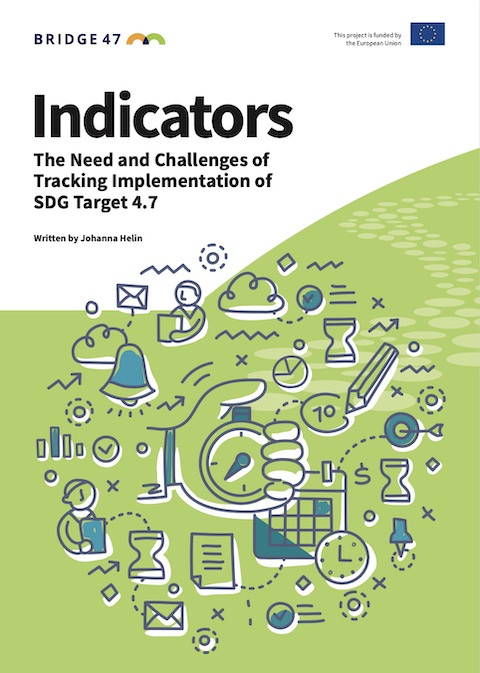 Indicators: The Need and Challenges of Tracking Implementation of Target 4.7 Année de publication: 2021 Auteur: Johanna Helin Auteur institutionnel: Bridge 47 This paper investigates the existing and proposed indicators and monitoring frame- works for 4.7. Examining efforts at national, regional, and global levels will identify the main challenges in measurement initiatives. The paper will start by looking at the context of SDGs and the special character of Target 4.7. Thereafter, it will discuss the process and limitations of defining the indicators at the global level. It will also review regional developments, tools, and ideas for national and local level assessment frameworks in Asia-Pacific and Europe. The paper ends with conclusions and policy recommendations.
  Resources: For SDG Target 4.7 Année de publication: 2021 Auteur: Sandra Oliveira Auteur institutionnel: Bridge 47 This paper is part of a series of publications commissioned to support advocacy for more space for SDG Target 4.7 of Agenda 2030 in European and global policies. In November 2019, Bridge 47 organised an event called Envision 4.7, which brought together civil society organisations, national governments, MEPs, European and global organisations, and together wrote a Roadmap for SDG Target 4.7 for Europe.Focusing on the key themes of this Envision 4.7 Roadmap and drawing on the Envision 4.7. policy papers as key references, this paper focuses on providing a global overview and identification of the types of resources re- quired to achieve this target.\
 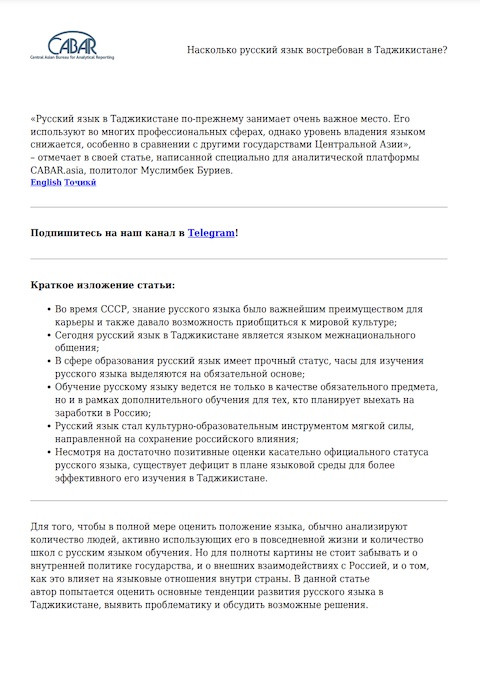 How Popular Is The Russian Language In Tajikistan? Année de publication: 2019 Auteur: Muslimbek Buriev Auteur institutionnel: Central Asian Bureau for Analytical Reporting (CABAR) | Institute for War and Peace Reporting (IWPR) «Russian language still occupies in Tajikistan a very important place. It is used in many professional spheres, but the proficiency level is being reduced in comparison with other Central Asian countries», -notes a political analyst Muslimbek Buriev in his article written specifically for analytical platform CABAR.asia. Насколько русский язык востребован в Таджикистане? Année de publication: 2019 Auteur: Muslimbek Buriev Auteur institutionnel: Central Asian Bureau for Analytical Reporting (CABAR) | Institute for War and Peace Reporting (IWPR) «Русский язык в Таджикистане по-прежнему занимает очень важное место. Его используют во многих профессиональных сферах, однако уровень владения языком снижается, особенно в сравнении с другими государствами Центральной Азии», – отмечает в своей статье, написанной специально для аналитической платформы CABAR.asia, политолог Муслимбек Буриев.
 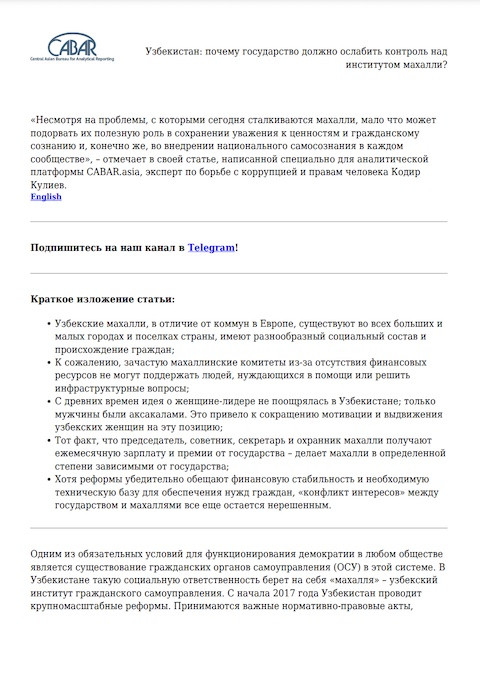 Uzbekistan: Why Should the State Weaken Control Over the Institute of Makhalla? Année de publication: 2019 Auteur: Kodir Kuliev Auteur institutionnel: Central Asian Bureau for Analytical Reporting (CABAR) | Institute for War and Peace Reporting (IWPR) One of the vital conditions for the functioning of democracy in any society is the existence of citizens’ self-governing bodies (CSB) within that system. In Uzbekistan, such social responsibility is assumed by “mahalla” – the Uzbek citizens’ self-governing institution. Since the beginning of 2017 Uzbekistan has been carrying out large-scale reforms. Important laws and regulations are being adopted, which should create favorable conditions for quality life and ensure freedom for the Uzbek people. With mahallas, however, such positive change in the long-run seems to be just a lip-service. The main challenges mahallas are facing today are, inter alia, obscured freedom they have in ruling themselves and controlling their own affairs and incapability to effectively tackle citizens’ problems, thus leaving people’s trust unjustified. Узбекистан: Почему государство должно ослабить контроль над институтом махалли? Année de publication: 2019 Auteur: Kodir Kuliev Auteur institutionnel: Central Asian Bureau for Analytical Reporting (CABAR) | Institute for War and Peace Reporting (IWPR) Одним из обязательных условий для функционирования демократии в любом обществе является существование гражданских органов самоуправления (ОСУ) в этой системе. В Узбекистане такую социальную ответственность берет на себя «махалля» – узбекский институт гражданского самоуправления. С начала 2017 года Узбекистан проводит крупномасштабные реформы. Принимаются важные нормативно-правовые акты, которые должны создать благоприятные условия для качественной жизни и обеспечить свободу узбекскому народу. Однако с махаллей такое положительное изменение в долгосрочной перспективе кажется неоднозначным. Основные проблемы, с которыми сегодня сталкиваются махалли – это ограниченная свобода и контроль собственных дел и неспособноть эффективно решать проблемы граждан, что не оправдывает доверия людей.
 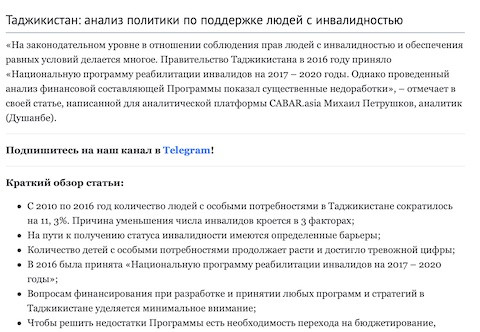 Tajikistan: Policy Analysis to Support Persons with Disabilities Année de publication: 2018 Auteur: Mikhail Petrushkov Auteur institutionnel: Central Asian Bureau for Analytical Reporting (CABAR) | Institute for War and Peace Reporting (IWPR) “Much is being done at the legislative level with regard to the observance of the rights of people with disabilities and ensuring equal conditions. In 2016, the Government of Tajikistan adopted the National Program for the Rehabilitation of Persons with Disabilities for 2017-2020. However, the analysis of the financial component of the Program showed significant shortcomings, ”says Mikhail Petrushkov, an analyst (Dushanbe), in his article written for the analytical platform CABAR.asia.
  [Résumé] La crise climatique est une crise des droits de l’enfant: Présentation de l’indice des risques climatiques pour les enfants Année de publication: 2021 Auteur: Nicholas Rees | Margaretha Barkhof | Jan Burdziej | Sophie Lee | Harriet Riley Auteur institutionnel: United Nations Children's Fund (UNICEF) La crise climatique est une crise des droits de l’enfant. Les canicules, les incendies et les inondations sans précédent qui viennent de frapper plusieurs pays sont annonciateurs d’une nouvelle normalité climatique particulièrement hostile. L’impact des changements climatiques est connu de tous. Les solutions le sont également. Il est inadmissible que les enfants et les jeunes d’aujourd’hui soient confrontés à un avenir aussi incertain. Partout dans le monde, à travers des manifestations, des interventions sur les réseaux sociaux et un engagement communautaire et citoyen, les enfants et les jeunes revendiquent haut et fort le changement. Les modi operandi classiques ont fait long feu. Le présent rapport s’appuie sur l’Indice des risques climatiques pour les enfants (IRCE) pour fournir un premier aperçu de l’exposition et de la vulnérabilité des enfants aux effets des changements climatiques.
  Reimagining Climate Education and Youth Leadership: Survey Report Année de publication: 2021 Auteur: Lucia Rost | Jessica Cooke | Isobel Fergus Auteur institutionnel: Plan International Climate change is a social, intergenerational, gender, and racial injustice. Plan International aims to support children and youth to meaningfully and safely engage in climate policy processes and to reduce the barriers preventing them from engaging in and influencing climate policy and advocacy.With this in mind, Plan International conducted a global online survey to capture the opinions and experiences of young people on climate change education and their participation in climate policy processes. The survey was available in seven languages and was open to 15 to 24-year- olds in all 77 countries where Plan International operates. Over 1,800 adolescents and youth, between the ages of 15 to 24, from 37 countries, participated: more than half (54 per cent) were 15 to 18 years old and 72 per cent were girls. Reimagining Climate Education and Youth Leadership: Survey Report Année de publication: 2021 Auteur: Lucia Rost | Jessica Cooke | Isobel Fergus Auteur institutionnel: Plan International El cambio climático es una injusticia social, intergeneracional, racial y de género. Plan International tiene como objetivo ayudar a las niñas, niños y jóvenes a involucrarse de manera significativa y segura en los procesos de formulación de políticas climáticas, así como eliminar los obstáculos que les impiden participar e influir en las políticas y las actividades de promoción relacionadas con el cambio climático. Plan International realizó una encuesta on line a nivel mundial para recopilar las opiniones y las experiencias de jóvenes sobre la educación en materia de cambio climático y su participación en los procesos de formulación de políticas climáticas. La encuesta se ofreció en siete idiomas y estuvo abierta a jóvenes de 15 a 24 años en los 77 países donde trabaja Plan International. En esta encuesta, participaron más de 1800 adolescentes y jóvenes, con edades comprendidas entre los 15 y los 24 años, y procedentes de 37 países: más de la mitad de las personas (54 %) tenían entre 15 y 18 años, y el 72 % eran niñas.