
Ressources
Explorez une large gamme de ressources sur le GCED afin d’approfondir votre compréhension et de renforcer vos activités de recherche, de plaidoyer, d’enseignement et d’apprentissage.
1,828 résultats trouvés
 Декларация молодежи о трансформации образования Année de publication: 2022 Auteur institutionnel: United Nations (UN) Принята Молодежная декларация о преобразовании образования. Это документ, подготовленный молодыми людьми со всего мира и представленный в пятницу Генеральному секретарю ООН.Эта декларация представляет собой вклад молодежи в Саммит по преобразованию образования 2022 года. В нем подчеркивается коллективная приверженность молодых людей преобразованию образования. 教育变革青年宣言 Année de publication: 2022 Auteur institutionnel: United Nations (UN) 《关于教育转型的青年宣言》已经发布。 这是一份由来自世界各地的年轻人准备的文件,并于周五提交给联合国秘书长。该宣言是青年对 2022 年转型教育峰会的投入。它突出了年轻人对转型教育的集体承诺。
  Some Features of the Gender Orientation of the Social Policy of the Central Asian Countries Année de publication: 2017 Auteur: A.D. Bekebaeva The article examines the gender-oriented social policy of Central Asian countries, its origins, features and disadvantages. Special attention is paid to the common Soviet past of the countries studied, since this period left a major imprint on the current state of gender issues in the region. Некоторые особенности гендерной ориентации социальной политики стран центральной Азии Année de publication: 2017 Auteur: A.D. Bekebaeva В статье рассматривается гендерно ориентированная социальная политика стран Центрльной Азии, ее истоки, особенности и недостатки. особое внимание уделено общему советскому прошлому исследуемых стран, так как этот период наложил основной отпечаток на современное состояние гендерных проблем в регионе.
 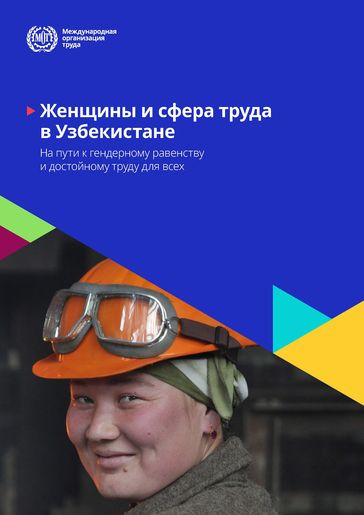 Women and the World of Work in Uzbekistan. Towards Gender Equality and Decent Work for All Année de publication: 2021 Auteur: Mansour Omeira Auteur institutionnel: International Labour Organization (ILO) The report is a response to the need for a comprehensive analysis of the situation of women in the labor sphere of Uzbekistan. The purpose of the report is to provide information for the development of policies, legislation, and initiatives aimed at the development and promotion of decent work for all women and men. Женщины и сфера труда в Узбекистане: На пути к гендерному равенству и достойному труду для всех Année de publication: 2021 Auteur: Mansour Omeira Auteur institutionnel: International Labour Organization (ILO) Доклад является ответом на необходимость всестороннего анализа положения женщин в сфере труда Узбекистана. Цель доклада – предоставление информации для разработки политики, законодательства и инициатив, направленных на развитие и продвижение достойного труда для всех женщин и мужчин.
  Juvenile Justice: Analysis of Legislation and Judicial Practice of the Republic of Uzbekistan Année de publication: 2015 Auteur institutionnel: UNICEF Uzbekistan This publication was prepared within the framework of cooperation between UNICEF, the Supreme Court of the Republic of Uzbekistan, and the Research Center on Democratization and Liberalization of Judicial Legislation and Ensuring the Independence of the Judicial System under the Supreme Court of the Republic of Uzbekistan. This report contains an analysis of the current legislation and judicial practice on the administration of juvenile justice for compliance with international standards and best practices. Правосудие в отношении несовершеннолетних: Анализ законодательства и судебной практики Республики Узбекистан Année de publication: 2015 Auteur institutionnel: UNICEF Uzbekistan Данная публикация подготовлена в рамках сотрудничества между ЮНИСЕФ, Верховным судом Республики Узбекистан и Исследовательским центром по демократизации и либерализации судебного законодательства и обеспечению независимости судебной системы при Верховном суде Республики Узбекистан. Данный отчет содержит анализ действующего законодательства и судебной практики по отправлению правосудия в отношении несовершеннолетних на предмет соответствия международным стандартам и передовой практике.
 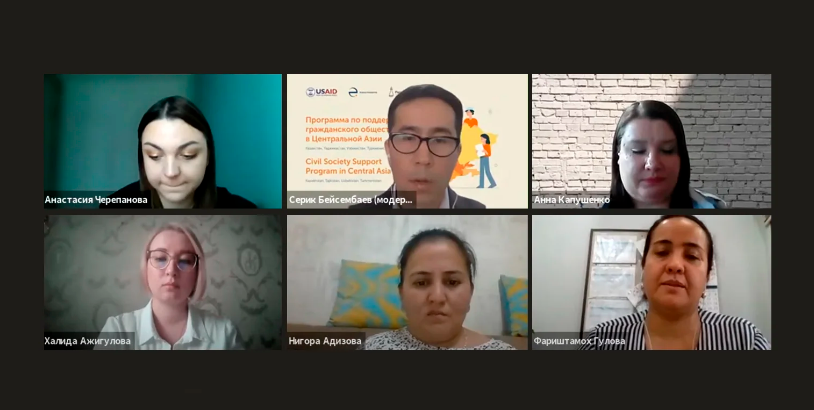 Combating Violence Against Women in Central Asia: New Laws, Old Practices Année de publication: 2021 Auteur institutionnel: Paperlab Research Center (Kazakhstan) The problem of violence against women is still acute in Central Asian countries. According to the UN, 18% of women from the countries of this region reported that they had personally experienced domestic violence and discrimination. At the PaperLab online discussion platform, experts and researchers, together with representatives of civil society and government agencies, discussed the topic of combating gender-based violence in the context of legislative and programmatic measures that are being implemented in Central Asian countries.
 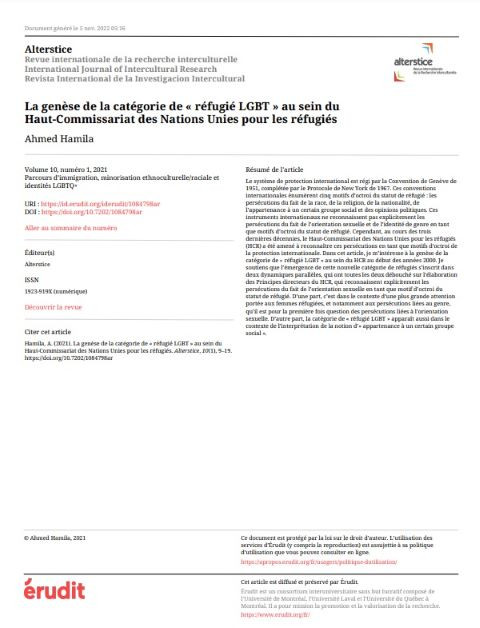 The Genesis of the Category of “LGBT Refugee” Within the United Nations High Commissioner for Refugees Année de publication: 2021 Auteur: Ahmed Hamila Auteur institutionnel: Alterstice The international protection system is governed by the Geneva Convention of 1951, supplemented by the New York Protocol of 1967. These international conventions list five grounds for granting refugee status: persecution based on race, religion, nationality, membership of a certain social group, and political opinions. These international instruments do not explicitly recognize persecution based on sexual orientation and gender identity as grounds for granting refugee status. However, over the past three decades, the Office of the United Nations High Commissioner for Refugees (UNHCR) has come to recognize such persecution as grounds for granting international protection. In this article, I focus on the genesis of the "LGBT refugee" category within the UNHCR in the early 2000s. The essay argue that the emergence of this new category of refugees is part of two parallel dynamics, which both led to the development of the UNHCR Guidelines, which explicitly recognize persecution based on sexual orientation as a ground for granting refugee status. On the one hand, it is in the context of greater attention paid to refugee women, and in particular to gender-related persecutions, that persecutions related to sexual orientation are for the first time discussed. On the other hand, the category of “LGBT refugee” also appears in the context of the interpretation of the notion of “belonging to a certain social group”.