
Ressources
Explorez une large gamme de ressources sur le GCED afin d’approfondir votre compréhension et de renforcer vos activités de recherche, de plaidoyer, d’enseignement et d’apprentissage.
1,828 résultats trouvés
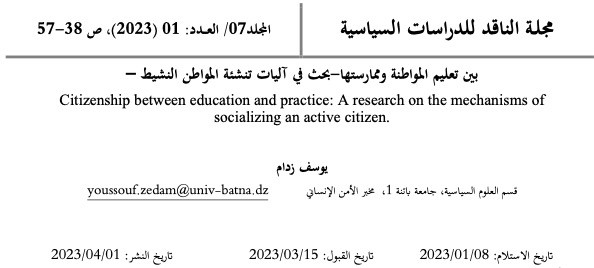 Citizenship Between Education and Practice: A Research on the Mechanisms of Training an Active Citizen (vol.7, no.1; Al-Naqid Journal for Political Studies) Année de publication: 2023 Auteur: Yusuf Zadam Auteur institutionnel: Mohamed Khider University of Biskra The study delves into the relationship between citizenship and education, aiming to understand the mechanisms for fostering an engaged citizenry. It argues that merely educating individuals about citizenship is insufficient; rather, democracy must be practiced within the diverse institutions, processes, and behaviors within the school. As such, the study elucidates the characteristics of the ideal citizen and desired citizenship, emphasizing the distinction between an 'active citizen' and a 'passive recipient.' Additionally, it explores the transition from citizenship education to a comprehension of democracy. The findings reveal that the school serves as a crucial arena shaping both active citizens and passive recipients. Therefore, the dynamics among various actors within the school environment significantly influence the type of citizen produced.
 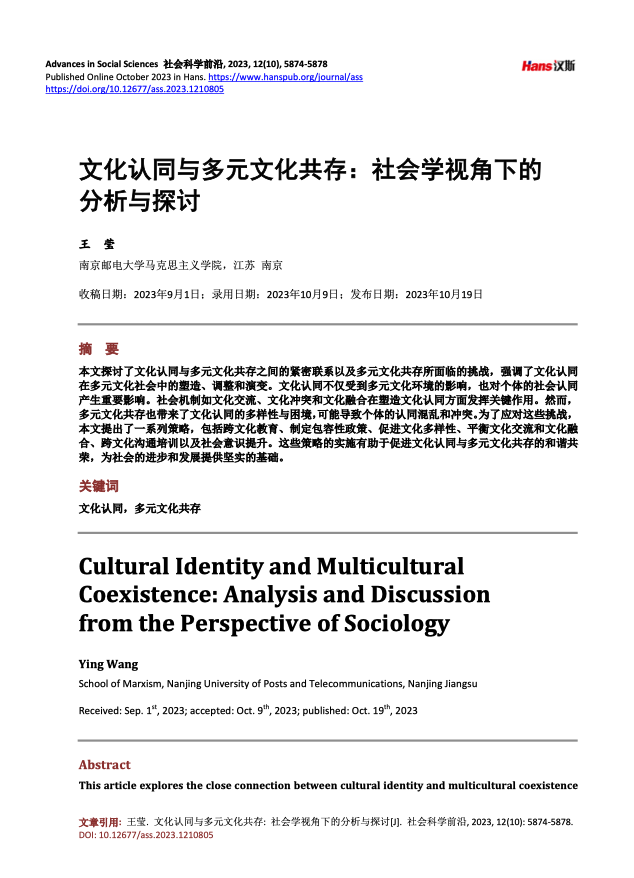 文化认同与多元文化共存:社会学视角下的分析与探讨 (社会科学前沿 第12卷 第10期) Année de publication: 2023 Auteur: 王莹 本文探讨了文化认同与多元文化共存之间的紧密联系以及多元文化共存所面临的挑战,强调了文化认同在多元文化社会中的塑造、调整和演变。文化认同不仅受到多元文化环境的影响,也对个体的社会认同产生重要影响。社会机制如文化交流、文化冲突和文化融合在塑造文化认同方面发挥关键作用。然而,多元文化共存也带来了文化认同的多样性与困境,可能导致个体的认同混乱和冲突。为了应对这些挑战,本文提出了一系列策略,包括跨文化教育、制定包容性政策、促进文化多样性、平衡文化交流和文化融合、跨文化沟通培训以及社会意识提升。这些策略的实施有助于促进文化认同与多元文化共存的和谐共荣,为社会的进步和发展提供坚实的基础。
  Inteligencia artificial y democracia Année de publication: 2024 Auteur: Daniel Innerarity Auteur institutionnel: UNESCO Montevideo | Latin American Council of Social Sciences (CLACSO) La Recomendación sobre la ética de la inteligencia artificial de la UNESCO, aprobada por todos los Esta- 1 dos miembros en noviembre de 2021, es el primer marco político global para la inteligencia artificial (IA) y señala diversos aspectos de esta tecnología que tienen impacto directo en la vida política. En sus consideraciones iniciales alude a sus posibles efectos en diversos ámbitos y, concretamente, en la de- mocracia. El presente informe pretende ampliar y concretar esos análisis y recomendaciones, desde los valores y principios de la Recomendación, poniendo foco en el impacto que la inteligencia artificial tie- ne y puede tener en la democracia, así como en las virtualidades que tanto la IA como la digitalización en general pueden tener en la mejora de los procedimientos de toma de decisión colectiva. Para abordar esta temática se plantean cuatro grandes asuntos:1. Las expectativas y las decepciones democráticas de la digitalización A modo de introducción se presentarán las principales demandas y expectativas sociales respecto al impacto de la digitalización en la democracia que se han ido configurando en los últimos años, tanto por personas expertas como por la opinión pública en general.2. El nuevo espacio público digital: la conversación democrática La democracia requiere de una conversación social de calidad y un espacio público que reúna deter- minadas propiedades, sin las cuales la democracia no puede sobrevivir o se verá debilitada. En este documento se abordarán las características de esta necesaria conversación en el entorno digital, se identificarán los problemas subyacentes y se propondrán posibles medidas para mejorarla.3. La democracia de los datos: la política del big data Los tres elementos que modificarán la política de este siglo son los sistemas cada vez más inteligentes y automatizados, una tecnología más integrada e interoperable y una sociedad más cuantificada. Si bien los datos son fundamentales para el gobierno de la sociedad, el documento se preguntará críticamente por la dimensión política y democrática de la big data.4. La democracia como forma de decisión política: gobernanza algorítmica La democracia es una forma de decisión colectiva. El documento examinará la compatibilidad de la proliferación de sistemas automáticos de decisión con los principios normativos del autogobierno de- mocrático. El incremento de la gobernanza algorítmica plantea diversos problemas y desafíos para la democracia, principalmente la identificación de las tareas que pueden ser resueltas por un algoritmo sin dañar los valores democráticos y el conjunto de condiciones que asegurarían esa compatibilidad. Por último, se efectuarán algunas recomendaciones para la gobernanza democrática de la inteli- gencia artificial para evitar o mitigar los impactos negativos y hacer que la gobernanza de la inteligen- cia artificial sea más democrática.
  Inteligencia Artificial centrada en los Pueblos Indígenas: Perspectivas desde América Latina y el Caribe Année de publication: 2023 Auteur: Luz Elena González Zepeda | Cristina Elena Martínez Pinto Auteur institutionnel: UNESCO Montevideo Este reporte es una invitación para entender la necesidad de una IA participativa que respete y se enriquezca con la diversidad cultural, convirtiéndose en una herramienta para el desarrollo sostenible y la promoción de libertades fundamentales.Se presenta como un llamado a la acción para incorporar activa y respetuosamente las perspectivas de los pueblos indígenas en la IA, apuntando hacia una futura sabiduría colectiva que honre la riqueza de las experiencias y conocimientos humanos.Todo esto, sobre la base de la Recomendación sobre la Ética en la Inteligencia Artificial de la UNESCO, que funciona como una brújula de orientación ética y un cimiento normativo mundial, que permitirá desarrollar IA al servicio de la sociedad, con especial énfasis a los grupos poblacionales más vulnerables, y respetuosa de los derechos humanos.
  Transformative pedagogy for learning to live together in Southern Africa: a practical guide Année de publication: 2022 Auteur institutionnel: UNESCO International Institute for Capacity-Building in Africa (IICBA) IntroductionEducation is a powerful force for peacebuilding and transformation: it can contribute to changing individuals and communities, promoting a more just and equitable world fostering inclusion, social cohesion and ultimately contributing to creating peaceful societies. Teachers play a central role in the establishment of knowledge, attitudes and values among young people; they also empower them to propose alternative narratives, to engage with their communities and to contribute to building peaceful societies through their actions.This work can be done through subject areas, e.g., history, civic and moral education, art, music, sports etc., or through dedicated subjects. In any case, there is a need to equip teachers with specific skills and knowledge and this guide can also be used in science subjects.This work cannot begin or take place in the school environment only. It is important to establish a continuum between the school and its surrounding environment. This requires knowledge of the local context and mobilization of organizations and/or community stakeholders. All these aspects are building blocks of transformative pedagogy, which is the central element of this Guide. Chapter One provides concrete elements of analysis to help understand violence and its root causes in the SADC region and to identify prevention strategies. Chapter Two discusses the importance of education, highlighting key elements that contribute to education for peace building and transformation. Chapter Three focuses on the importance of fostering ethical reflections as spaces for dialogue and identity building to develop a sense of purpose and belonging. Chapter Four provides concrete approaches for teachers to adopt Transformative Pedagogy .Chapter Five highlights core competences for Learning to Live Together understood as the combination of knowledge, skills and attitudes essential to promote mutual understanding and social cohesion (the core competencies presented do not constitute an exhaustive list). Chapter Six discusses learners empowerment and participation in community engagement, equipping teachers with concrete tools and approaches to support learners as active change-makers to transform their communities. Chapter seven focuses on assessment as a key component of the transformative learning process allowing both teachers and learners to self-reflect, make connections, understand where they are in the learning process, how they arrived there and what questions they may still have. Chapter Eight introduces concrete activities for learners that can inspire teachers, as well as provide some ideas of initiatives that can be organised. A table at the beginning of Chapter Eight connects the relevant contents of the Guide with each activity presented.
  Harnessing the Power of the Social and Human Sciences to Shape Inclusive, Sustainable, and Just Societies in South-East Asia: A Position Paper Année de publication: 2023 Auteur: Phinith Chanthalangsy Auteur institutionnel: UNESCO Bangkok This paper provides an overview of the Social and HumanSciences (SHS) Unit, UNESCO Regional Office in Bangkok holisticapproach to building a more just and fair society for all in theSouth-East Asian region toward 2030 and beyond. The paperprovides two sections focused on thechallengesidentified in theregion and some potentialpathways for the future, from thepoint of view of UNESCO’s Social and Human Sciences Sector. The content of this paper has been discussed with aregionalexpert consultative group that gathered in Bangkok during aMOST regional Conference on 22–23 June 2023. The paper offersgrounds forstrategic orientations and partnershipsin keydomains where UNESCO's expertise in the social and humansciences can make a difference in South-East Asia
  Reimagining Education: The International Science and Evidence Based Education Assessment; Summary for Decision Makers (SDM) Année de publication: 2022 Auteur: Anantha Kumar Duraiappah | Nienke M. van Atteveldt | Joanne Marieke Buil | Kriti Singh | Rongxiu Wu Auteur institutionnel: Mahatma Gandhi Institute of Education for Peace and Sustainable Development (MGIEP) The International Science and Evidence Based Education (ISEE) Assessment is an initiative of the UNESCO Mahatma Gandhi Institute of Education for Peace and Sustainable Development (MGIEP), and is its contribution to the Futures of Education process launched by UNESCO Paris in September 2019. In order to contribute to re-envisioning the future of education with a science and evidence based report, UNESCO MGIEP embarked on the first-ever large scale assessment of knowledge of education.
  유네스코 미래담론 연구 Année de publication: 2023 Auteur: 전상인 | 김두환 | 박범순 | 한준 | 박남기 | 백영연 Auteur institutionnel: 유네스코한국위원회 이 보고서는 미래문해력 증진을 위한 기초연구이다. 한국의 미래가 주요 관심이나, 이는 인류 전체의 미래에 대한 통찰과도 무관하지 않을 것이다. 이 보고서에서는 미래를 ‘한 세대’에 해당하는 향후 30년 정도로 상정했다. 먼저 유관 전문가들이 교육과 문화, 과학 및 커뮤니케이션 영역에서 각각 어떤 변화를 예상하는지를 검토했다. 이를 바탕으로 보통의 한국인이 해당 영역의 미래를 어떻게 인식하고 있는지를 살펴보기 위해 전국적 설문조사가 필요하다고 판단하여, 이를 위한 설문조사 문항 초안을 제안했다. 만약 후속 연구로서 이와 같은 설문조사가 이루어진다면 미래문해에 대한 전문가와 일반인들의 공통점 및 차이점을 드러낼 수 있을 것이며, 경우에 따라 외국의 미래문해 현황과의 비교도 가능할 것이다. 궁극적으로는 한국사회의 미래문해력 증진을 위한 정책적 노력에도 일조하게 될 것이다.
  Gender Mainstreaming in Water Governance in Central Asia Année de publication: 2020 Auteur institutionnel: Organization for Security and Co-operation in Europe (OSCE) The OCEEA has developed this guide on gender mainstreaming in water management in Central Asia for water professionals in the region. Consideration of minor aspects in the management of increased water content and increased sensitivity, since it can manifest itself as higher sensitivity and a decrease in social disproportion. When women and men equally decide how water is used, it becomes more toxic and more exposed to the needs of the population. Учет гендерных факторов в управлении водными ресурсами в Центральной Азии Année de publication: 2020 Auteur institutionnel: Organization for Security and Co-operation in Europe (OSCE) БКЭЭД разработало это руководство по учету гендерной проблематики в управлении водными ресурсами в Центральной Азии для специалистов-водников региона. Учет гендерных аспектов в управлении водными ресурсами способствует стабильности и безопасности, поскольку может привести к более эффективной политике и уменьшить социальные диспропорции и напряженность. Когда женщины и мужчины в равной степени принимают решение о том, как использовать воду, решения становятся более целенаправленными и в большей степени отражают потребности всего населения.