
Ressources
Explorez une large gamme de ressources sur le GCED afin d’approfondir votre compréhension et de renforcer vos activités de recherche, de plaidoyer, d’enseignement et d’apprentissage.
1,828 résultats trouvés
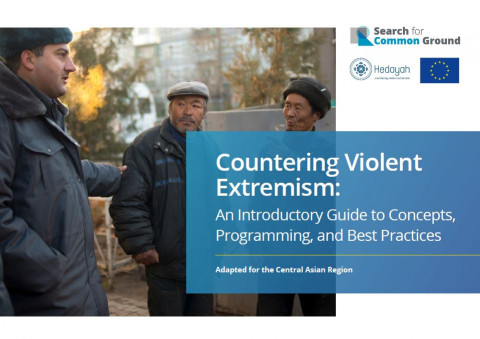 Countering Violent Extremism: An Introductory Guide to Concepts, Programming, and Best Practices Année de publication: 2019 Auteur institutionnel: Search for Common Ground This curriculum aims to update the best practices and experience gained in the process of countering violent extremism. The anti-violent extremism program, adapted for Central Asia, is designed to train civil servants and civil society organizations. This curriculum delivers a contextually literate countering violent extremism and awareness-raising training program that is relevant to your context in an accessible way. It highlights the benefits of collaborative approaches beyond the use of military or securitized responses to violent extremism, drawing on good practices, and offers tools and guidance for easy adaptation to your local context and cultures. Finally, it encourages the early identification and mitigation of risks with programming, as well as ensuring a Do No Harm approach.While this curriculum will offer guidance around how to design, implement, and monitor constructive responses to violent extremism, an understanding of project management is assumed. Therefore, it is not a training program on general project management skills, monitoring and evaluation, or on fundraising.Since the problem of violent extremism is complex and highly context-specific, it is also not a guide to the drivers of violent radicalization in your local context, nor does it proscribe the programs and policies that would be most effective. Instead, it introduces you to the guiding questions and tools necessary to make informed and effective choices in your own efforts to counter violent extremism.
 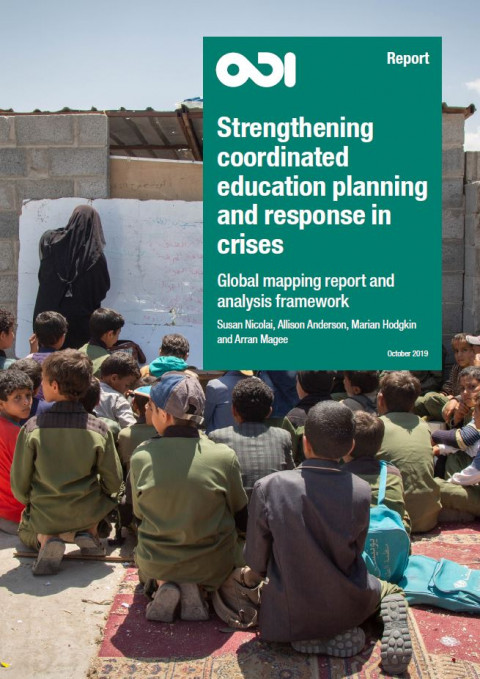 Strengthening Coordinated Education Planning and Response in Crises: Global Mapping Report and Analysis Framework Année de publication: 2019 Auteur: Susan Nicolai | Allison Anderson | Marian Hodgkin | Arran Magee Auteur institutionnel: Overseas Development Institute (ODI) This report presents a framework for analysis of formal coordination approaches for education planning and response in emergencies and protracted crises. It reviews concepts and definitions of coordination, approaches and structures for coordinated planning and response, and expected outcomes of these processes, with a focus on humanitarian structures across the humanitarian–development nexus.It is part of a set of publications produced in partnership with the Global Education Cluster, the Inter-Agency Network for Education in Emergencies and UNHCR – the UN Refugee Agency – with funding from the Education Cannot Wait Fund. The conceptual framework and set of research questions that emerge from this report is applied to six country case studies, which will be published in December 2019.
 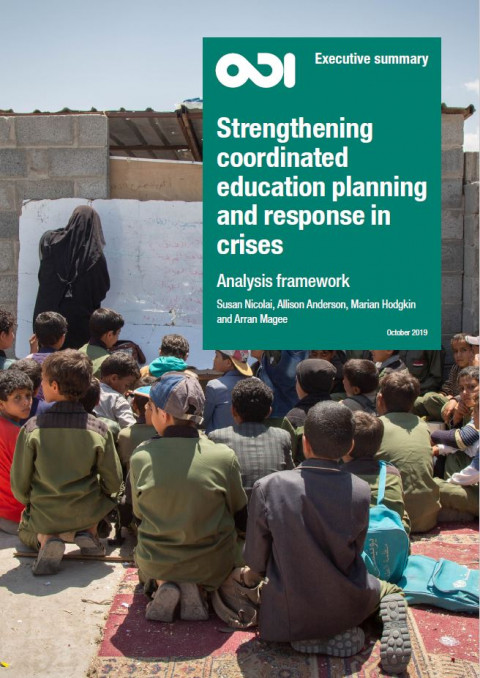 [Summary] Strengthening Coordinated Education Planning and Response in Crises: Analysis Framework; Executive Summary Année de publication: 2019 Auteur: Susan Nicolai | Allison Anderson | Marian Hodgkin | Arran Magee Auteur institutionnel: Overseas Development Institute (ODI) This report presents a framework for analysis of formal coordination approaches for education planning and response in emergencies and protracted crises. It reviews concepts and definitions of coordination, approaches and structures for coordinated planning and response, and expected outcomes of these processes, with a focus on humanitarian structures across the humanitarian–development nexus. The main types of formal education coordination groups include Education Clusters, Refugee Education Working Groups and Local Education Groups (LEGs). These often have different purposes and organisations associated with them, sometimes resulting in overlaps and gaps in coordination efforts. Противодействие насильственному экстремизму: Вводное руководство по концепциям, разработке программ и передовой практике Année de publication: 2019 Auteur institutionnel: Search for Common Ground Данная учебная программа направлена актуализацию передовых методов и опыта, накопленного в процессе противодействия насильственному экстремизму. Программа по противодействию насильственному экстремизму, адаптированная для Центральной Азии, предназначена для подготовки государственных служащих и работников из организаций гражданского общества. Это контекстуально грамотная и удобная для восприятия учебная программа по противодействию насильственному экстремизму и повышению осведомленности, учитывающая вашу специфику. В ней освещаются преимущества подходов к сотрудничеству, выходящих за рамки применения военных или секьюритизированных мер реагирования на насильственный экстремизм и подкрепленных передовой практикой, а также предлагаются инструменты и рекомендации для простойадаптации к вашим локальным условиям и культуре. Наконец, программа способствует раннему выявлению и смягчению рисков посредством разработки программ, а также использования подхода «Не навреди» (Do No Harm).Данная программа предлагает руководство по разработке, реализации и мониторингу конструктивных мер противодействия насильственному экстремизму, при этом также давая общее представление об управлении проектами. Таким образом, данная учебная программа не направлена на развитие общих навыков управления проектами, мониторинга и оценки или на привлечение средств. Поскольку проблема насильственного экстремизма сложна и в значительной степени зависит от локального контекста, программа также не является руководством по движущим силам радикализации в вашем местном контексте и не предлагает программы и политику, которые могли бы быть наиболее эффективными. Вместо этого программа познакомит вас с наводящими вопросами и инструментами, необходимыми для принятия обоснованных и эффективных решений в вашей работе по противодействию насильственному экстремизму.
 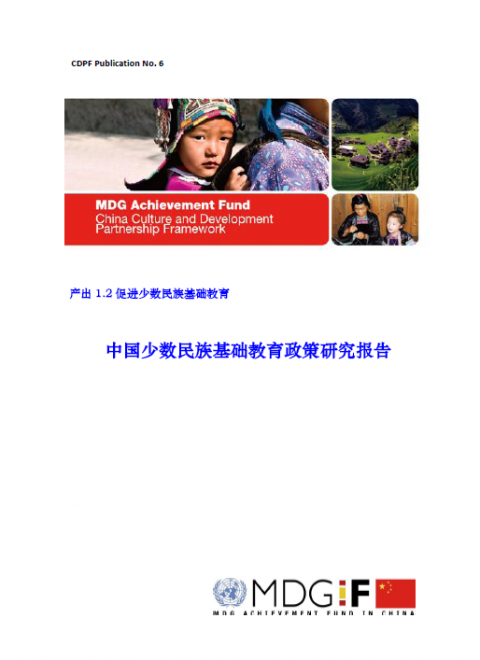 中国少数民族基础教育政策研究报告 Année de publication: 2010 Auteur institutionnel: UNESCO Beijing 本报告是在“提高少数民族群体的受教育程度及文化上敏感的教育”的框架下是实地调查少数民族基础教育政策研究实施情况。2010年,根据对中国政府制定、实施的少数民族基础教育政策文本分析报告,确定实地调研的目标和任务,对三个项目省十二个个案点调研报告。通过田野调查和问卷调查,六个调研组完成十二个个案点调研报告。基于十二个个案调研报告内容形成本报告,并在此基础上提出改进建议和下一步的行动计划。
  Identifying with Horror: Teaching about the Holocaust - A response to Simone Schweber's "Simulating Survival" The author responds to Simone Schweber's article "Simulating Survival", an article that praised the use of a simulation about the Holocaust by a public school teacher. In her response, Ben-Peretz discusses the impact of Schweber's article, some issues concerning the public school teacher's mode of teaching, why the Holocaust should be taught, and implications for teacher education. (Abstract In : Educating about Social Issues in the 20th and 21st Centuries: A Critical Annotated Bibliography)
  The Ecological Catastrophe Facing Democracy Année de publication: 2015 Auteur: Antoine Chollet | Romain Fell Auteur institutionnel: Université du Québec à Montréal (UQAM) | Éditions en environnement VertigO In this article we aim to analyze the specific temporal regimes associated with the discourses of environmental – and especially, climatic – catastrophe. By empirically describing and analyzing the images of the future used in catastrophist discourses, we seek to demonstrate that these discourses lead to anti-democratic political positions. Hence, we normatively argue for the replacement of these discourses by another understanding of the future, of temporality, and of time itself, and we theoretically define the lineaments of such an understanding. Finally, our aim is not to challenge the severity of the current ecological crises but rather, by way of reframing these crises in a present setting, and by pointing to their contradictory multiplicity, to contribute to a serious assessment of their nature. Only thus, is it possible to acknowledge the possibility of a democratic politics of socio-ecological relations. Le catastrophisme écologique contre la démocratie Année de publication: 2015 Auteur: Antoine Chollet | Romain Fell Auteur institutionnel: Université du Québec à Montréal (UQAM) | Éditions en environnement VertigO Il s’agit dans cet article d’interroger le régime temporel spécifique associé au catastrophisme écologique, et en particulier dans sa variante climatique. Nous cherchons à montrer que les images du futur qui sont utilisées dans les discours catastrophistes, que nous décrivons et dont nous analysons les différentes formes, produisent des positions politiques antidémocratiques. Dès lors, nous plaidons pour leur remplacement par une autre conception du futur, de la temporalité, et du temps lui-même dont nous esquissons les contours sur un plan théorique. Il ne s’agit nullement pour nous de contester la profondeur des crises écologiques que le monde expérimente actuellement, mais au contraire, en les ramenant dans le présent d’une part, et en montrant leur multiplicité contradictoire d’autre part, d’en faire prendre la mesure réelle. C’est ainsi que la possibilité d’une politique démocratique des rapports socio-écologiques peut être comprise.
  [Summary] The United Nations World Water Development Report 2019: Leaving No One Behind; Executive Summary Année de publication: 2019 Auteur: Richard Connor | Stefan Uhlenbrook | Engin Koncagül Auteur institutionnel: UNESCO World Water Assessment Programme (WWAP) People from different groups are ‘left behind’ for different reasons. Discrimination, exclusion, marginalization, entrenched power asymmetries and material inequalities are among the main obstacles to achieving the human rights to safe drinking water and sanitation for all and realizing the water-related goals of the 2030 Agenda. Poorly designed and inadequately implemented policies, inefficient and improper use of financial resources, as well as policy gaps fuel the persistence of inequalities in access to safe drinking water and sanitation. Unless exclusion and inequality are explicitly and responsively addressed in both policy and practice, water interventions will continue to fail to reach those most in need and who are likely to benefit most.Improving water resources management and providing access to safe and affordable drinking water and sanitation for all is essential for eradicating poverty, building peaceful and prosperous societies, and ensuring that ‘no one is left behind’ on the road towards sustainable development. These goals are entirely achievable, provided there is a collective will to do so. [Resumen] Informe Mundial de las Naciones Unidas sobre el Desarrollo de los Recursos Hídricos 2019:no dejar a nadie atrás, resumen ejecutivo Année de publication: 2019 Auteur: Richard Connor | Stefan Uhlenbrook | Engin Koncagül Auteur institutionnel: UNESCO World Water Assessment Programme (WWAP) Personas de distintos grupos “se quedan atrás” por diferentes motivos. Discriminación, exclusión, marginación, asimetrías de poder arraigadas y desigualdades materiales se encuentran entre los principales obstáculos para lograr los derechos humanos al agua potable segura y al saneamiento para todos y para alcanzar los objetivos relacionados con el agua de la Agenda 2030. Las políticas mal diseñadas y aplicadas de manera inadecuada, un uso ineficaz e inadecuado de los recursos financieros, así como las brechas en las políticas, alimentan la persistencia de las desigualdades en el acceso al agua potable segura y al saneamiento. A menos que la exclusión y la desigualdad se aborden de forma explícita y responsable tanto en las políticas como en la práctica, las intervenciones sobre el agua seguirán fracasando a la hora de llegar a los más necesitados y a quienes probablemente beneficiarían más.Mejorar la gestión de los recursos hídricos y facilitar el acceso al agua potable y saneamiento seguros y asequibles para todo el mundo es esencial para erradicar la pobreza, construir sociedades pacíficas y prósperas y garantizar que “no dejar a nadie atrás” en el camino hacia un desarrollo sostenible. Estos objetivos son plenamente alcanzables, siempre que exista la voluntad colectiva de hacerlo.