
Ressources
Explorez une large gamme de ressources sur le GCED afin d’approfondir votre compréhension et de renforcer vos activités de recherche, de plaidoyer, d’enseignement et d’apprentissage.
14 résultats trouvés
 Education for Social Peace Année de publication: 2018 Auteur: Idris Sultan Saleh Auteur institutionnel: Morocco. Ministry of Awqaf and Islamic Affairs The author reviews the concept of social peace and its importance for individuals and societies. Then he goes on to refer to Islamic religion and its framing of societies with social peace. The article concludes with a discussion of education in the light of social peace. التربية من أجل السلام الاجتماعي Année de publication: 2018 Auteur: Idris Sultan Saleh Auteur institutionnel: Morocco. Ministry of Awqaf and Islamic Affairs يستعرض الكاتب مفهوم السلام ألاجتماعي وأهميته للإفراد والمجتمعات. ومن ثم يستطرد في الاشارة للدين الاسلامي وتأطيره للمجتمعات بالسلام الاجتماعي. ويختم المقال بمناقشة التربية في ضوء السلام الاجتماعي.
  معايير جودة الدمج التعليمي Année de publication: 2020 Auteur: Abdalbasit Huaidi | Eman Durki Auteur institutionnel: Child Evaluation and Education Center الفيديو عبارة عن شرح لمعايير الدمج التعليمي في مركز تعليم وتقويم الطفل. ويشرح المحاضر وثيقة جودة معايير الدمج بجميع مجالاتها وأهدافها. الفيديو مناسب للمؤسسات التربوية المهتمة بالدمج التعليمي. Quality Standards for Educational Inclusion Année de publication: 2020 Auteur: Abdalbasit Huaidi | Eman Durki Auteur institutionnel: Child Evaluation and Education Center The video is an explanation of the educational inclusion standards in the Child Education and Assessment Center. The lecturer explains the quality document of the integration standards in all its fields and objectives. The video is suitable for educational institutions interested in educational integration.
 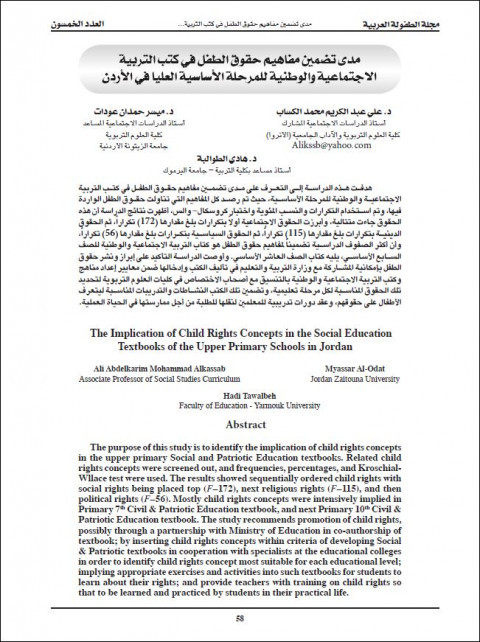 مدى تضمين مفاهيم حقوق الطفل في كتب التربية الاجتماعية والوطنية للمرحلة الأساسية العليا في الأردن Année de publication: 2012 Auteur: الكساب، علي عبد الكريم محم Auteur institutionnel: Kuwait Society for the Advancement of Arab Children (KSAAC) هدفت هذه الدراسة إلى التعرف على مدى تضمين مفاهيم حقوق الطفل في كتب التربية الاجتماعية والوطنية للمرحلة الأساسية حيث تم رصد كل المفاهيم التي تناولت حقوق الطفل الواردة فيها. وتم استخدام التكرارات والنسب المئوية واختبار كروسكال-والس. أظهرت نتائج الدراسة أن هذه الحقوق جاءت متتالية، وأبرزت الحقوق الاجتماعية أولا بتكرارات بلغ مقدارها (172) تكرارا، ثم الحقوق الدينية بتكرارات بلغ مقدارها (115) تكرارا، ثم الحقوق السياسية بتكرارات بلغ مقدارها (56) تكرارا، وأن أكثر الصفوف الدراسية تضمينا لمفاهيم حقوق الطفل هو كتاب التربية الاجتماعية والوطنية للصف السابع الأساسي، يليه كتاب الصف العاشر الأساسي. وأوصت الدراسة التأكيد على إبراز ونشر حقوق الطفل بإمكانية المشاركة مع وزارة التربية والتعليم في تأليف الكتب وإدخالها ضمن معايير إعداد مناهج وكتب التربية الاجتماعية والوطنية بالتنسيق مع أصحاب الاختصاص في كليات العلوم التربوية لتحديد تلك الحقوق المناسبة لكل مرحلة تعليمية، وتضمين تلك الكتب النشاطات والتدريبات المناسبة ليتعرف الأطفال على حقوقهم، وعقد دورات تدريبية للمعلمين لنقلها للطلبة من أجل ممارستها في الحياة العملية. The Implication of Child Rights Concepts in the Social Education Textbooks of the Upper Primary Schools in Jordan Année de publication: 2012 Auteur: الكساب، علي عبد الكريم محم Auteur institutionnel: Kuwait Society for the Advancement of Arab Children (KSAAC) The purpose of this study is to identify how far are the concepts of child rights included in the Social and National Education textbooks of the the basic education classes. Relevant child rights concepts were monitored and frequencies, percentages, and KroschialWllace test were used. The results showed that child rights came in a sequence of order. Social rights came on top (F=172), followed by religious rights (F=115) and political rights (F=56). The text books with most referencies to child rights concepts were the Civic and National education books of class Basic Education 10.The study recommends promoting child rights by writing relevant books and adding child rehigts concepts to the criteria of authoring civic and national education curriculla and textbooks, possibly in partnership with the Ministry of Education and in cooperation with specialists at the faculties of sciences of education, in order to identify child rights concepts, most suitable for each educational level, with appropriete activities and excercises for children to lern about their implying appropriate into such textbooks for students to learn about their rights. Teachers should be provided with training in order to help children parctice them in reality.
 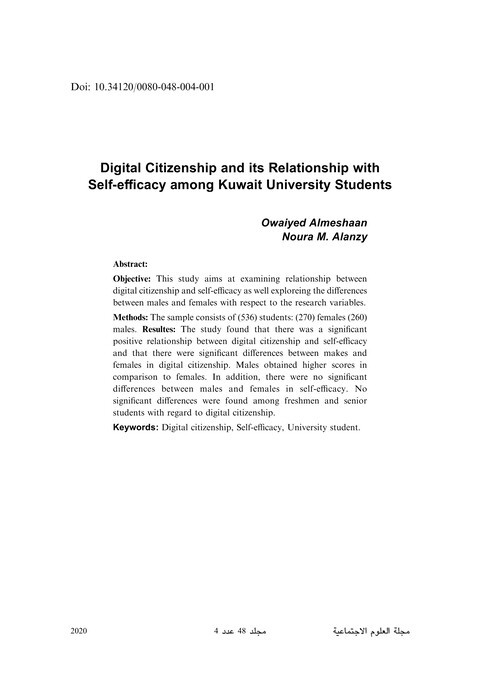 المواطنة الرقمية وعلاقتها بالكفاءة الذاتية لدى طلاب جامعة الكويت وطالباتها (مجلة العلوم الاجتماعية ;no.4, vol.48) Année de publication: 2020 Auteur: Owaiyed Almeshaan | Noura Alanzy Auteur institutionnel: Kuwait University تهدف هذه الدراسة إلى فحص العلاقة بين المواطنة الرقمية والكفاءة الذاتية، والكشف عن الفروق بين الذكور والإناث في متغيرات الدراسة. المنهجية: تكونت عينة الدراسة من (536)؛ بواقع (266) من الذكور و(270) من الإناث. النتائج: كشفت نتائج الدراسة عن أنه توجد علاقة موجبة بين المواطنة الرقمية والكفاءة الذاتية، كما توجد فروق دالة إحصائياً بين الذكور والإناث في المواطنة الرقمية؛ إذ إن متوسط الذكور أعلى من متوسط الإناث، بينما لا توجد فروق بينهما في الكفاءة الذاتية. كما لا توجد فروق دالة إحصائياً بين الذكور والإناث وفقاً للكلية والمرحلة الدراسية. Digital Citizenship and Its Relationship With Self-Efficacy Among Kuwait University Students (Journal of Social Sciences; vol.48, no.4) Année de publication: 2020 Auteur: Owaiyed Almeshaan | Noura Alanzy Auteur institutionnel: Kuwait University This study aims at examining relationship between digital citizenship and self-efficacy as well exploring the differences between males and females with respect to the research variables.Methods: The sample consists of (536) students: (270) females (260) males. Results: The study found that there was a significant positive relationship between digital citizenship and self-efficacy and that there were significant differences between males and females in digital citizenship. Males obtained higher scores in comparison to females. In addition, there were no significant differences between males and females in self-efficacy. No significant differences were found among freshmen and senior students with regard to digital citizenship.
 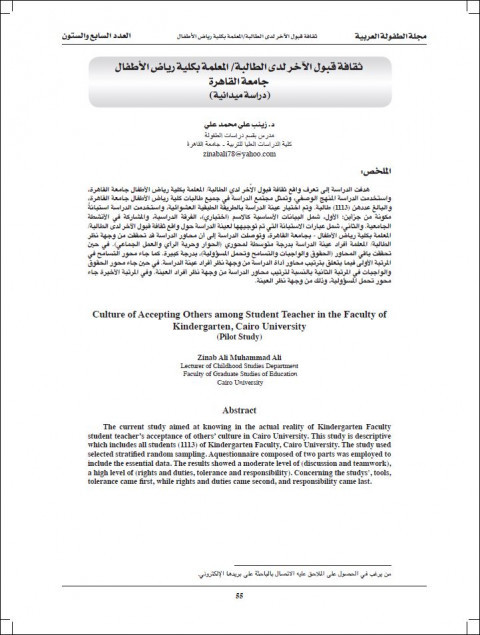 ثقافة قبول الآخر لدى الطالبة/ المعلمة بكلية رياض الأطفال - جامعة القاهرة: دراسة ميدانية Année de publication: 2016 Auteur: علي، زينب علي محمد Auteur institutionnel: Kuwait Society for the Advancement of Arab Children (KSAAC) هدفت الدراسة إلى تعرف واقع ثقافة قبول الاًخر لدي الطالبة/ المعلمة بكلية رياض الأطفال - جامعة القاهرة. استخدمت الدراسة المنهج الوصفي، وتمثل مجتمع الدراسة في جميع طالبات كلية رياض الأطفال جامعة القاهرة، والبالغ عددهن (1113) طالبة. تم اختيار عينة الدراسة بالطريقة الطبقية العشوائية، واستخدمت الدراسة استبانةً مكونة من جزأين: الأول، شمل البيانات الأساسية كالاسم (اختياري)، الفرقة الدراسية، والمشاركة في الأنشطة الجامعية. والثاني، شمل عبارات الاستبانة التي تم توجيهها لعينة الدراسة حول واقع ثقافة قبول الآخر لدى الطالبة/ المعلمة بكلية رياض الأطفال. توصلت الدراسة إلى أن محاور) بدرجة كبير. كما جاء محور التسامح في المرتبة الأولى فيما يتعلق بترتيب محاور أداة الدراسة من وجهة نظر أفراد عينة الدراس. في حين جاء محور الحقوق والواجبات في المرتبة الثانية بالنسبة لترتيب محاور الدراسة من وجهة نظر أفراد العينة. وفي المرتبة الأخيرة جاء محور تحمل المسؤولية، وذلك من وجهة نظر العينة. Culture of Accepting Others among Student Teacher in the Faculty of Kindergarten, Cairo University: Pilot Study Année de publication: 2016 Auteur: علي، زينب علي محمد Auteur institutionnel: Kuwait Society for the Advancement of Arab Children (KSAAC) The study aimed at knowing in the actual reality of accepting the others’ culture by the students/ teachers of the Kindergarten Faculty at Cairo University. This study is descriptive and includes all students (1113) of the Kindergarten Faculty. The study used selected stratified random sampling. A questionnaire composed of two parts was employed to include the essential data. The results showed a moderate level of 'discussion and teamwork', a high level of 'rights and duties, tolerance and responsibility'. Concerning the study’s tools, tolerance came first, while rights and duties came second, and responsibility came last.