
Ressources
Explorez une large gamme de ressources sur le GCED afin d’approfondir votre compréhension et de renforcer vos activités de recherche, de plaidoyer, d’enseignement et d’apprentissage.
3,780 résultats trouvés
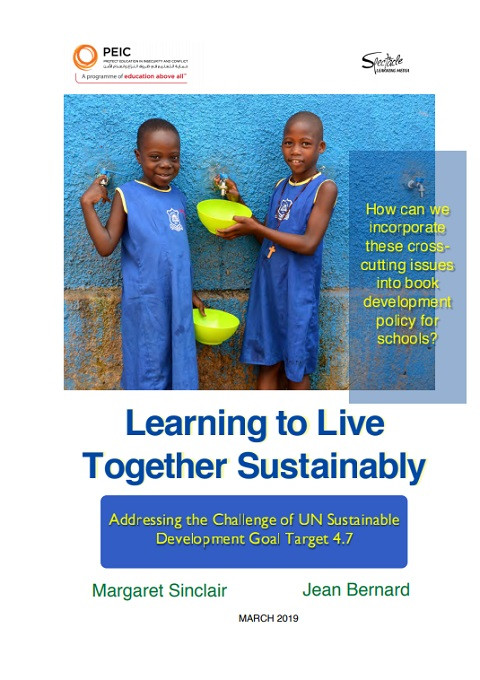 Learning to Live Together Sustainably: Addressing the Challenge of UN Sustainable Development Goal Target 4.7 Année de publication: 2019 Auteur: Margaret Sinclair | Jean Bernard Auteur institutionnel: Protect Education in Conflict and Insecurity (PEIC) | Spectacle Learning Media The practical advice and guidelines in this book help support learning to live together, conflict transformation and peace at the individual, group and community levels. The framework for developing widely accessible, high quality learning materials supports the UN Sustainable Development Goals and is relevant to formal and non-formal education activities and projects. This document also raises important issues about the professional responsibilities of policy-makers at global and national level, who determine what content is addressed in the classroom. In particular, it addresses the need for education materials that support cross-cutting issues such as learning to live together, global citizenship education, and education for sustainable development.
  Guidelines on Human Rights Education for Secondary School Systems Année de publication: 2012 Auteur institutionnel: OSCE. Office for Democratic Institutions and Human Rights (ODIHR) These guidelines, which focus on human rights education in secondary schools, aim to support systemic and effective human rights learning for all young people. They were prepared on the basis of broad consultations involving teachers, teachers’ unions, teacher trainers, educational administrators, NGO specialists, and representatives from intergovernmental agencies and national human rights institutions.The current document presents approaches to be adopted when planning or implementing human rights education for secondary schools related to six key structural areas: the human rights-based approach to human rights education; core competencies; curricula; teaching and learning processes; evaluation; and professional development and support of educational personnel. The guidelines also offer a list of key materials to assist in planning, implementing and evaluating human rights education in schools.
  دليل لفائدة المكونين و الوسطاء لإستعمال " دليل شباب تونس في تعلم الديمقراطية " Année de publication: 2013 Auteur institutionnel: UNESCO Rabat The main aim of these manual and guide is to raise awareness among Tunisian youth about the values of democracy, human rights and responsible citizenship, and empower youth to make their voice heard during this critical period in the Tunisian democratic transition.
  Opening new windows to sow peace: building citizenship Année de publication: 2015 Auteur: Tatiana Zuluaga Zapata | Carlos Humberto Vélez Ocampo | Laura Juliana Pachón Rodríguez | María Julieta Ortiz Fernández Auteur institutionnel: Bogotá. Secretaría de Educación del Distrito (SED) This document aims to help students come with innovative ideas to generate transformations for peace and citizenship in Colombia. It is aimed at creating a conscious mobilization every April 9, during the commemoration of the victims and the missing in Colombia, and has the intention of motivating citizens to fill the streets with joy, raise their voices and commit to peace. Ouvrez de nouvelles fenêtres pour semer la paix: la construction de la citoyenneté ... Année de publication: 2015 Auteur: Tatiana Zuluaga Zapata | Carlos Humberto Vélez Ocampo | Laura Juliana Pachón Rodríguez | María Julieta Ortiz Fernández Auteur institutionnel: Bogotá. Secretaría de Educación del Distrito (SED) Ce document vise à aider les élèves à venir avec des idées novatrices pour générer des transformations pour la paix et la citoyenneté en Colombie. Il est destiné à créer une mobilisation consciente le 9 Avril, lors de la commémoration des victimes et des disparus en Colombie, et a l'intention des citoyens de motivation pour remplir les rues avec joie, faire entendre leur voix et engager à la paix. Abrir nuevas ventanas para sembrar la paz: una ciudadanía que construye… Année de publication: 2015 Auteur: Tatiana Zuluaga Zapata | Carlos Humberto Vélez Ocampo | Laura Juliana Pachón Rodríguez | María Julieta Ortiz Fernández Auteur institutionnel: Bogotá. Secretaría de Educación del Distrito (SED) This document aims to help students come with innovative ideas to generate transformations for peace and citizenship in Colombia. It is aimed at creating a conscious mobilization every April 9, during the commemoration of the victims and the missing in Colombia, and has the intention of motivating citizens to fill the streets with joy, raise their voices and commit to peace.
  The Role of Education in Countering Violent Extremism Année de publication: 2013 Auteur institutionnel: Center on Global Counterterrorism Cooperation and Hedayah On 18 and 19 September 2013, the Center on Global Counterterrorism Cooperation (CGCC) and Hedayah co-hosted in New York City an expert roundtable on “The Role of Education in Countering Violent Extremism.” The meeting brought together a group of policy-makers, researchers and practitioners to discuss challenges and best practices related to efforts to counter violent extremism through education. The Role of Education in Countering Violent Extremism Année de publication: 2013 Auteur institutionnel: Center on Global Counterterrorism Cooperation and Hedayah Les 19 et 20 septembre 2013, le Centre de coopération internationale pour la lutte contre le terrorisme (Center on Global Counterterrorism Cooperation, CGCC) et Hedayah ont accueilli une table ronde d'experts, à New York, sur « le rôle de l'éducation pour lutter contre l'extrémisme violent » (The Role of Edcuation in Countering Violent Extremism). Cet événement a réuni des décideurs politiques, des chercheurs et des praticiens afin de discuter des défis et des meilleures pratiques dans les efforts réalisés pour lutter contre l'extrémisme violent par l'éducation.
  Education and Conflict: Complexity and Chaos Année de publication: 2003 Auteur: Lynn Davies Based on the author's extensive research and experience of education in several areas afflicted by conflict, the book explores the relationship between schooling and social conflict and looks at conflict internal to schools. It posits a direct link between the ethos of a school and the attitudes of future citizens towards 'others'. It also looks at the nature and purpose of peace education and war education, and addresses the role of gender and masculinity. Education and Conflict: Complexity and Chaos Année de publication: 2003 Auteur: Lynn Davies Basé sur une recherche approfondie de l'auteur et sur son expérience en terme d'éducation dans plusieurs zones affectées par des conflits, ce livre analyse la relation entre le fait d'aller à l'école et le conflit social, et s'attache aux conflits qui surviennent au sein des établissements scolaires. L’auteur postule un lien direct entre l'éthos adopté par une école donnée et le comportement de ses futures citoyens envers « les autres ». Il s'attache également à la nature et à l'objet de l'éducation pour la paix et de l'enseignement des conflits, et aborde la question du rôle joué par le genre et la masculinité.