
Ressources
Explorez une large gamme de ressources sur le GCED afin d’approfondir votre compréhension et de renforcer vos activités de recherche, de plaidoyer, d’enseignement et d’apprentissage.
2,161 résultats trouvés
 Environmental Education Toolkit Guide for Latin America and the Caribbean Année de publication: 2023 Auteur: Eloísa Tréllez Solís Auteur institutionnel: United Nations Environment Programme (UNEP) The Environmental Education Toolkit is aimed primarily at teachers, multipliers and facilitators in Latin America and the Caribbean (LAC), and aims to promote interdisciplinary approaches, with a view to the transversality of environmental education. In the new context of a post-COVID-19 health emergency world, this approach becomes more relevant and necessary to achieve a better vision and understanding of the relationships between humans and nature; between societies, cultures and with the ecosystems on which they depend. In the chapters that make up this publication, an approach is proposed through a methodological proposal for reflection and action, the Interdisciplinary Roundtables for Environmental Education towards Sustainability, whose main objective is to strengthen and complement the environmental education processes that are carried out both in educational centers and in community groups, from an interdisciplinary, transversal perspective and with systemic thinking. Guía de herramientas de educación ambiental para América Latina y el Caribe Année de publication: 2023 Auteur: Eloísa Tréllez Solís Auteur institutionnel: United Nations Environment Programme (UNEP) La Guía de Herramientas de Educación Ambiental está dirigida principalmente a docentes, multiplicadores y facilitadores de América Latina y el Caribe (ALC), tiene el propósito de impulsar enfoques interdisciplinarios, con miras a la transversalidad de la educación ambiental. En el nuevo contexto de un mundo post emergencia sanitaria COVID-19 este enfoque se vuelve más relevante y necesario para lograr una mejor visión y entendimiento de las relaciones entre el ser humano y la naturaleza; entre las sociedades, culturas y con los ecosistemas, de los que depende. Se propone, en los capítulos que integran esta publicación, un abordaje a través de una propuesta metodológica de reflexión y acción, las Mesas Interdisciplinarias de Educación Ambiental hacia la Sostenibilidad, cuyo objetivo principal es fortalecer y complementar los procesos de educación ambiental que se llevan a cabo tanto en centros educativos como en grupos comunitarios, desde una perspectiva interdisciplinaria, transversal y con pensamiento sistémico.
 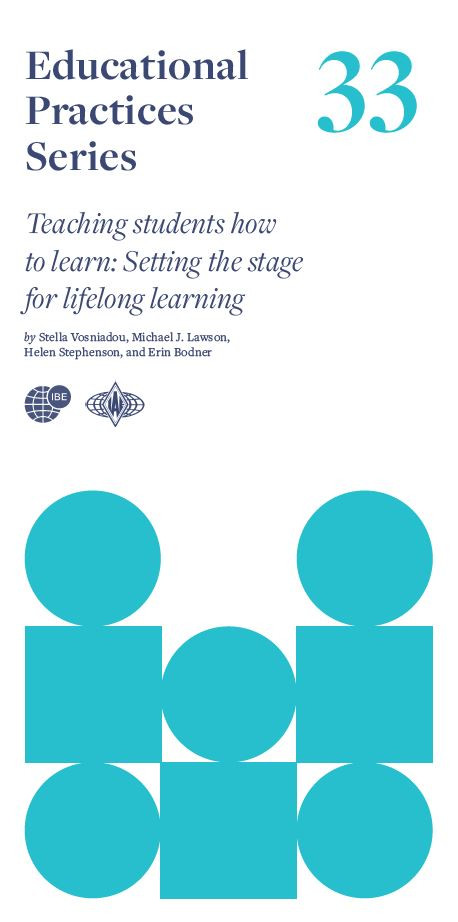 Teaching Students How to Learn: Setting the Stage for Lifelong Learning (Educational Practices Series No. 33) Année de publication: 2021 Auteur: Stella Vosniadou | Michael J. Lawson | Helen Stephenson | Erin Bodner Auteur institutionnel: UNESCO International Bureau of Education (IBE) | International Academy of Education In this Teaching How to Learn booklet, teachers can find information about some of the cognitive, metacognitive, emotional, and motivational capabilities that characterise self-regulated learners, and some of the actions that teachers can take to promote self-regulated learning in their students. These include giving students time to engage in constructive tasks independently or in collaboration with their peers and providing them with the knowledge and strategies that they can use to manage their learning and control their motivation and emotions while they complete these tasks successfully.
 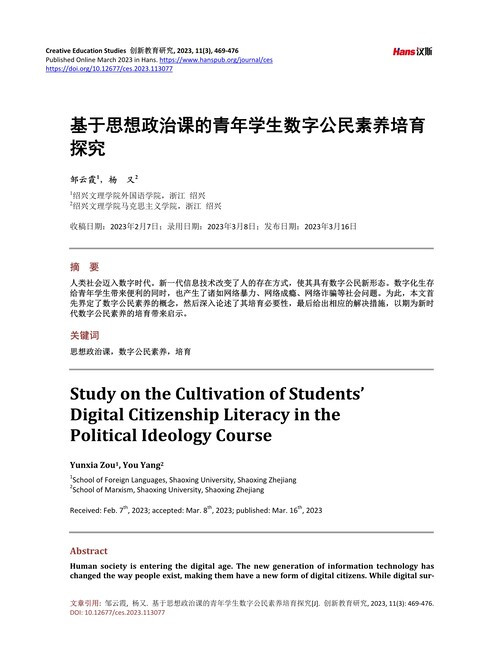 Study on the Cultivation of Students’ Digital Citizenship Literacy in the Political Ideology Course (Creative Education Studies; Vol.11, No.3) Année de publication: 2023 Auteur: 邹云霞 | 杨又 Human society is entering the digital age. The new generation of information technology has changed the way people exist, making them have a new form of digital citizens. While digital sur-vival brings convenience to youth students, it also brings about social problems such as cyberbullying, Internet addiction, online fraud and so on. Therefore, this paper first defines the concept of digital citizenship, then discusses the necessity of cultivating digital citizenship, and finally gives the corresponding measures to bring enlightenment for the cultivation of digital citizenship in the new era. 基于思想政治课的青年学生数字公民素养培育探究 (创新教育研究; Vol.11, No.3) Année de publication: 2023 Auteur: 邹云霞 | 杨又 人类社会迈入数字时代。新一代信息技术改变了人的存在方式,使其具有数字公民新形态。数字化生存给青年学生带来便利的同时,也产生了诸如网络暴力、网络成瘾、网络诈骗等社会问题。为此,本文首先界定了数字公民素养的概念,然后深入论述了其培育必要性,最后给出相应的解决措施,以期为新时代数字公民素养的培育带来启示。
  School Coexistence Toolkit: Prevention of Gender-Based Violence Auteur institutionnel: Ministry of Education of Colombia The infographics on the prevention of gender-based violence are intended precisely to raise awareness about this naturalized phenomenon so that families, children, adolescents and young people, and educators understand that this type of violence is not normal, it causes suffering and serious consequences for victims, and cannot be tolerated in any way. The infographics, based on the protocol, provide information in a simple and easy-to-understand way about what gender-based violence is, which can be sexual, physical, psychological or symbolic violence, how to prevent it, and what to do if you identify a victim or are a victim of this aggression. Kit de herramientas para la convivencia escolar: Prevención de las violencias basadas en el género Auteur institutionnel: Ministry of Education of Colombia Las infografías de prevención de las violencias basadas en el género, tienen la intencionalidad precisamente de sensibilizar sobre este fenómeno naturalizado para que las familias, las niñas, niños, adolescentes y jóvenes y los educadores, entiendan que estas violencias no son normales, producen sufrimiento y graves secuelas entre las víctimas y no pueden ser toleradas de ninguna manera. Las infografías, basadas en el protocolo, informan, de una manera sencilla y fácil de comprender, sobre qué son las violencias de género, las cuales pueden ser violencia sexual, física, psicológica o simbólica, cómo prevenirlas y qué hacer en caso de identificar una víctima o ser víctima de estas agresiones.
 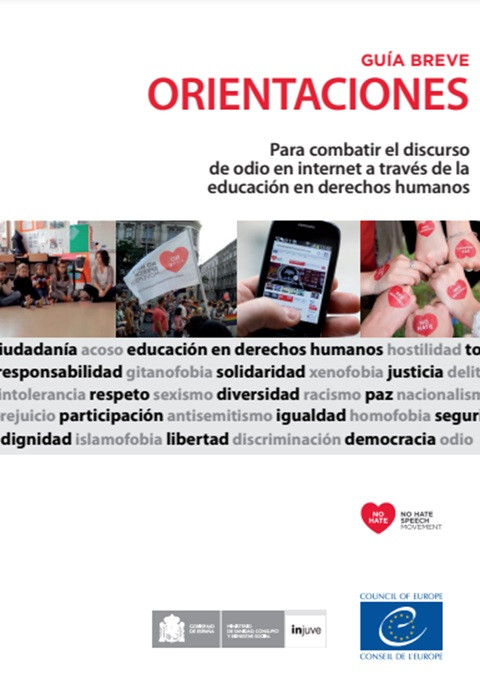 Brief Guidance Guide: To Combat Hate Speech on the Internet Through Human Rights Education Année de publication: 2016 Auteur: Ellie Keen | Mara Georgescu Auteur institutionnel: Youth Institute | Council of Europe The Youth Institute has published “Bookmarks”, a guide to combat hate speech on the Internet, which aims to be a brief and useful manual for the dissemination of concepts related to human rights and freedom of expression, as well as to raise and face the challenge of defending these rights on the Internet from a young perspective. It also aims to become a practical tool for action, training and awareness-raising work, aimed at both young people themselves and trainers, to establish in a simple way the essential concepts related to online hate speech and provide mechanisms to combat it. Guía breve orientaciones: Para combatir el discurso de odio en internet a través de la educación en derechos humanos Année de publication: 2016 Auteur: Ellie Keen | Mara Georgescu Auteur institutionnel: Youth Institute | Council of Europe El Instituto de la Juventud ha editado “Orientaciones”, una guía para luchar contra el odio en internet que pretende ser un breve manual útil para la difusión de los conceptos relacionados con los derechos humanos y la libertad de expresión, así como plantear y afrontar el reto de defender estos derechos en internet desde una perspectiva joven. También nace con el objetivo de convertirse en una herramienta práctica para la acción, el trabajo formativo y de sensibilización, dirigida tanto a los propios jóvenes como a los formadores, para fijar de manera sencilla los conceptos esenciales relacionados con el discurso de odio online y aportar mecanismos para combatirlo.
 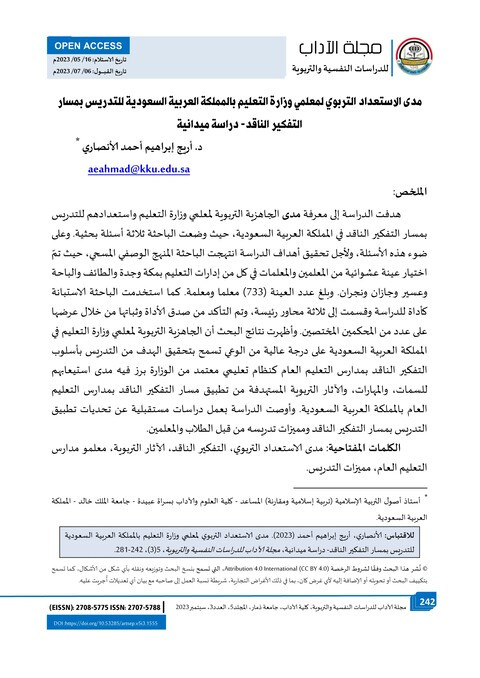 The Extent of Educational Readiness of Using Thinking Skills Strategy among Teachers at the Ministry of Education, Saudi Arabia: A Field Study (Arts for Educational & Psychological Studies; Vol.5, No.3) Année de publication: 2023 Auteur: Areej Ibrahim Ahmed Al Ansari Auteur institutionnel: Dhamar University This study aimed to identify educational readiness and willingness of teachers affiliated to the Ministry of Education to use critical thinking in their teaching, in Saudi Arabia. To achieve the study objectives, the descriptive survey method was adopted, and a questionnaire was used to collect data from the study sample which consisted of (733) male and female teachers, randomly selected from education directorates of Makkah, Jeddah, Taif, Al-Baha, Asir, Jazan, and Najran. The questionnaire included three main dimensions;and after testing its validity, and reliability, it was administered to the sample. The study results showed that teachers’ educational readiness scored a high degree of awareness that would allow achieving the goal of teaching by using critical thinking in schools as a teaching strategy approved by the Ministry of Education. The teachers also showed their understanding of the characteristics, skills and educational effects of the application of the critical thinking strategy in schools. The study recommended conducting future studies on the challenges and advantages of applying the critical thinking strategy from the perspective of students and teachers.Keywords: Extent of educational readiness, Critical thinking, Educational effects, School teachers.