
Ressources
Explorez une large gamme de ressources sur le GCED afin d’approfondir votre compréhension et de renforcer vos activités de recherche, de plaidoyer, d’enseignement et d’apprentissage.
1,473 résultats trouvés
 Educação para a cidadania global: preparando alunos para os desafios do século XXI Année de publication: 2014 Auteur institutionnel: UNESCO The United Nations Secretary-General’s Global Education First Initiative (GEFI) has established education as a means to ‘foster global citizenship’ – one of its three priority areas. To support this, UNESCO organized two landmark meetings on GCE in 2013. This publication aims to define the parameters of GCE by using the collective expertise, experience and wisdom of those participants who gathered at these landmark events, and to plan for future action in line with emerging thinking and other ongoing work. The review establishes that GCE has a critical role to play in equipping learners with competencies to deal with the dynamic and interdependent world of the twenty-first century. While GCE has been applied in different ways in different contexts, regions and communities, it has a number of common elements, which include fostering in learners. In formal settings, GCE can be delivered as an integral part of an existing subject (such as civic or citizenship education, social studies, environmental studies, geography or culture), or as an independent subject area. Integrated models appear to be more common. Some less traditional, but at least as effective, pathways for GCE have included the following: the use of information and communication technologies and social media, sport competitions and the use of art and music, and youth-led initiatives employing a wide variety of approaches. Both traditional and new horizons for GCE are profiled in this review. This publication also explores a number of enabling conditions for the promotion and implementation of GCE. These include: the existence of an open environment for universal values, the implementation of transformative pedagogy and support for youth-led initiatives. The review acknowledges that there are a number of ongoing tensions with the concepts of global citizenship and global citizenship education. While these tensions vary, they all point to the fundamental question of how to promote universality (e.g. common and collective identity, interest, participation, duty), while respecting singularity (e.g. individual rights, self-improvement). Some ways forward to resolve these tensions are suggested, whilst maintaining that challenges around theoretical elements of GCE should not undermine its practice. The processes documented in this publication have strengthened partnerships, built coalitions and contributed to improving the evidence base on the theory and practice of global citizenship education. While there are tasks that remain, this foundation bodes well for improving the enabling conditions and the practices highlighted in this review. By preparing learners to fulfil their potential in an increasingly globalized world, we are promoting transformed societies that are also better equipped to deal with the twenty-first century challenges and to seize twenty-first century opportunities. Education à la citoyenneté mondiale: préparer les apprenants aux défis du XXIe siècle Année de publication: 2015 Auteur institutionnel: Organisation des Nations Unies pour l'éducation, la science et la culture (UNESCO) The United Nations Secretary-General’s Global Education First Initiative (GEFI) has established education as a means to ‘foster global citizenship’ – one of its three priority areas. To support this, UNESCO organized two landmark meetings on GCE in 2013. This publication aims to define the parameters of GCE by using the collective expertise, experience and wisdom of those participants who gathered at these landmark events, and to plan for future action in line with emerging thinking and other ongoing work. The review establishes that GCE has a critical role to play in equipping learners with competencies to deal with the dynamic and interdependent world of the twenty-first century. While GCE has been applied in different ways in different contexts, regions and communities, it has a number of common elements, which include fostering in learners. In formal settings, GCE can be delivered as an integral part of an existing subject (such as civic or citizenship education, social studies, environmental studies, geography or culture), or as an independent subject area. Integrated models appear to be more common. Some less traditional, but at least as effective, pathways for GCE have included the following: the use of information and communication technologies and social media, sport competitions and the use of art and music, and youth-led initiatives employing a wide variety of approaches. Both traditional and new horizons for GCE are profiled in this review. This publication also explores a number of enabling conditions for the promotion and implementation of GCE. These include: the existence of an open environment for universal values, the implementation of transformative pedagogy and support for youth-led initiatives. The review acknowledges that there are a number of ongoing tensions with the concepts of global citizenship and global citizenship education. While these tensions vary, they all point to the fundamental question of how to promote universality (e.g. common and collective identity, interest, participation, duty), while respecting singularity (e.g. individual rights, self-improvement). Some ways forward to resolve these tensions are suggested, whilst maintaining that challenges around theoretical elements of GCE should not undermine its practice. The processes documented in this publication have strengthened partnerships, built coalitions and contributed to improving the evidence base on the theory and practice of global citizenship education. While there are tasks that remain, this foundation bodes well for improving the enabling conditions and the practices highlighted in this review. By preparing learners to fulfil their potential in an increasingly globalized world, we are promoting transformed societies that are also better equipped to deal with the twenty-first century challenges and to seize twenty-first century opportunities.
 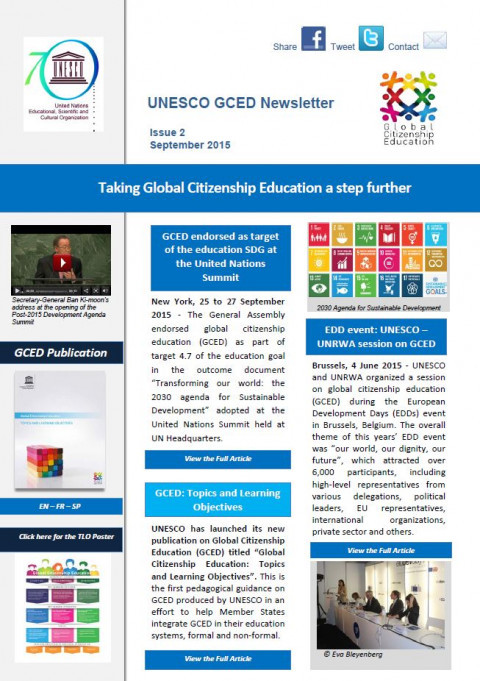 UNESCO GCED eNewsletter Issue 2 Année de publication: 2015 Auteur institutionnel: UNESCO Featuring:Taking Global Citizenship Education a step furtherGCED endorsed as target of the education SDG at the United Nations SummitGCED: Topics and Learning ObjectivesEDD event: UNESCO-UNRWA session on GCEDCapacity-building workshops-providing assistance for GCED implementationGCED for West African countries – building on peace and human rights educationTool for writing textbooks free of prejudiceOrientation and Capacity Building on GCED for Latin American and Caribbean countriesKey tweetsUpcoming events
 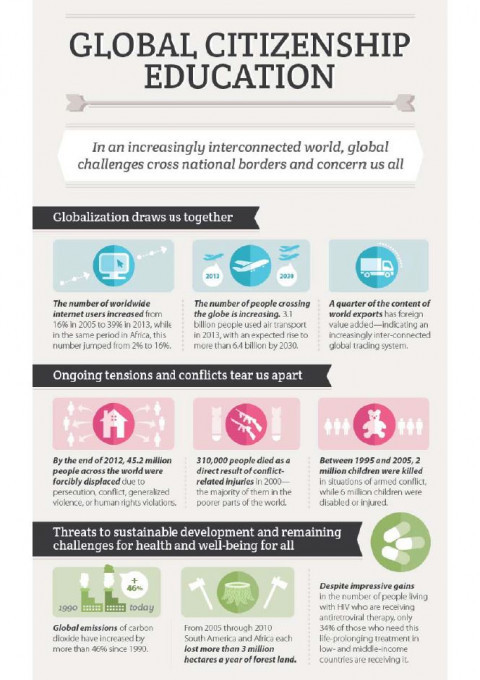 Global Citizenship Education infographic Année de publication: 2014 Auteur institutionnel: UNESCO In an increasingly interconnected world, global challenges cross national borders and concern us all. With issues like these threatening human and environmental well-being, we need to re-think the role and relevance of education. We need Global Citizenship Education. Global Citizenship Education is transformative. What are the barriers to this kind of education? What needs to change in education? What is UNESCO doing? What can you do?
 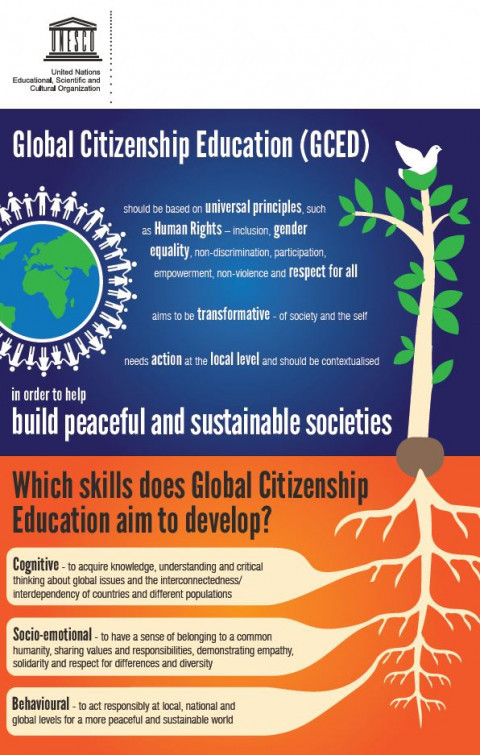 Global Citizenship Education (GCED) infographic Année de publication: 2015 Auteur institutionnel: UNESCO Which skills does Global Citizenship Education aim to develop? How can effectively implement Global Citizenship Education? Who are the key players? Éducation à la citoyenneté mondiale infographique Année de publication: 2015 Auteur institutionnel: UNESCO Quelles compétences pour l' Education citoyenneté mondiale visant à développer? Comment peut-on effectivement mettre en œuvre l'éducation à la citoyenneté mondiale? Quels sont les principaux acteurs?
 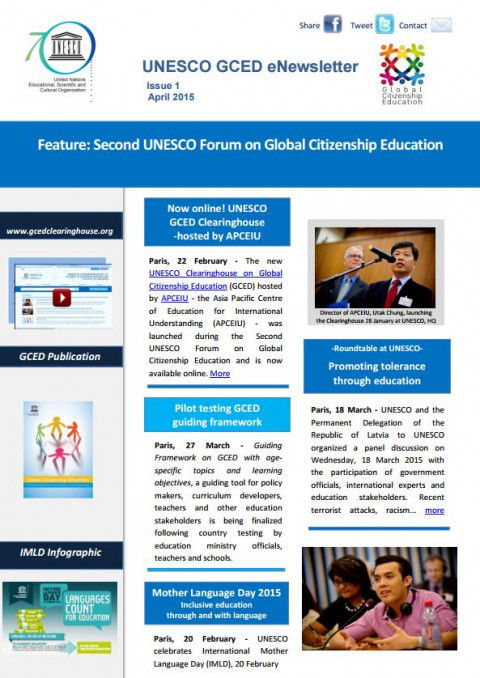 UNESCO GCED eNewsletter Issue 1 Année de publication: 2015 Auteur institutionnel: UNESCO Feature: Second UNESCO Forum on Global Citizenship EducationNow online! UNESCO GCED Clearinghouse hosted by APCEIUPilot testing GCED guiding framework(Roundtable at UNESCO) Promoting tolerance through educationMother Tongue Day 2015: inclusive education through and with language(Interview) Roland Villamero speaks on GCED at the community levelHIghlights: Second UNESCO Forum on Global Citizenship Education, 28-30 January 2015, Paris HQSecond UNESCO Forum on GCED puts spotlight on Post-2015 developmentGlobal citizenship must be placed in the centre of education systemsAmira Yahyaoui's feature presentation at the Second UNESCO GCED ForumJoint Youth Statement2nd GCED Forum photo gallery UNESCO ECM e Bulletin Bulletin Numéro 1 Année de publication: 2015 Auteur institutionnel: Organisation des Nations Unies pour l'éducation, la science et la culture (UNESCO) Caractéristique: Deuxième Forum de l'UNESCO sur l'éducation sur la citoyenneté mondialeMaintenant en ligne! UNESCO ECM Centre hébergé par APCECIcadre d'orientation Piolot test ECM(Table ronde à l'UNESCO) Tolérance Promouvoir par l'éducationLangue maternelle Jour 2015: l'éducation inclusive à travers et avec la langue(Interview) Roland Villamero parle sur ECM au niveau communautaireHighlights: Deuxième Forum de l'UNESCO sur l'éducation sur la citoyenneté mondiale, 28-30 Janvier 2015, HQ ParisDeuxième Forum de l'UNESCO sur ECM met les projecteurs sur L'après 2015 le développementLa citoyenneté mondiale doit être placé au centre des systèmes éducatifsfonction de la présentation de Amira Yahyaoui lors du deuxième Forum ECM UNESCODéclaration des jeunes mixte2ème Forum ECM galerie photo
  Second UNESCO Forum on Global Citizenship Education: building peaceful and sustainable societies: final report Année de publication: 2015 Auteur institutionnel: UNESCO The Second UNESCO Forum on Global Citizenship Education (GCED) was organized in Paris from 28 to 30 January 2015 under the overall theme 'Building peaceful and sustainable societies: preparing for post-2015'. The Forum was organized in support of the UN Secretary General's Global Education First Initiative (GEFI) and on the occasion of UNESCO's 70th Anniversary. The Forum was organized by the Division for Teaching, Learning and Content, Educatio Sector, UNESCO, with the support of Austria, the Sultanate of Oman and the Republic of Korea. Other partners also included the United Nations Secretary-General's Global Education First Initiative (GEFI), UNESCO's Mahatma Gandhi Institute of Education for Peace and Sustainable Development (MGIEP), UNESCO's Asia-Pacific Centre of Education for International Understanding (APCEIU), the King Abdullah Bin Abdulaziz International Centre for Interreligious and Intercultural Dialogue (KAICIID) and the Learning Matrix Task Force. Some 250 participants from 61 countries from all regions of the world attended the Forum. These included decision-and policy-makers, practitioners, teachers, development partners, academics, the private sector, civil society representatives (national, regional and international level) as well as learners and youth representatives. The Forum was organized around three plenary sessions and 20 concurrent sessions. Topics under consideration included, among others, GCED in the post-2015 education agenda, measuring GCED learning outcomes, teaching practices, peace and human rights education, respect for diversity and inter-religious education, tackling discrimination and violence, education for sustainable development, youth involvement, the use of ICT and social media, and others. For an overview of the programme, please see Annex I. Second UNESCO Forum on Global Citizenship Education: building peaceful and sustainable societies: final report Année de publication: 2015 Auteur institutionnel: Organisation des Nations Unies pour l'éducation, la science et la culture (UNESCO) Le deuxième Forum de l'UNESCO sur l'éducation à la citoyenneté mondiale (ECM) a été organisé à Paris du 28 au 30 Janvier 2015 sous le thème général «Construire des sociétés pacifiques et durables: préparer l'après-2015». Le Forum a été organisé à l'appui d’Éducation Globale Première Initiative du Secrétaire général de l'ONU (EGPI) et à l'occasion du 70e anniversaire de l'UNESCO. Le Forum a été organisé par la Division de l'enseignement, l'apprentissage et du contenu, Secteur Educatio, l'UNESCO, avec le soutien de l'Autriche, le Sultanat d'Oman et la République de Corée. D'autres partenaires comprenaient également ’Éducation Globale Première Initiative du Secrétaire général du Secrétaire général de l’ONU (EGPI), Mahatma Gandhi Institute de l'UNESCO de l'éducation pour la paix et le développement durable (MGIEP), Asie-Pacifique Centre de l'UNESCO de l'éducation pour la compréhension internationale (APCEIU), le roi Abdallah Bin Abdulaziz Centre international pour le dialogue interreligieux et interculturel (KAICIID) et le Groupe de travail Matrice d'apprentissage. Quelque 250 participants de 61 pays de toutes les régions du monde ont participé au Forum. ceci inclut décisions et les décideurs politiques, les praticiens, les enseignants, les partenaires de développement, des universitaires, le secteur privé, les représentants de la société civile (niveau national, régional et international), ainsi que les apprenants et les représentants de la jeunesse.Le Forum a été organisé autour de trois sessions plénières et 20 sessions simultanées. Sujets à l'étude comprenaient, entre autres, ECM dans l'agenda de l'éducation post-2015, la mesure des résultats ECM d'apprentissage, les pratiques d'enseignement, éducation à la paix et les droits de l'homme, le respect de la diversité et de l'éducation inter-religieux, la lutte contre la discrimination et la violence, l'éducation pour le développement durable, la participation des jeunes, l'utilisation des TIC et des médias sociaux, et d'autres. Pour un aperçu du programme, s'il vous plaît voir l'annexe I.