
Ressources
Explorez une large gamme de ressources sur le GCED afin d’approfondir votre compréhension et de renforcer vos activités de recherche, de plaidoyer, d’enseignement et d’apprentissage.
106 résultats trouvés
 La compasión y la auto-compasión: El secreto mejor guardado en la eduación. Année de publication: 2021 Auteur institutionnel: Campus Virtual MIMI Este webinar trata sobre las herramientas que permiten que la compasión y la auto-compasión puedan ser aplicadas en la vida diaria. Se contextualiza en la pandemia de COVID-19 un momento crítico para el mundo que merece estrategias para entenderse a si mismos y a los otros y de esta manera, contriuir al bienestar propio y de los otros. Describe el concepto de compasión y su importancia en la cotidianidad así como sus efectos de su práctica y como la auto-compasión permiten su sostenibilidad.
  Mindfulness in the Context of Education Année de publication: 2021 Auteur institutionnel: Campus Virtual MIMI This podcast deals with the concept of mindfulness, understood as an Eastern tradition that in recent years has been adapting to Western culture from different contexts to work on its own well-being. It is also defined by the author Jon Kabat-Zinn, who has brought to the West is practical, as the possibility of paying attention in a determined way to the present moment, without judgments. It has 3 components: attention, the intention to be present and attitudes individuals. It shows to be an inherent quality of the human being, as well as a capacity and ability that is trained, a practice that helps the brain in terms of its predispositions and has scientific bases that strongly relate it to mental health, due to its intervention in the nervous system , which generate a balance in the activation of this system. Therefore, the objective of mindfulness is to generate a possibility to balance emotions and learn to regulate them. It allows thoughts to connect with the body, which impacts on affective symptoms by strengthening the immune system. The video shows the ways to use it in everyday life in the academic context. La atención plena en el contexto de la educación Année de publication: 2021 Auteur institutionnel: Campus Virtual MIMI Este Podcast trata acerca del concepto de atención plena, entendido como una tradición oriental que en los ultimos años se ha venido adaptando a la cultura occidental desde distintos contextos para trabajar en el bienestar propio. La define también a partir de el autor Jon Kabat-Zinn, quien ha traido a occidente está practica, como la posibilidad de prestar atención de manera determinada al momento presente, sin juicios.Tiene 3 componentes la atencjón, la intención de estar presente y actitudes particulares. Evidencia ser una cualidad inherente al ser humano, así como una capacidad y habilidad que se entrena, una práctica que ayuda al cerebro en cuanto a sus predisposiciones y tiene bases científicas que la relacionan fuertemente con la salud mental, por su intervención en el sistema nervioso, que generan un equilibrio en la activación de este sistema. Por tanto el objetivo de la atención plena es generar una posibilidad de equilibrar las emociones y aprender a regularlas. Permite que los pensamientos se conecten con el cuerpo lo que impacta en los síntomas de tipo afectivo fortaleciendo el sistema inmune. El video muestra las maneras para usarlo en la vida cotidiana en el contexto académico.
 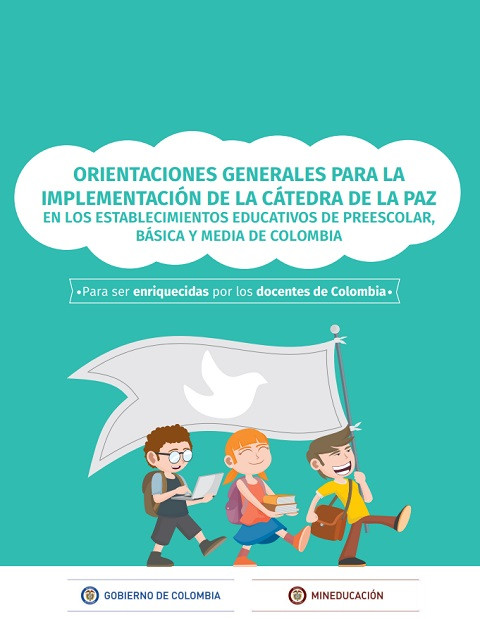 General Guidelines for the Implementation of the Peace Class in Preschool, Elementary and Middle School in Colombia Année de publication: 2016 Auteur: Enrique Chaux | Ana María Velásquez Auteur institutionnel: Colombia. Ministerio de Educación Nacional This document presents the general guidelines for educational communities in Colombia to carry out their peace education projects within the framework of the Peace Law. Orientaciones generales para la implementación de la cátedra de la paz: En los establecimientos educativos de preescolar, básica y media de colombia Année de publication: 2016 Auteur: Enrique Chaux | Ana María Velásquez Auteur institutionnel: Colombia. Ministerio de Educación Nacional En este documento se presentan las orientaciones generales para que las comunidades educativas de Colombia puedan llevar a cabo sus proyectos de educación para la paz en el marco de la cátedra para la paz.
  Informe de referente regional 2010: oportunidades de aprendizaje escolar de la ciudadanía en América Latina: currículos comparados Année de publication: 2010 Auteur: Cristián Cox Donoso Auteur institutionnel: Sistema Regional de Evaluacion y Desarrollo de Competencias Ciudadanas (SREDECC) This report has three purposes, the first, to describe the contexts and challenges of education for citizenship education in Latin America; secondly, to describe the process of implementation and creation of the Latin American version of the International Civic and Citizenship Education Study (ICCS) test and compare the categories of both evaluation tools; lastly, to characterize, in a comparative way, the citizenship education curricula of Colombia, Chile, Guatemala, Mexico, Paraguay, and the Dominican Republic. The results of the report rise from the analysis of secondary sources on the socio-educational contexts in which citizenship education is based upon in Latin America, as well as a comparative analysis of the original educational curricula of the six countries of this project. The structure of the chapters and the sections of this document are arranged according to the referred purposes. The first chapter focuses on the sociocultural context of the educational system that is in charge of shaping citizens. Recent evidence on beliefs and democratic practices in the region will be examined. Later, the evolution of the school systems in the last decade and a half will be described. Finally, in order to establish a “base line” on the role of citizenship education in education policy, first the curricula, pedagogies, and teacher formation and evaluation will be examined. The second chapter focuses on the process of generation of the Latin American evaluative method, part of the ICCS test. Then, in a detailed manner, a comparative analysis of the categories or evaluation criteria of both tests will be presented in order to show the predominant opinion of citizenship education in the 6 countries. Trying to identify certain patterns, the report concludes with a chapter that makes interpretations and projections about the tendencies observed in current curricula and propose new criteria for the development of new education curricula.