
Ressources
Explorez une large gamme de ressources sur le GCED afin d’approfondir votre compréhension et de renforcer vos activités de recherche, de plaidoyer, d’enseignement et d’apprentissage.
2,193 résultats trouvés
 Education Reform in Pakistan Année de publication: 2014 Auteur institutionnel: International Crisis Group In April 2010, the eighteenth constitutional amendment committed Pakistan to free and compulsory education for all children between the ages of five and sixteen. Yet millions are still out of school, and the education system remains alarmingly impoverished. The madrasa (religious school) sector flourishes, with no meaningful efforts made to regulate the seminaries, many of which propagate religious and sectarian hatred. Militant violence and natural disasters have exacerbated the dismal state of education. The public education system needs to foster a tolerant citizenry, capable of competing in the labour market and supportive of democratic norms within the country and peace with the outside world. Education Reform in Pakistan Année de publication: 2014 Auteur institutionnel: International Crisis Group En Avril 2010, le Pakistan s’est engagé, l'amendement constitutionnel XVIII, à mettre en place une éducation gratuite et obligatoire pour tous les enfants âgés de cinq à seize ans. Pourtant, des millions d’enfants ne sont encore à l'école et le système éducatif s’appauvrit d’une façon alarmante. Le secteur de la madrasa (école religieuse) fleurit, sans que des efforts significatifs soient déployés pour réglementer les séminaires, qui propagent souvent la haine religieuse et le sectarisme. La violence militante et les catastrophes naturelles ont aggravé l'état lamentable de l'éducation. Le système public de l'éducation doit favoriser une citoyenneté tolérante, compétitive sur le marché du travail et apportant son soutien aux normes démocratiques dans le pays et à la paix avec le monde extérieur.
 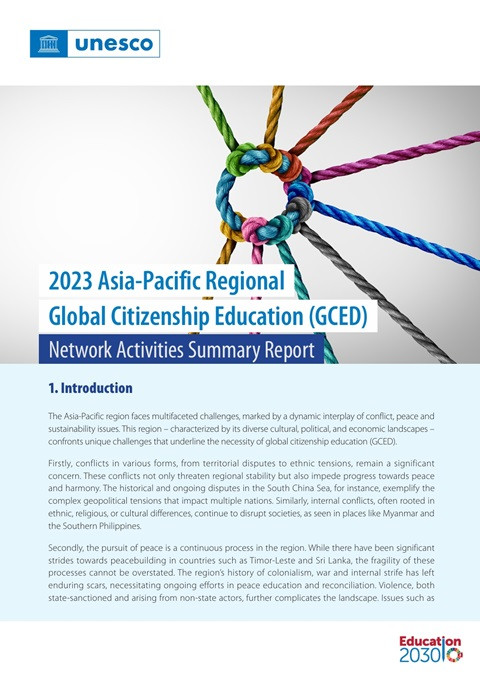 2023 Asia-Pacific Regional Global Citizenship Education (GCED): Network Activities Summary Report Année de publication: 2023 Auteur: Seek Ling Tan Auteur institutionnel: UNESCO Bangkok This is a summary report from the Global Citizenship Education (GCED) network activities in Asia-Pacific in 2023. The Asia-Pacific Regional Global Citizenship Education Network, spearheaded by UNESCO Bangkok and the Asia-Pacific Centre of Education for International Understanding (APCEIU), has illuminated the path to empower learners to become global citizens since its inception in 2018. In 2023, their journey was punctuated by significant milestones and a revitalized commitment to propel GCED across the region. This commitment is particularly evident in the key priority areas of advocacy, capacity building, learning/teaching materials, policy and research and the synergizing of regional collaboration towards Education 2030.
 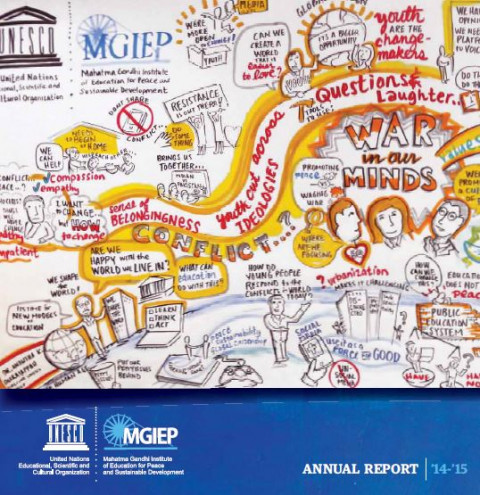 MGIEP Annual Report '14-'15 Année de publication: 2016 Auteur institutionnel: Mahatma Gandhi Institute of Education for Peace and Sustainable Development (MGIEP) The Mahatma Gandhi Institute of Education for Peace and Sustainable Development (MGIEP) is UNESCO’s first Category I institute in the Asia-Pacific region, established with the generous support of the Government of India. UNESCO MGIEP focuses on transforming current education policies and practices by developing innovative teaching and learning methods.Their objective is to build generations of young people equipped to create peaceful and sustainable societies. This annual report describes MGIEP’s main works and various educational programmes for peace and sustainable development.
  MGIEP Annual Report 2015-2016 Année de publication: 2017 Auteur institutionnel: Mahatma Gandhi Institute of Education for Peace and Sustainable Development (MGIEP) The Mahatma Gandhi Institute of Education for Peace and Sustainable Development (MGIEP) is UNESCO’s first Category I institute in the Asia-Pacific region, established with the generous support of the Government of India.UNESCO MGIEP focuses on transforming current education policies and practices by developing innovative teaching and learning methods. Their objective is to build generations of young people equipped to create peaceful and sustainable societies.This annual report describes MGIEP’s main works and various educational programmes for peace and sustainable development.
  Mahatma Gandhi Institute of Education for Peace and Sustainable Development: a joint initiative by UNESCO and the government of India Année de publication: 2013 Auteur institutionnel: Mahatma Gandhi Institute of Education for Peace and Sustainable Development (MGIEP) The United Nations Educational, Scientific and Cultural Organization (UNESCO) and the Government of India are embarking on a major new partnership to create the Mahatma Gandhi Institute of Education for Peace and Sustainable Development. Through research and capacity-building, the Institute aims to develop and promote new approaches to education, empowering learners to transform their lives and build a more peaceful and sustainable world. Based in New Delhi, this will be the first UNESCO specialized education Institute in India, and the first in the Asia-Pacific region. It is particularly fitting that the Institute is hosted by India, the birthplace of Mahatma Gandhi and a country that has made a significant commitment to education over the past decades. Institut Mahatma Gandhi d'éducation pour la paix et le développement durable: une initiative conjointe de l'UNESCO et le gouvernement de l'Inde Année de publication: 2013 Auteur institutionnel: Mahatma Gandhi Institute of Education for Peace and Sustainable Development (MGIEP) L'Organisation des Nations Unies pour l'éducation, la science et la culture (UNESCO) et le Gouvernement de l'Inde se lancent dans un nouveau partenariat majeur pour créer l'Institut Mahatma Gandhi d'éducation pour la paix et le développement durable. Grâce à la recherche et le renforcement des capacités, l'Institut vise à développer et promouvoir de nouvelles approches de l'éducation, l'autonomisation des apprenants pour transformer leur vie et construire un monde plus pacifique et durable. Basé à New Delhi, ce sera le premier Institut de l'UNESCO spécialisé de l'éducation en Inde, et la première dans la région Asie-Pacifique. Il est particulièrement approprié que l'Institut est hébergé par l'Inde, le lieu de naissance du Mahatma Gandhi et un pays qui a pris un engagement important à l'éducation au cours des dernières décennies. Mahatma Gandhi Institute of Education for Peace and Sustainable Development: UNESCO's first category 1 Institute in the Asia-Pacific Année de publication: 2014 Auteur institutionnel: Mahatma Gandhi Institute of Education for Peace and Sustainable Development (MGIEP) The Mahatma Gandhi Institute of Education for Peace and Sustainable Development (MGIEP) is UNESCO’s first Category 1 Institute in the Asia-Pacific. The Institute will be a key strategic player in UNESCO’s work towards quality Education for All and the transformative shift envisioned for the Post 2015 agenda. Established in cooperation with the Government of India, MGIEP has been created to play a leading role in research, knowledge sharing, capacity building and policy formulation in the area of peace and sustainability education. The Institute aims to promote, assimilate and generate high quality research to lead the intellectual and policy discourse for education and global citizenship in the region. It was named after Mahatma Gandhi, as a tribute to his ideas of non-violence and sustainable living. The President of India and the Director-General of UNESCO jointly announced the establishment of the Institute in November, 2012. It is located in New Delhi. Mahatma Gandhi Institute of Education for Peace and Sustainable Development: UNESCO's first category 1 Institute in the Asia-Pacific Année de publication: 2014 Auteur institutionnel: Mahatma Gandhi Institute of Education for Peace and Sustainable Development (MGIEP) L'Institut Mahatma Gandhi d'éducation pour la paix et le développement durable (MGIEP) est la première catégorie de l'UNESCO 1 Institut dans la région Asie-Pacifique. L'Institut sera un acteur stratégique clé dans le travail de l'UNESCO à l'éducation de qualité pour tous et le changement de transformation envisagé pour le programme post 2015. Fondée en coopération avec le Gouvernement de l'Inde, MGIEP a été créé pour jouer un rôle de premier plan dans la recherche, le partage des connaissances, le renforcement des capacités et la formulation des politiques dans le domaine de l'éducation de la paix et de la durabilité. L'Institut vise à promouvoir, d'assimiler et de générer des recherches de haute qualité pour diriger le discours intellectuel et politique de l'éducation et la citoyenneté mondiale dans la région. Il a été nommé d'après le Mahatma Gandhi, comme un hommage à ses idées de non-violence et de vie durable. Le Président de l'Inde et le Directeur général de l'UNESCO ont annoncé conjointement la mise en place de l'Institut en Novembre 2012. Il est situé à New Delhi. Mahatma Gandhi Institute of Education for Peace and Sustainable Development: UNESCO's first category 1 institute in the Asia-Pacific brochure Année de publication: 2014 Auteur institutionnel: Mahatma Gandhi Institute of Education for Peace and Sustainable Development (MGIEP) The Mahatma Gandhi Institute of Education for Peace and Sustainable Development (MGIEP) is UNESCO’s first Category 1 Institute in the Asia-Pacific. The Institute will be a key strategic player in UNESCO’s work towards quality Education for All and the transformative shift envisioned for the Post 2015 agenda. Established in cooperation with the Government of India, MGIEP has been created to play a leading role in research, knowledge sharing, capacity building and policy formulation in the area of peace and sustainability education. The Institute aims to promote, assimilate and generate high quality research to lead the intellectual and policy discourse for education and global citizenship in the region. It was named after Mahatma Gandhi, as a tribute to his ideas of non-violence and sustainable living. The President of India and the Director-General of UNESCO jointly announced the establishment of the Institute in November, 2012. It is located in New Delhi.