
Ressources
Explorez une large gamme de ressources sur le GCED afin d’approfondir votre compréhension et de renforcer vos activités de recherche, de plaidoyer, d’enseignement et d’apprentissage.
2,657 résultats trouvés
 Défi des professeurs d'université à cultiver la citoyenneté Mondiale des étudiants Année de publication: 2014 Auteur institutionnel: National Science and Technology Council (Taiwan) A l'intersection de la mondialisation et de la localisation depuis les années 1990, la nation se retire dans l'ère de la mondialisation et en même temps faire face aux défis de problèmes intérieurs, tels que l'indifférence du vote, le retrait de la protection sociale, la discrimination raciale, les conflits culturels, etc. La politique, les droits économiques, sociaux et culturels des citoyens sont également accompagnés de responsabilités. Le rôle de l'éducation est d'aider les gens à réaliser leurs rôles en tant que citoyens du monde, en améliorant la qualité des citoyens, et la promotion de la maturité de la société entière et la sphère publique. 大學校院教師培養學生全球公民素養之挑戰 Année de publication: 2014 Auteur institutionnel: 國家科學及技術委員會 In the intersection of globalization and localization since the 1990s, the nation is stepping into the era of globalization and simultaneously facing challenges of inner problems, such as indifference of voting, shrinkage of social welfare, racial discrimination, cultural conflicts, etc. The political, economic, social and cultural rights for citizens are also accompanied with responsibilities. The role of education is to help people realize their roles as global citizens, through enhancing the quality of citizens, and promoting the maturity of whole society and public spheres. Democracy and diversity: principles and concepts for educating citizens in a global age Année de publication: 2005 Auteur: James A. Banks | Cherry A. McGee Banks | Carlos E. Cortes | Carole L. Hahn | Merry M. Merryfield | Kogila A. Moodley | Stephen Murphy-Shigematsu | Audrey Osler | Caryn Park | Walter C. Parker Auteur institutionnel: Center of Multicultural Education, University of Washington The Center for Multicultural Education at the University of Washington convened—with support from the Spencer Foundation—a Diversity, Citizenship, and Global Education Consensus Panel. The Panel’s goal was to develop a set of principles, concepts, and guidelines that school practitioners can use to build or renew citizenship education programs that balance diversity and unity and prepare students to become effective citizens in a global context. An important resource for the Panel’s work was the book that resulted from an earlier conference sponsored by the Center, Diversity and Citizenship Education: Global Perspectives (Banks, 2004a).The Consensus Panel developed four principles and identified ten concepts, which are detailed in this publication. The Panel also developed a checklist that is designed for use by educators who want to consider the extent to which the principles and concepts identified by the Panel are reflected in their classrooms and schools.PRINCIPLESSection I Diversity, Unity, Global Interconnectedness, and Human Rights1. Students should learn about the complex relationships between unity and diversity in their local communities, the nation, and the world.2. Students should learn about the ways in which people in their community, nation, and region are increasingly interdependent with other people around the world and are connected to the economic, political, cultural, environmental, and technological changes taking place across the planet.3. The teaching of human rights should underpin citizenship education courses and programs in multicultural nation-states.Section II Experience and Participation4. Students should be taught knowledge about democracy and democratic institutions and provided opportunities to practice democracy. Démocratie et diversité: principes et concepts pour l'éducation des citoyens dans un âge global Année de publication: 2005 Auteur: James A. Banks | Cherry A. McGee Banks | Carlos E. Cortes | Carole L. Hahn | Merry M. Merryfield | Kogila A. Moodley | Stephen Murphy-Shigematsu | Audrey Osler | Caryn Park | Walter C. Parker Auteur institutionnel: Center of Multicultural Education, University of Washington Le Centre pour l'éducation multiculturelle à l'Université de Washington a convoqué-avec le soutien de la Fondation-a Spencer Diversité, Citoyenneté et Éducation Globale Panel Consensus . L'objectif du Groupe est de développer un ensemble de principes, des concepts et des lignes directrices que les praticiens de l'école peuvent utiliser pour construire ou de renouveler les programmes d'éducation à la citoyenneté que la diversité de l'équilibre et de l'unité et de préparer les étudiants à devenir des citoyens efficaces dans un contexte mondial. Une ressource importante pour les travaux du Groupe spécial était le livre qui résulte d'un earlierconférencesponsored par le Centre, la diversité et l'éducation à la citoyenneté: perspectives mondiales (banques, 2004a). Le groupe de concertation a élaboré quatre principes et identifi é dix concepts, qui sont détaillées dans cette publication. Le Groupe spécial a également mis au point une liste de contrôle qui est conçu pour être utilisé par les éducateurs qui veulent examiner la mesure dans laquelle les principes et les concepts identifi és par le Groupe sont refl ète dans leurs salles de classe et les écoles. PRINCIPES Section I Diversité, Unité, Global interconnectivité et droits de l'homme 1. Les élèves devraient en apprendre davantage sur les relations complexes entre l'unité et la diversité dans leurs communautés locales, la nation et le monde. 2. Les élèves devraient en apprendre davantage sur les façons dont les gens dans leur communauté, de la nation et de la région sont de plus en plus interdépendantes avec d'autres personnes dans le monde et sont reliés aux changements économiques, politiques, culturels, environnementaux et technologiques qui ont lieu à travers la planète. 3. L'enseignement des droits de l'homme devrait soutenir les cours et les programmes d'éducation à la citoyenneté dans les États-nations multiculturelles. Section II Expérience et participation 4. Les élèves doivent apprendre les connaissances sur la démocratie et les institutions démocratiques et a fourni des occasions de pratiquer la démocratie. Guide Pratique sur l'éducation à la citoyenneté mondiale ses pratiques d'enseignement - Prendre l'étude des étudiants du Collège comme un exemple Année de publication: 2012 Auteur: Amy Shumin Chen Auteur institutionnel: National Taiwan Normal University. Center for Educational Research and Innovation La mondialisation a contribué une forte influence sur les mouvements sociaux, les risques et les crises et incorpore en outre des expériences de vie individuelles dans les événements mondiaux. En ce qui concerne les tendances actuelles, ce document examine la transformation des caractéristiques de la citoyenneté mondiale et analyse les dimensions de l'apprentissage de la citoyenneté mondiale. Cette étude porte sur les pratiques pédagogiques qui se réfèrent aux aspects liés à L'éducation à la citoyenneté Mondiale (ECM) et donne un exemple de premier cycle d'apprentissage. L'article examine ce qui suit: 1) Illustrant les milieux de la citoyenneté mondiale en tant que cadre d'actions individuelles dans le contexte de la mondialisation. 2) Construire les dimensions de l'apprentissage et des concepts connexes de la citoyenneté mondiale. 3) Discuter des fondements théoriques et le contenu des pratiques pédagogiques envers l'éducation à la citoyenneté mondiale. 4) Le document donne également des conclusions et des suggestions pour la recherche future. 論全球公民教育與其教學實踐-以大學生的學習為例 Année de publication: 2012 Auteur institutionnel: 國立臺灣師範大學教育研究與創新中心 Globalization has contributed a strong influence on social movements, risks and crisis and further embeds individual life experiences in global events. Regarding current trends, this paper investigates the features transformation of global citizenship and analyzes the learning dimensions of global citizenship.This study focuses on pedagogical practices which refer to the related aspects in global citizenship education and gives an example of undergraduates learning.The article examines the following:1)Illustrating the backgrounds of global citizenship as a framework of individual actions in the context of globalization.2) Constructing the learning dimensions and related concepts of global citizenship.3) Discussing the theoretical foundations and contents of pedagogical practices toward global citizenship education.4) The paper also gives conclusions and suggestions for future research Citizenship, identity and education: examining the public purposes of schools in an age of globalization Année de publication: 2006 Auteur: Fernando Reimers Auteur institutionnel: UNESCO International Bureau of Education (IBE) Educational institutions exist to achieve public purposes. One of those purposes is to develop citizenship. In the 21st century, citizenship includes global citizenship. In an era of globalization effective citizenship includes the knowledge, ability and disposition to engage peacefully and constructively across cultural differences for purposes of addressing personal and collective needs and of achieving sustainable human–environmental interactions, this requires internalizing global values. Addressing these challenges of globalization will require making citizenship education and the development of global values an explicit objective of efforts to improve quality throughout the world, critically examining theories and evidence about the effectiveness of various approaches to developing citizenship and global citizenship and supporting activities aligned with this public purpose. This public purpose should support the development of a political culture that fosters the rule of national and international law and respect of human rights, the development of understanding to support trade and economic and peaceful bilateral and international diplomacy as the preferred means to solve international disputes, the development of the capability to understand and address the serious environmental challenges facing humanity and to collaborate across national boundaries in the creation of sustainable forms of human–environmental interactions and in the development of the skills to promote rationality in deliberation and action, and to advance science and technology as means to improve human health and well-being. At present, however, many education systems and reforms are insufficiently focused on quality, or focus instead on a very narrow and self-referenced definition of quality. It is possible to educate people to understand and appreciate cultural differences and to understand and accept human rights in a framework of global values that includes compassion and caring, concern for others, respect and reciprocity. These values, dispositions, knowledge and skills can be developed in a range of institutions that societies have to pass on what they value to the young, and to re-create culture: families, religious institutions, the media, workplaces, political institutions and also schools. While there is no reason to assume that schools can be more effective in this task than any of these other institutions, they have greater potential to be aligned with transnational efforts to promote global civility. They are a public space, and consequently also a globally public space, in ways in which families and religious institutions are not. If schools actively engage in teaching hatred or intolerance, or if they fail to prepare students adequately for global civility, these failures can be noted by international institutions that can potentially mobilize resources to support national and local efforts to prepare students for global citizenship. There is not a similar network linking national and transnational institutions, public and private, governmental and non-governmental, that attends to the dynamics of families and other ‘‘private’’ spaces. Citoyenneté, identité et de l'éducation: l'examen des fins publiques des écoles à l'ère de la mondialisation Année de publication: 2006 Auteur: Fernando Reimers Auteur institutionnel: UNESCO International Bureau of Education (IBE) Les établissements d'enseignement existent pour parvenir à des fins publiques. L'un de ces objectifs est de développer la citoyenneté. Au 21e siècle, la citoyenneté comprend la citoyenneté mondiale. Dans une ère de mondialisation citoyenneté effective comprend les connaissances, la capacité et la disposition à engager pacifique et constructive entre les différences culturelles aux fins de répondre aux besoins personnels et collectifs et de réaliser des interactions humaines-environnementales durables, ce qui nécessite l'intériorisation des valeurs globales. Pour relever ces défis de la mondialisation, il faudra faire de l'éducation à la citoyenneté et le développement des valeurs mondiales un objectif explicite des efforts pour améliorer la qualité dans le monde entier, l'examen critique des théories et des preuves sur l'efficacité des différentes approches pour développer la citoyenneté et la citoyenneté mondiale et soutenir les activités alignées cet effet public. Cet objectif public devrait soutenir le développement d'une culture politique qui favorise la primauté du droit national et international et le respect des droits de l'homme, le développement de la compréhension pour soutenir le commerce et la diplomatie bilatérale et internationale économique et pacifique comme le moyen privilégié pour résoudre les conflits internationaux, le développement de la capacité à comprendre et à relever les défis environnementaux humanité face à de graves et de collaborer à travers les frontières nationales dans la création de formes durables d'interactions homme-environnement et dans le développement des compétences pour promouvoir la rationalité dans la délibération et de l'action, et de faire avancer la science et la technologie comme moyen d'améliorer la santé humaine et le bien-être. À l'heure actuelle, cependant, de nombreux systèmes d'éducation et les réformes ne sont pas suffisamment axées sur la qualité, ou se concentrent plutôt sur une définition très étroite et auto-référencé de la qualité. Il est possible d'éduquer les gens à comprendre et à apprécier les différences culturelles et à comprendre et à acept droits de l'homme dans un cadre de valeurs globales qui comprend la compassion et la compassion, le souci des autres, le respect et la réciprocité. Ces valeurs, les dispositions, les connaissances et les compétences peuvent être développées dans un éventail d'institutions que les sociétés doivent passer sur ce qu'ils apprécient le jeune, et de recréer la culture: les familles, les institutions religieuses, les médias, les milieux de travail, les institutions politiques et aussi écoles. Bien qu'il n'y ait aucune raison de supposer que les écoles peuvent être plus efficaces dans cette tâche que l'une de ces autres institutions, ils ont un plus grand potentiel pour être aligné avec les efforts transnationaux visant à promouvoir la civilité mondiale. Ils sont un espace public, et par conséquent aussi un espace public à l'échelle mondiale, dans les façons dont les familles et les institutions religieuses ne sont pas. Si les écoles participent activement à l'enseignement à la haine ou l'intolérance, ou si elles ne parviennent pas à préparer les étudiants de manière adéquate pour la civilité mondiale, ces échecs peuvent être notées par les institutions internationales qui peuvent potentiellement mobiliser des ressources pour soutenir les efforts nationaux et locaux pour préparer les élèves à la citoyenneté mondiale. Il n'y a pas un réseau similaire reliant les institutions nationales et transnationales, publiques et privées, gouvernementales et non-gouvernementales, qui assiste à la dynamique des familles et d'autres «espaces» «privés».
 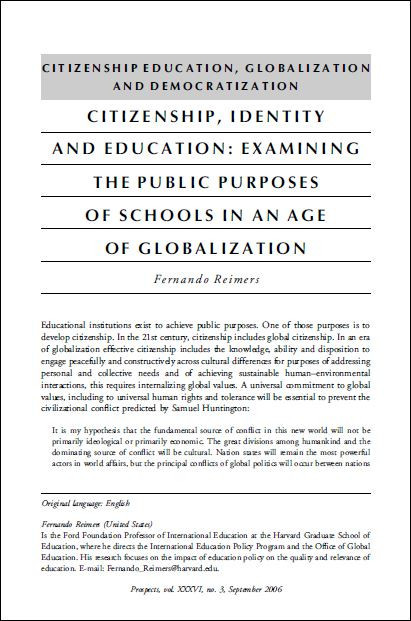 Citizenship, Identity, and Education: Examining the Public Purposes of Schools in an Age of Globalization Année de publication: 2006 Auteur: Fernando Reimers Auteur institutionnel: UNESCO International Bureau of Education (IBE) One of the purposes of educational institutions is to develop citizenship. In the 21st century, citizenship includes global citizenship. Addressing the challenges of globalization will require making citizenship education and the development of global values an explicit objective of efforts to improve quality throughout the world, critically examining theories and evidence about the effectiveness of various approaches to developing citizenship and global citizenship and supporting activities aligned with this public purpose. In this article, the author does not argue for an exclusive effort to focus schools on civic education, but rather for a balanced effort to elevate educational quality making it more relevant to address global challenges and opportunities, of which civic education and global education are components, much neglected at present. The author also does not suggest making civic education the only purpose of the curriculum or making it a priority to the expense of science, math, arts or physical and health education, but he thinks that helping students develop a sense of purpose, situated within broader civic and global purposes, would also facilitate high level engagement with science, mathematical and artistic pursuits.
 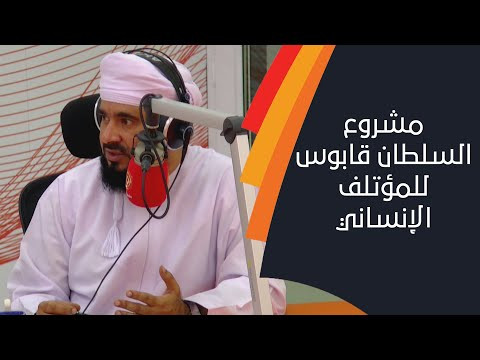 The Sultan Qaboos Project for the Humanitarian Année de publication: 2019 Auteur institutionnel: Al Shabiba The program deals with the Human Recombinant Project, its importance and objectives. The project came with the blessing of the late Sultan in order to gather the efforts of nations to improve human lives, and to raise human awareness of the importance of a shared global ethics system.