
Ressources
Explorez une large gamme de ressources sur le GCED afin d’approfondir votre compréhension et de renforcer vos activités de recherche, de plaidoyer, d’enseignement et d’apprentissage.
1,451 résultats trouvés
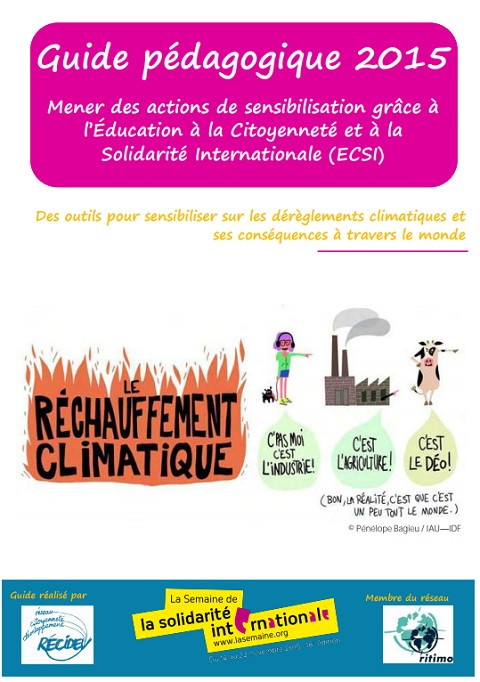 Guide pédagogique 2015: Mener des actions de sensibilisation grâce à l'Education à la Citoyenneté et à la Solidarité Internationale (ECSI): Des outils pour sensibiliser sur les dérèglements climatiques et ses conséquences à travers le monde Année de publication: 2015 Auteur institutionnel: RéCiDev Besançon (Réseau Citoyenneté Développement) Ce guide pédagogique est destiné aux acteurs de la semaine de solidarité internationale qui se déroule tous les ans autour de la 3ème semaine de novembre en France. Il propose des outils d'Education à la citoyenneté et à la solidarité internationale (ECSI) pour mener des actions de sensibilisation sur le dérèglement climatique et ses conséquences à travers le monde. Il comprend :- une première partie théorique sur les valeurs et la pédagogie de l'ECSI- une seconde partie pratique qui présente des outils pédagogiques- une troisième partie qui donne des informations pratiques sur les acteurs et les ressources en ECSI.
  No Poverty: Educational Resource for Teachers and Facilitators Année de publication: 2017 Auteur institutionnel: Concern Worldwide No Poverty – Educational resource for teachers and facilitators contains activities, statistics and information to explore the extent of poverty in the world, it’s causes and consequences as well as the aims of the sustainable development goals which aspire to address this issue. The booklet includes statistics, three activities complete with resources ready to photocopy and key terminology.
  Le guide de l’antiracisme Année de publication: 2016 Auteur institutionnel: Movement contre le Racisme, l’Antisémitisme et la Xénophobie (MRAX) Ce guide est destiné aux personnes qui veulent vivre ensemble dans une société multiculturelle où chacun est égal en droit et en dignité, indépendamment de ses origines, de sa couleur de peau, de sa culture, de sa religion, de sa langue. Ce guide de l’antiracisme devrait vous aider à franchir le pas. De l’indifférence vers la volonté d’agir. De l’impuissance vers l’action. Il explore la réalité concrète du racisme et des discriminations. Il contient des informations utiles et pratiques, des explications synthétiques, des définitions clés, des témoignages, des réponses juridiques, des conseils, des pistes d’action, des outils pédagogiques pour lutter contre le racisme.
  Strengthening Health System Responses to Gender-based Violence in Eastern Europe and Central Asia: A Resource Package Année de publication: 2014 Auteur institutionnel: United Nations Population Fund (UNFPA) | Women Against Violence Europe (WAVE) This collection of materials is the result of a collaboration between UNFPA (United Nations Population Fund), the UNFPA Regional Office for population for the countries of Eastern Europe and Central Asia and the WAVE Network (Women Against Violence in Europe) and is an updated edition of the compilation, revised in 2013-2014. It has been brought in line with new requirements in terms of enhancing the response of the health system to gender inequality; its content has been updated taking into account the latest international developments. Усиление роли системы здравоохранения в реагировании на гендерное насилие в Восточной Европе и Центральной Азии: Сборник материалов. Année de publication: 2014 Auteur institutionnel: United Nations Population Fund (UNFPA) | Women Against Violence Europe (WAVE) Данный сборник материалов является результатом сотрудничества ЮНФПА (Фонд ООН в области народонаселения), Регионального офиса Фонда ООН в области народонаселения для стран Восточной Европы и Центральной Азии и Сети WAVE («Женщины против насилия в Европе») и является обновленной редакцией сборник, переработанной в 2013-2014 гг. Теперь он в большей степени отвечает современным требованиям с точки зрения усиления реагирования системы здравоохранения на ГН, а его содержание обновлено с учетом новейших международных наработок.
 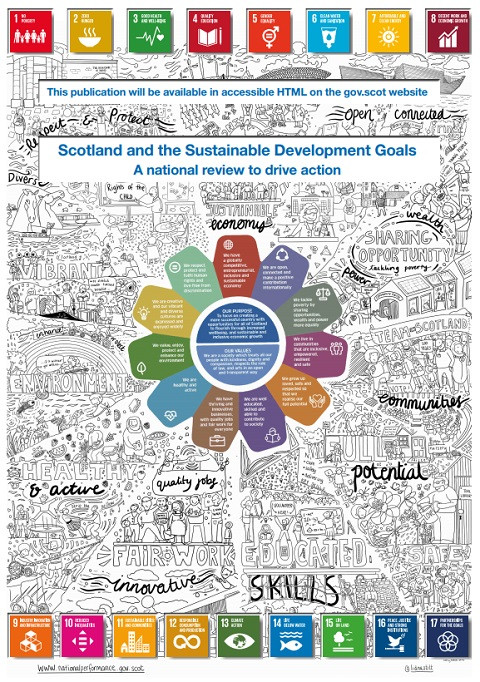 Scotland and the Sustainable Development Goals: A National Review to Drive Action Année de publication: 2020 Auteur institutionnel: Government of Scotland The 2030 Agenda for Sustainable Development provides a shared blueprint for peace and prosperity for people and the planet, now and into the future. As part of this, the Sustainable Development Goals (SDGs) are a universal call to action. Scotland signed up to the SDGs in 2015 and this review brings together evidence, actions and stories of how we are making progress to meet the Goals. It contains inspirational examples of how people across Scotland are taking action to make us a more successful country and to ensure we are at the forefront of this international agenda. It also highlights some of the challenges we face. This review, a collaborative effort between the SDG Network Scotland, Scottish Government and the Convention of Scottish Local Authorities (COSLA), scratches the surface of the depth of activity across Scotland. This review provides an overall picture of activity and performance based on the evidence currently available.
 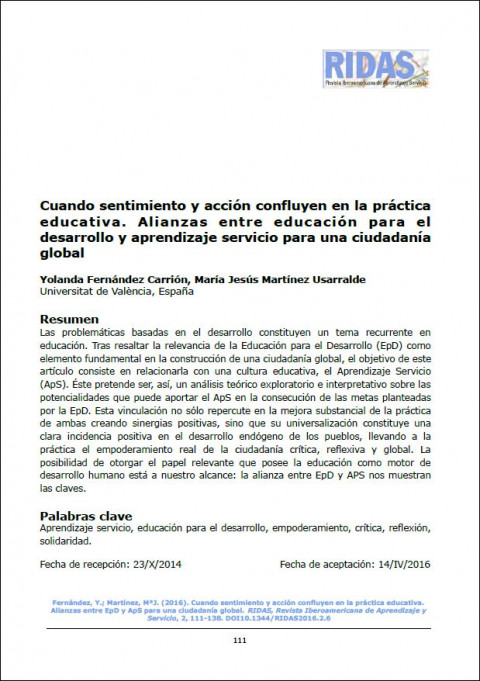 When Feeling and Action Come Together in Educational Practice. Relations Between Development Education and Learning Service for a Global Citizenship Année de publication: 2016 Auteur: Yolanda Fernández Carrión | Mª Jesús Martínez Usarralde The difficulties based on the development are a usual topic in education. After emphasizing the relevance of the development education as an essential element for the construction of the global citizenship, the challenge stands out by its innovative intention of trying to implicate it with service learning. This one tries to be an explorative and interpretative theoretic analyses about the potentialities which can be provided by service learning in the achievement of the objectives planned by the development education. This correlation not only affects the substantial improvement of both practices by building positive synergies but also its universalization forms a clear positive influence in the endogenous development of the village people, carrying out the real empowerment of the critical, sensible and global citizenship. The possibility of giving the main role as a human developmental engine to education is within our reach and the union between development education and service learning teaches us the keys. Cuando sentimiento y acción confluyen en la práctica educativa. Alianzas entre educación para el desarrollo y aprendizaje servicio para una ciudadanía global Année de publication: 2016 Auteur: Yolanda Fernández Carrión | Mª Jesús Martínez Usarralde Las problemáticas basadas en el desarrollo constituyen un tema recurrente en educación. Tras resaltar la relevancia de la Educación para el Desarrollo (EpD) como elemento fundamental en la construcción de una ciudadanía global, el objetivo de este artículo consiste en relacionarla con una cultura educativa, el Aprendizaje Servicio (ApS). Éste pretende ser, así, un análisis teórico exploratorio e interpretativo sobre las potencialidades que puede aportar el ApS en la consecución de las metas planteadas por la EpD. Esta vinculación no sólo repercute en la mejora substancial de la práctica de ambas creando sinergias positivas, sino que su universalización constituye una clara incidencia positiva en el desarrollo endógeno de los pueblos, llevando a la práctica el empoderamiento real de la ciudadanía crítica, reflexiva y global. La posibilidad de otorgar el papel relevante que posee la educación como motor de desarrollo humano está a nuestro alcance: la alianza entre EpD y APS nos muestran las claves.
 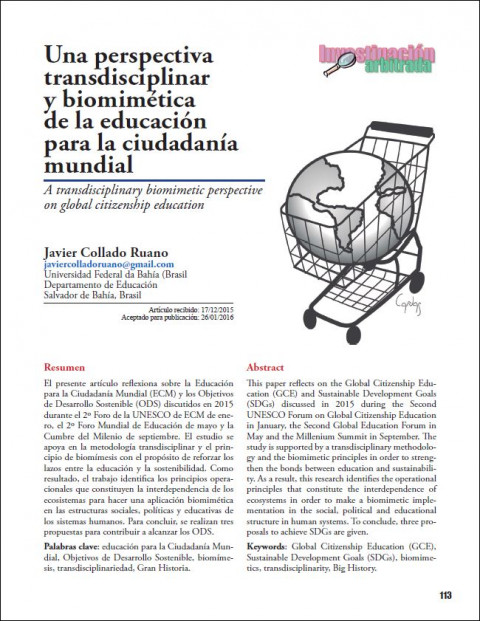 A Transdisciplinary Biomimetic Perspective on Global Citizenship Education Année de publication: 2016 Auteur: Javier Collado Ruano Auteur institutionnel: University of the Andes This paper reflects on the Global Citizenship Edu- cation (GCE) and Sustainable Development Goals (SDGs) discussed in 2015 during the Second UNESCO Forum on Global Citizenship Education in January, the Second Global Education Forum in May and the Millenium Summit in September. The study is supported by a transdisciplinary methodolo- gy and the biomimetic principles in order to streng- then the bonds between education and sustainabili- ty. As a result, this research identifies the operational principles that constitute the interdependence of ecosystems in order to make a biomimetic imple- mentation in the social, political and educational structure in human systems. To conclude, three pro- posals to achieve SDGs are given. Una perspectiva transdisciplinar y biomimética de la educación para la ciudadanía mundial Année de publication: 2016 Auteur: Javier Collado Ruano Auteur institutionnel: University of the Andes El presente artículo reflexiona sobre la Educación para la Ciudadanía Mundial (ECM) y los Objetivos de Desarrollo Sostenible (ODS) discutidos en 2015 durante el 2o Foro de la UNESCO de ECM de enero, el 2o Foro Mundial de Educación de mayo y la Cumbre del Milenio de septiembre. El estudio se apoya en la metodología transdisciplinar y el principio de biomímesis con el propósito de reforzar los lazos entre la educación y la sostenibilidad. Como resultado, el trabajo identifica los principios operacionales que constituyen la interdependencia de los ecosistemas para hacer una aplicación biomimética en las estructuras sociales, políticas y educativas de los sistemas humanos. Para concluir, se realizan tres propuestas para contribuir a alcanzar los ODS.