
Ressources
Explorez une large gamme de ressources sur le GCED afin d’approfondir votre compréhension et de renforcer vos activités de recherche, de plaidoyer, d’enseignement et d’apprentissage.
1,180 résultats trouvés
 Global Report on Teachers: Addressing Teacher Shortages and Transforming the Profession Année de publication: 2024 Auteur institutionnel: UNESCO | International Task Force on Teachers for Education 2030 The world faces a critical shortage of teachers, hindering the achievement of SDG 4 and the Education 2030 agenda. This first Global Report on Teachers stresses the urgency of this challenge and calls for immediate action. Exposing a projected deficit of 44 million primary and secondary education teachers by 2030, the report examines the complexity of the crisis, from sub-Saharan Africa’s need for 15 million more teachers to a decline in the attractiveness of the profession and subsequent retention challenges in higher-income countries. Filling a void in the field and grounded in new data, the report calls for international cooperation and increased education investment, offering a roadmap to empower teachers and to find policy solutions to ensure every learner is taught by a qualified, motivated and well-supported teachers.
  Reconciliation through Global Citizenship Education Année de publication: 2023 Auteur institutionnel: UNESCO This document zeroes in on how concepts of GCED and reconciliation are addressed in current research and practice and aims to provide existing grounds and future considerations for policy-makers concerned with reconciliation through education.
 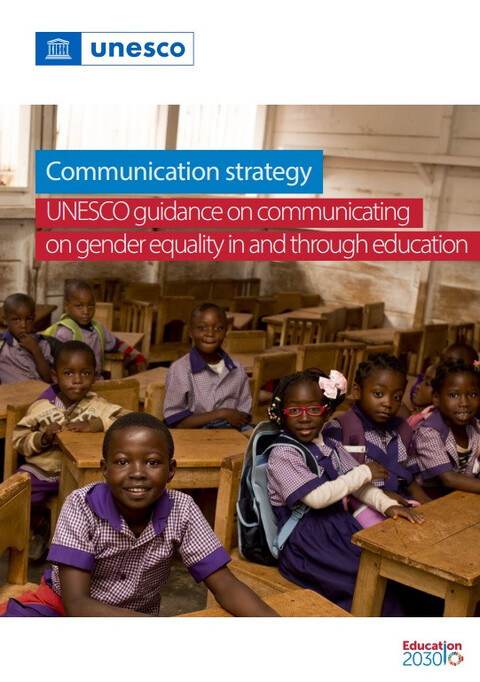 Communication Strategy: UNESCO Guidance on Communicating on Gender Equality in and through Education Année de publication: 2022 Auteur institutionnel: UNESCO About 259 million children and youth are out of school according to the UNESCO Institute for Statistics, including 127 million girls and 132 million boys. Twothirds of the 750 million non-literate adults around the world are women. This gender disparity remains one of the persistent challenges in adult literacy and education. The COVID-19 pandemic has exacerbated existing challenges, disrupting the education of over 1.5 billion learners. UNESCO estimates that close to 24 million children and youth, including over 11 million girls and 13 million boys, may drop out of school due to the pandemic’s economic impact. A window of opportunity is now more than ever open to build back equal. This communication strategy is designed to provide strategic guidance on communicating on gender equality in and through education. While prepared for UNESCO Education Sector staff, including those at Headquarters, in Field/Regional/Cluster Offices and in Institutes as well as for implementing partners, a broader audience of gender focal points, partners, Member States and others with an interest in and commitment to gender equality in and through education may also find this strategy particularly useful. Estrategia de comunicación: Orientaciones de la UNESCO sobre la comunicación en materia de igualdad de género en y a través de la educación Année de publication: 2022 Auteur institutionnel: UNESCO Según el Instituto de Estadística de la UNESCO, aproximadamente 259 millones de niños y jóvenes no están escolarizados, entre los cuales 127 millones de niñas y 132 millones de niños. Asimismo, dos tercios de los 750 millones de adultos analfabetos de todo el mundo son mujeres. Esta disparidad de género sigue siendo uno de los desafíos persistentes en la alfabetización de adultos y la educación. La pandemia de COVID-19 ha exacerbado los desafíos existentes, interrumpiendo la educación de más de 1 500 millones de alumnos. La UNESCO calcula que aproximadamente 24 millones de niños y jóvenes, incluyendo más de 11 millones de niñas y 13 millones de niños, pueden llegar a abandonar la escuela debido al impacto económico de la pandemia. Ahora más que nunca se abre la posibilidad de reforzar la igualdad. Esta estrategia de comunicación está diseñada para proporcionar una orientación estratégica sobre la comunicación de la igualdad de género en y a través de la educación. Aunque se ha preparado teniendo en cuenta al personal del Sector de la Educación de la UNESCO en la Sede, las oficinas fuera de la Sede, regionales y multipaís y los institutos, así como a los asociados en la ejecución, esta estrategia también puede resultar especialmente útil a un público más amplio de coordinadores en cuestiones de género, socios, Estados Miembros y otras personas interesadas y comprometidas con la igualdad de género en y a través de la educación. Stratégie de communication: Orientations de l’UNESCO pour la communication relative à l’égalité des genres dans et par l’éducation Année de publication: 2022 Auteur institutionnel: UNESCO Selon l’Institut de statistique de l’UNESCO, 259 millions d’enfants et de jeunes ne sont pas scolarisés, dont 127 millions de filles et 132 millions de garçons. Les deux tiers des 750 millions d’adultes analphabètes à travers le monde sont des femmes. Cet écart entre les genres reste l’un des défis les plus persistants à relever en matière d’alphabétisme des adultes et d’éducation. La pandémie de la COVID-19 a exacerbé les difficultés préexistantes, perturbant l’éducation de plus de 1,5 milliard d’apprenants. L’UNESCO estime que près de 24 millions d’enfants et de jeunes, dont plus de 11 millions de filles et 13 millions de garçons, pourraient être déscolarisés en raison des répercussions économiques de la pandémie. Aujourd’hui, nous avons plus que jamais l’occasion de reconstruire l’égalité. Cette stratégie de communication est conçue pour orienter la communication relative à l’égalité des genres dans et par l’éducation. Bien que préparée avec des considérations pour le personnel du Secteur de l’éducation de l’UNESCO au siège, dans les bureaux hors siège, régionaux et multi-pays et instituts, ainsi que pour les partenaires de mise en œuvre, un public plus large de points focaux pour le genre, de partenaires, d’États membres et d’autres ayant un intérêt et un engagement pour l’égalité des genres dans et par l’éducation peuvent également trouver cette stratégie particulièrement utile.
  Peace Education in the 21st Century: An Essential Strategy for Building Lasting Peace Année de publication: 2024 Auteur institutionnel: UNESCO This report provides an overview of the importance of peace education, highlighting the challenges and opportunities for using it in efforts to bring about lasting global peace. It reviews key research and is heavily inspired by the discussions held in the context of the revision process of the 1974 Recommendation concerning education for international understanding, co-operation and peace and education relating to human rights and fundamental freedoms. More specifically, this report draws from the following notes developed by UNESCO in 2022: “Current understandings, and threats to lasting peace”, “New understandings of education’s contributions to peace”, and “The role of non-state actors in the promotion of peace through education”.
  Human Rights Education: Key Success Factors Année de publication: 2023 Auteur institutionnel: UNESCO This study, commissioned by the UNESCO in cooperation with the United Nations Office of the High Commissioner for Human Rights (OHCHR), examines the impact of human rights education (HRE) pedagogies and good practices worldwide, with a specific focus on the primary and secondary levels in formal education. Using a data-driven approach that includes a literature review and surveys and interviews with informants, the study identifies key success factors for impactful HRE and provides recommendations for future research and practice. The study finds that HRE can have a positive impact on learners’ knowledge and understanding of human rights, as well as their attitudes and behaviours related to human rights. It is an essential resource for education stakeholders looking to promote HRE at all levels of society and through a lifelong learning lens.
  Revision Process of the 1974 Recommendation concerning Education for International Understanding, Co-operation and Peace and Education relating to Human Rights and Fundamental Freedoms: Comments from Observers to the Plenary Meetings of the International Expert Group (IEG) Année de publication: 2023 Auteur institutionnel: UNESCO Adopted in 1974, the Recommendation concerning education for international understanding, co-operation and peace and education relating to human rights and fundamental freedoms is considered a landmark legal instrument that brings together for the first time peace, international understanding, human rights, fundamental freedoms and education. In line with the Resolution adopted at UNESCO’s General Conference at its 41st Session in November 2021 (41C/Resolution 17), UNESCO launched the revision of the Recommendation and convened an International Expert Group (IEG) to advise the Organization on the changes. The work of the IEG took place between May and June 2022. Though the meetings of the IEG were technical in nature (category VI), in order to ensure an open and transparent process, the Permanent Delegations were invited to listen-in to the deliberations of the IEG online, as observers, along with a select number of non-governmental organizations, intergovernmental organizations, and United Nations entities. At the end of each plenary meeting, observers to the IEG plenary meetings could submit written comments. This document compiles the comments received from observers during this process and submitted to the IEG members for their consideration.
 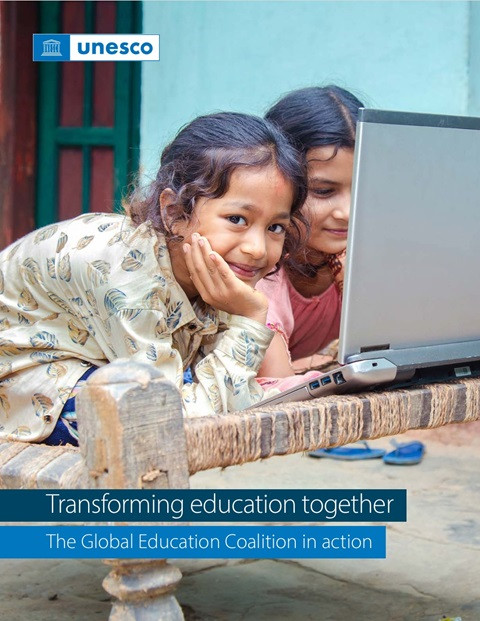 Transforming Education Together: The Global Education Coalition in Action Année de publication: 2023 Auteur institutionnel: UNESCO The Global Education Coalition, launched by UNESCO, is a platform for col-laboration and exchange to protect the right to education during this unprec-edented disruption and beyond. This is the fourth progress report of the Coalition and builds on the inaugural document released in September 2020 and the first annual report published in March 2021. This document covers activity between November 2021 and March 2023.
  International Forum on AI and Education: Steering AI To Empower Teachers and Transform Teaching, 5–6 December 2022; Analytical Report Année de publication: 2023 Auteur: Fengchun Miao | Kelly Shiohira | Zaahedah Vally | Wayne Holmes Auteur institutionnel: UNESCO | JET Education Services The International Forum on AI and Education has contributed ‘to peace and security by promoting collaboration among the nations through education, science and culture’ (UNESCO, 1945). The Forum has now become the world’s leading event promoting knowledge-sharing, the understanding of peoples, and the achievement of international agreements, in the fast-developing and increasingly impactful field of AI and education. The fourth edition of the International Forum on Artificial Intelligence and Education aimed to foster knowledge sharing specifically on how to steer the design and use of AI to empower teachers and to transform teaching methodologies within the broad framework of digital transformation of education. The Forum sought to bring together a range of expertise and experiences across the globe, and, in keeping with UNESCO priorities, a special focus was placed on Africa. A total of 16 national strategies were presented at the Forum by the various national ministers and representatives invited to attend. The national strategies shared during the Forum also unveiled the varying levels of preparedness and policy responses toward AI across different regions, a reminder that the pre-existing digital divide still underpins the system-wide uptake and integration of AI in education. Therefore, not all of the strategies were directly related to or containing AI because some areas that were represented at the conference are still at the nascent stages of AI Strategy development. The presentations of national initiatives and strategies related to AI from these countries shed light on the general awareness of policy-makers on the impact of AI in education and the commitment of national governments to fostering AI competencies among students and teachers. This report focus on the following key themes: national strategies on AI and education; critical reviews of roles of AI in the digital transformation of education; ethical principles and their implementation with a specific focus on gender equality; AI competencies for teachers, and notable algorithms or AI platforms and AI-informed pedagogies. The report concludes with considerations for the future based on the authors’ own analysis of the key role of human teachers, steering the human-centered approach, mainstreaming gender equity, designing education-specific AI models and innovative pedagogy, and ensuring human agency in defining problems and designing solutions.a