
Ressources
Explorez une large gamme de ressources sur le GCED afin d’approfondir votre compréhension et de renforcer vos activités de recherche, de plaidoyer, d’enseignement et d’apprentissage.
1,444 résultats trouvés
 تقرير المديرة العامة لمنظمة الأمم المتحدة للتربية والعلم والثقافة عن متابعة تنفيذ الإعلان وبرنامج العمل المتعلقين بثقافة السلام Année de publication: 2013 Auteur institutionnel: United Nations. Secretary-General, 2007-2016 (Ban, Ki-moon) | UNESCO. Director-General, 2009-2017 (Bokova, I.G.) هذا هو تقريـر مقـدم مـن المـديرة العامـة لمنظمـة الأمـم المتحـدة للتربيـة والعلم والثقافة عملاً بقرار الجمعية العامة ٦٧/١، لمتابعة تنفيذ الإعلان وبرنامج العمل المتعلقين بثقافة السلام. وقد استعرضت المديرة العامة لمحة عامة عن الأنشطة المنفذة لترويج ثقافة السلام واللاعنف، بالاشتراك مع منظمة الأمم المتحدة للتربية والعلم والثقافة (اليونيسكو) باعتبارها الوكالة الرائدة في منظومة الأمم المتحدة المعنية بهذا الموضوع.
  Final Report: 2nd Youth Leadership Workshop on Global Citizenship Education Année de publication: 2016 Auteur institutionnel: APCEIU This report provides an overview of the activities carried out during the 2nd Youth Leadership Workshop on Global Citizenship Education (GCED) held in Busan, Republic of Korea, from 11 - 16 July 2016. As an APCEIU's 2nd youth workshop, this programme gathered 49 youth activists from 38 countries around the world to exchange their ideas and identify GCED leadership strategies in order to mobilize young people for GCED in local and national contexts and advance the agenda globally. This report also aims to convey the voice of the youth on GCED: their thoughts and reflections on GCED and its priority areas. The workshop was co-organized by APCEIU and UN Secretary General’s Global Education First Initiative (GEFI); it was sponsored by Busan University of Foreign Studies and the Geum-jeong District of Busan Metropolitan City. For more information, please contact APCEIU's Office of Education and Training at ent@unescoapceiu.org. 제2차 세계시민교육 청년리더십 워크숍 최종보고서 Année de publication: 2016 Auteur institutionnel: 유네스코 아시아태평양 국제이해교육원 본 보고서는 2016년 7월 11일부터 16일까지 부산에서 열린 ‘제2차 세계시민교육 청년리더십 워크숍(2nd Youth Leadership Workshop on GCED)’에서 이루어진 활동 개요를 제공한다. 이 워크숍은 유네스코 아태교육원과 유엔 사무총장의 글로벌교육우선구상(GEFI)가 공동주최하고 부산외국어대학교와 부산광역시 금정구가 후원하였다.이 프로그램에 전세계 38개국 49명의 청년활동가들이 참가하여 세계시민교육에 대한 아이디어를 교환하며, 세계시민교육을 전 세계적으로 확산하고 지역·국가적 차원의 청년활동을 증진하기 위한 리더십 전략을 논의하였다. 본 보고서는 6일간의 워크숍 활동들에 대한 기록과 더불어 세계시민교육의 주체로서 청년들의 세계시민교육의 의미와 우선 과제들에 대한 목소리를 담고자 했다. 문의: 유네스코 아태교육원 교육연수실(ent@unescoapceiu.org)
  Final Report: 2016 UNESCO/KOICA Joint Fellowship Programme Année de publication: 2016 Auteur institutionnel: APCEIU This report provides an overview of the activities carried out during the 2016 UNESCO/KOICA Joint Fellowship Programme held in Republic of Korea from 1 September - 31 October, 2016.In its 10th year of implementation, UNESCO/KOICA Joint Fellowship Programme 2016 invited 25 educators from 17 countries in Africa and the Asia-Pacific region for two months; from September 1st to October 31st. The overarching goal of the Programme was to enhance the capacities of participating educators under the themes of “Teacher Training for Basic Education,” “Use of ICT for Education (or e-Learning),” “Leadership in Global Education” and “Girls’ Education.” Composed of various segments such as lectures, workshops, hands-on activities, and seminars, which were closely interlinked with each module, the modules were designed to enable the participants to reorient their perspectives on educational development, to gain essential knowledge and skills, and furthermore to produce meaningful and relevant outputs that could be widely applied in their local contexts.For more information, please contact APCEIU's Office of Education and Training at ent@unescoapceiu.org.
 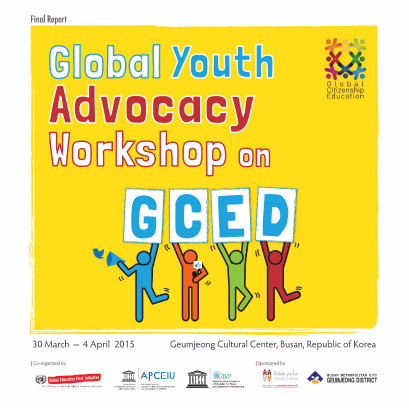 Global youth advocacy workshop on GCED: final report Année de publication: 2015 Auteur institutionnel: APCEIU The United Nations Secretary-General's Global Education First Initiative (GEFI) recognizes Global Citizenship Education (GCED) as one of its three priorities. UNSG GEFI has generated momentum for GCED which has since been in the target of the education goal in the Muscat Agreement 2014 and in the proposed Sustainable Development Goals (SDGs) of the Open Working Group. The proposed SDGs will provide the basis for further intergovernmental negotiations on the post 2014 development agenda.In support of UNSG GEFI, UNESCO held its Second Global Forum on Global Citizenship Education on Building Peaceful and Sustainable Societies: Preparing for Post-2015 from 28 to 30 January 2015 in Paris, France. The forum aimed to identify GCED related inputs to the emerging Framework for Action on Education for the post 2015 development agenda, as well as key dimensions of GCED in relation to peace. Furthermore, it had a concurrent session dedicated to youth on Driving the GCED Agenda Forward: Acting with and for Young People to assemble the perspectives, ideas, and priorities of youth on GCED. Against this background, the Global Youth Advocacy Workshop on GCED, co-organized by GEFI, the Asia-Pacific Centre of Education for International Understanding (APCEIU) and UNESCO's Mahatma Gandhi Institute of Education for Peace and Sustainable Development (MGIEP) aimed to build the capacity of dynamic youth leaders from countries around the world to advocate for GCED. The participants of the workshop were selected on the basis of their previous experiences, present engagement, and future commitment in educating youth at the local and national levels. The objectives of the workshop were: 1. To build a common understanding of GCED and its key priority areas by building on the dialogue initiated at the Paris GCED Forum.2. To allow the participating youth leaders to elaborate an advocacy strategy suitable for implementation at the local and national levels to advance the GCED agenda beyond 2015.3. To establish a wider network of youth advocates on GCED to advance the agenda globally. La jeunesse mondiale atelier de plaidoyer sur ECM: rapport final Année de publication: 2015 Auteur institutionnel: Centre Asie-Pacifique d'éducation pour la compréhension internationale (APCEIU) À l'appui de SGNU GEFI, l'UNESCO a tenu son Forum mondial Deuxième sur L'éducation à la citoyenneté Mondiale (ECM) sur la construction de sociétés pacifiques et durables: Préparation de L'après 2015 du 28 au 30 Janvier 2015 à Paris, France. Le forum visait à identifier les entrées liées à l'ECM au Cadre émergent d'action sur l'éducation pour le programme de développement post 2015, ainsi que les dimensions clés de l'ECM par rapport à la paix. En outre, il a eu une séance simultanée dédiée aux jeunes sur la conduite du ECM Agenda Forward: Agir avec et pour les jeunes à assembler les perspectives, les idées et les priorités de la jeunesse sur ECM. Dans ce contexte, l'atelier de plaidoyer mondial de la jeunesse sur ECM, co-organisé par GEFI, le Centre Asie-Pacifique d'éducation pour la compréhension internationale (APCECI) et de l'Institut Mahatma Gandhi de l'UNESCO de l'éducation pour la paix et le développement durable (MGIEP) visant à construire le la capacité des jeunes leaders dynamiques des pays du monde entier à plaider pour ECM. Les participants de l'atelier ont été sélectionnés sur la base de leurs expériences précédentes, l'engagement présent et futur engagement dans l'éducation des jeunes aux niveaux local et national. Les objectifs de l'atelier étaient les suivants: 1. Pour construire une compréhension commune de l'ECM et de ses domaines prioritaires en misant sur le dialogue initié lors du Forum ECM Paris. 2. Pour permettre aux jeunes leaders participants d'élaborer une stratégie de plaidoyer approprié pour la mise en œuvre aux niveaux local et national pour faire avancer l'ordre du jour de l'ECM au-delà de 2015. 3. Pour établir un réseau plus large de défenseurs des jeunes sur ECM pour faire avancer l'ordre du jour à l'échelle mondiale. 글로벌시민교육 청소년 리더십 워크숍 최종보고서 Année de publication: 2015 Auteur institutionnel: 유네스코 아시아태평양 국제이해교육원 본 보고서는 2015년 3월 30일부터 4월 4일까지 부산에서 열린 ‘글로벌시민교육 청소년 리더십 워크숍(Global Youth Advocacy Workshop on GCED)’의 최종보고서이다. 이번 워크숍은 글로벌시민교육 청소년 옹호활동에 초점을 둔 첫 번째 워크숍으로서, 전세계 34개국에서 45명의 청소년 활동가들이 참가하여 글로벌시민교육에 대한 아이디어를 교환하며, 글로벌시민교육을 전 세계적으로 확산하고 지역·국가적 차원의 청소년 글로벌시민교육 활동을 증진하기 위한 핵심 전략을 논의하는 장이었다. 본 보고서는 6일 간의 워크숍 활동들에 대한 기록과 더불어 글로벌시민교육의 주체로서 글로벌시민교육의 의미와 우선 과제들에 대한 젊은이들의 목소리를 담고자 했다. 본 워크숍은 유네스코 아태교육원과 유엔 사무총장의 글로벌교육우선구상(GEFI), 유네스코 마하트마간디 평화지속가능발전교육원(MGIEP)가 공동주최하고 부산시 금정구와 에듀케이트어차일드(Educate A Child)가 후원했다.문의: 유네스코 아태교육원 교육연수팀(ent@unescoapceiu.org)
 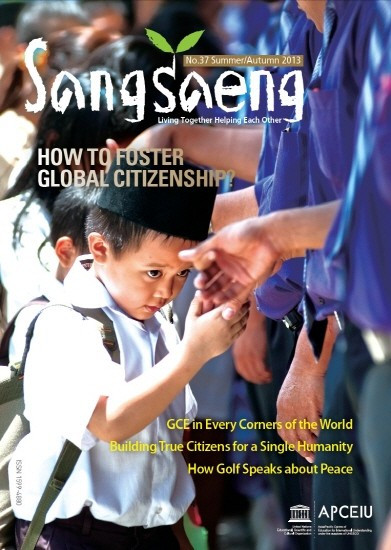 Paving the way together for global citizenship education (SangSaeng no. 37 summer autumn 2013) Année de publication: 2013 Auteur institutionnel: APCEIU SangSaeng No. 37- How to Foster Global Citizenship? has been published. In order to help our readers better grasp the concept of global citizenship and provide useful information and new ideas, this issue deals with various aspects of global citizenship education.3 Director’s Message4 Special ColumnBuilding True Citizens for a Single Humanity8 Focus: How to Foster Global Citizenship?8 Eliminating World Challenges through Global Citizenship Education 13 Developing Global Citizens with a Global Perspective18 Living in a New World Starts with Education23 GCE in Every Corners of the World28 Best Practices28 Hands-on Hand Print for Environmental Sustainability32 Bhutan Teachers Learn New Models of Education35 Comic Relief: Song of the City36 Special ReportPaving the Way Together for Global Citizenship Education40 InterviewBuilding a Global Community out of the Ashes of Poverty42 LetterCapturing Moments of Living in Harmony44 Peace in My MemoryHow Golf Speaks about Peace47 Understanding the Asia-Pacific RegionDiscovering Locks beyond the Function of Opening and Closing50 APCEIU in Action
  Final Report: 18th Asia-Pacific Training Workshop on EIU Année de publication: 2018 Auteur institutionnel: APCEIU This report is the summary of the 18th Asia-Pacific Workshop on EIU (APTW) held in the Republic of Korea from 20 to 28 July 2018. Designed as TOT (Training of Trainers), the Workshop has invited 31 teacher educators/trainers from the Asia-Pacific region, strengthening their capacities to carry out Global Citizenship Education in their respective institutions and countries.
 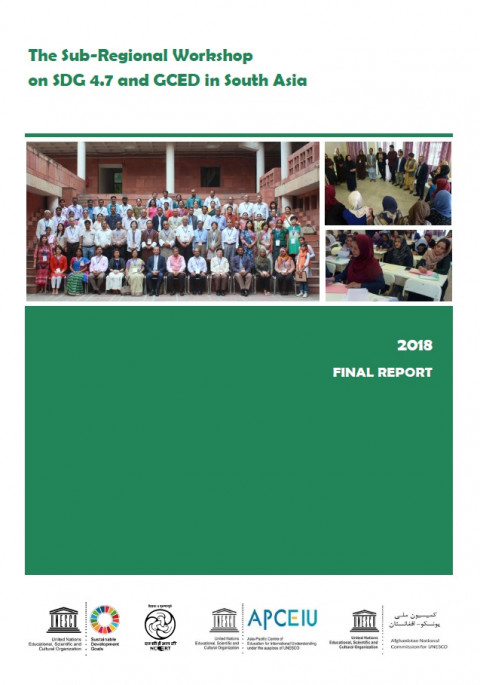 Final Report: 2018 Sub-regional Workshop on SDG 4.7 and GCED Année de publication: 2018 Auteur institutionnel: APCEIU This report is the summary of the Sub-regional Workshop on SDG 4.7 and GCED in South Asia. Implemented by two occasions, the Workshop has offered the platform for the key educators from the South Asian region to discuss GCED in the regional context of achieving SDG 4.7. The report provides the overview of the two workshops held in India and Afghanistan in 2018.