
Ressources
Explorez une large gamme de ressources sur le GCED afin d’approfondir votre compréhension et de renforcer vos activités de recherche, de plaidoyer, d’enseignement et d’apprentissage.
2,199 résultats trouvés
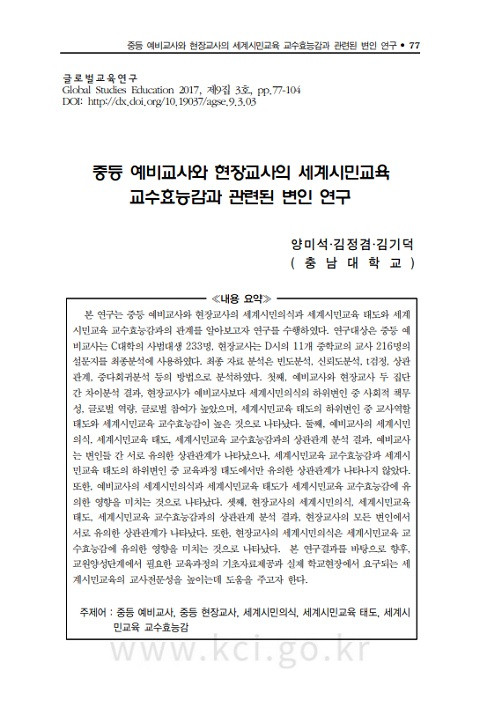 중등 예비교사와 현장교사의 세계시민교육 교수효능감과 관련된 변인 연구 (글로벌교육연구; Vol. 9, No. 3) Année de publication: 2017 Auteur: 양미석 | 김정겸 | 김기덕 Auteur institutionnel: 글로벌교육연구학회 본 연구는 중등 예비교사와 현장교사의 세계시민의식과 세계시민교육 태도와 세계시민교육 교수효능감과의 관계를 알아보고자 연구를 수행하였다. 연구대상은 중등 예비교사는 C대학의 사범대생 233명, 현장교사는 D시의 11개 중학교의 교사 216명의 설문지를 최종분석에 사용하였다. 최종 자료 분석은 빈도분석, 신뢰도분석, t검정, 상관관계, 중다회귀분석 등의 방법으로 분석하였다. 첫째, 예비교사와 현장교사 두 집단 간 차이분석 결과, 현장교사가 예비교사보다 세계시민의식의 하위변인 중 사회적 책무성, 글로벌 역량, 글로벌 참여가 높았으며, 세계시민교육 태도의 하위변인 중 교사역할 태도와 세계시민교육 교수효능감이 높은 것으로 나타났다. 둘째, 예비교사의 세계시민의식, 세계시민교육 태도, 세계시민교육 교수효능감과의 상관관계 분석 결과, 예비교사는 변인들 간 서로 유의한 상관관계가 나타났으나, 세계시민교육 교수효능감과 세계시민교육 태도의 하위변인 중 교육과정 태도에서만 유의한 상관관계가 나타나지 않았다. 또한, 예비교사의 세계시민의식과 세계시민교육 태도가 세계시민교육 교수효능감에 유의한 영향을 미치는 것으로 나타났다. 셋째, 현장교사의 세계시민의식, 세계시민교육 태도, 세계시민교육 교수효능감과의 상관관계 분석 결과, 현장교사의 모든 변인에서 서로 유의한 상관관계가 나타났다. 또한, 현장교사의 세계시민의식은 세계시민교육 교수효능감에 유의한 영향을 미치는 것으로 나타났다. 본 연구결과를 바탕으로 향후, 교원양성단계에서 필요한 교육과정의 기초자료제공과 실제 학교현장에서 요구되는 세계시민교육의 교사전문성을 높이는데 도움을 주고자 한다.
 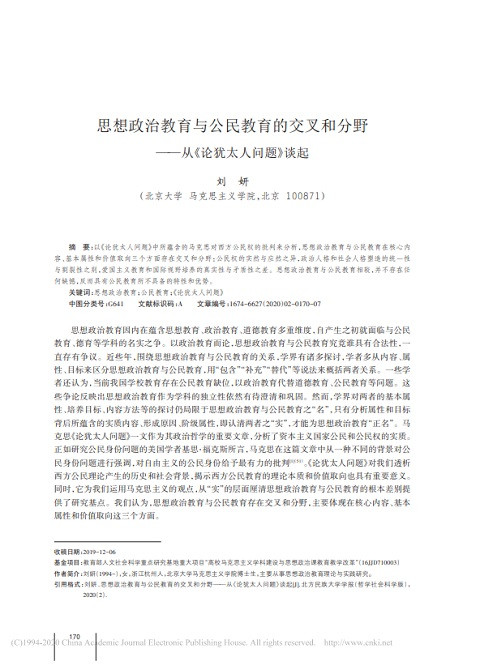 The Intersection and Division between Ideological and Political Education and Civic Education: Starting from the question of the Jewish Question (Journal of North Minzu University; No. 2) Année de publication: 2020 Auteur: Liu Yan Auteur institutionnel: North Minzu University Based on the analysis of Marx’s critique of western citizenship contained in On the Jewish Question, ideological and political education and citizenship education have overlaps and divergences in three aspects, core content, basic attributes and value orientation:the difference between actual and expected of citizenship, the difference between the unity and fragmentation of political personality and social personality, the difference between the authenticity and contradiction of patriotism education and the cultivation of international vision. Compared with civic education, ideological and political education does not have any regrets, but has characteristics and advantages that civic education does not have.
 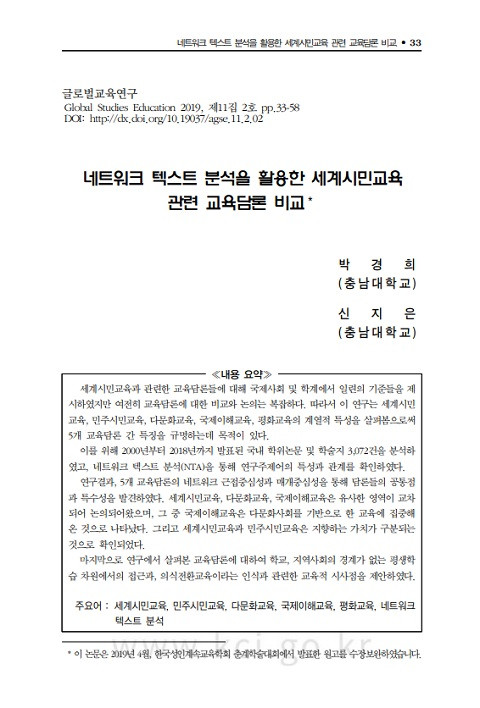 Comparison on Educational Discourses About Global Citizenship Education Using Network Text Analysis (Global Studies Education; Vol. 11, No. 2) Année de publication: 2019 Auteur: Kyunghee Park | JiEun Shin Auteur institutionnel: Association of | Global Studies Education The purpose of this study is to analyze the differences between ‘global citizenship education’, ‘democratic civic education’, ‘multicultural education’, ‘education for international understanding’, and ‘peace education’. For this, 3,072 research papers from 2000 to 2018 selected, and network text analysis(NTA) was conducted to confirm the characteristics and changes of the five educational discourses. As a result, the commonness and specificities of them were derived through the ‘closeness centrality’ and ‘betweenness centrality’ on the NTA. ‘Global citizenship education’, ‘multicultural education’, and ‘education for international understanding’ have crossed the content area. And ‘education for international understanding’ was based on a multicultural society. The values-oriented between ‘global citizenship education’ and ‘democratic civic education’ were distinguished. Finally, it is suggested that the five educational discourses need to be on the approach of lifelong learning, and they are education oriented toward change in consciousness. 네트워크 텍스트 분석을 활용한 세계시민교육 관련 교육담론 비교 (글로벌교육연구; Vol. 11, No. 2) Année de publication: 2019 Auteur: 박경희 | 신지은 Auteur institutionnel: 글로벌교육연구학회 세계시민교육과 관련한 교육담론들에 대해 국제사회 및 학계에서 일련의 기준들을 제시하였지만 여전히 교육담론에 대한 비교와 논의는 복잡하다. 따라서 이 연구는 세계시민교육, 민주시민교육, 다문화교육, 국제이해교육, 평화교육의 계열적 특성을 살펴봄으로써 5개 교육담론 간 특징을 규명하는데 목적이 있다. 이를 위해 2000년부터 2018년까지 발표된 국내 학위논문 및 학술지 3,072건을 분석하였고, 네트워크 텍스트 분석(NTA)을 통해 연구주제어의 특성과 관계를 확인하였다. 연구결과, 5개 교육담론의 네트워크 근접중심성과 매개중심성을 통해 담론들의 공통점과 특수성을 발견하였다. 세계시민교육, 다문화교육, 국제이해교육은 유사한 영역이 교차되어 논의되어왔으며, 그 중 국제이해교육은 다문화사회를 기반으로 한 교육에 집중해 온 것으로 나타났다. 그리고 세계시민교육과 민주시민교육은 지향하는 가치가 구분되는 것으로 확인되었다. 마지막으로 연구에서 살펴본 교육담론에 대하여 학교, 지역사회의 경계가 없는 평생학습 차원에서의 접근과, 의식전환교육이라는 인식과 관련한 교육적 시사점을 제안하였다.
 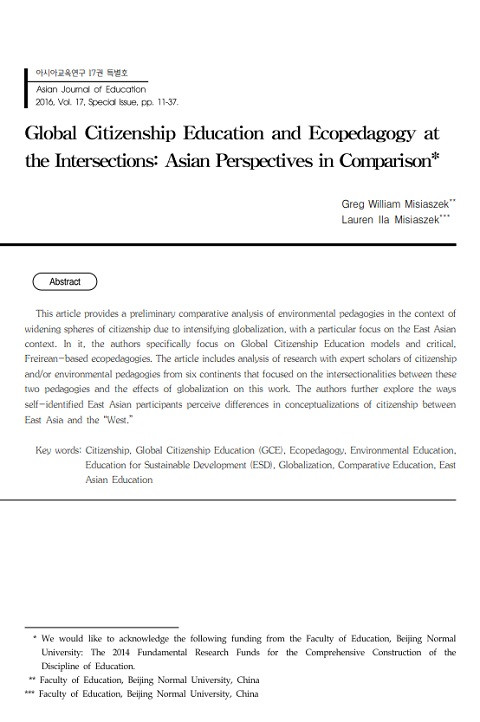 Global Citizenship Education and Ecopedagogy at the Intersections: Asian Perspectives in Comparison (Asian Journal of Education; Vol. 17, Special Issue) Année de publication: 2016 Auteur: Greg William Misiaszek | Lauren Ila Misiaszek Auteur institutionnel: Seoul National University. Education Research Institute This article provides a preliminary comparative analysis of environmental pedagogies in the context of widening spheres of citizenship due to intensifying globalization, with a particular focus on the East Asian context. In it, the authors specifically focus on Global Citizenship Education models and critical, Freirean-based ecopedagogies. The article includes analysis of research with expert scholars of citizenship and/or environmental pedagogies from six continents that focused on the intersectionalities between these two pedagogies and the effects of globalization on this work. The authors further explore the ways self-identified East Asian participants perceive differences in conceptualizations of citizenship between East Asia and the “West.”
  A Desirable and Practical Approach to Global Citizenship Education: An Exploration of “Global Storylines” in Scotland (Studies in Foreign Education; Vol. 47, No. 3) Année de publication: 2020 Auteur: Rao Shuqi Auteur institutionnel: Northeast Normal University The problems that global citizenship education has to deal with are threefold. “Global Storylines”, which provides corresponding solutions to practical difficulties, has emerged as the most effective approach to global citizenship education in Scotland. Firstly, global citizenship education has enjoyed a long continuity of government support. Through integrating with the current curriculum landscape, “Global Storylines” experiences secure curriculum status. Secondly, by utilizing “storylines” and educational drama, global society and global issues are introduced in subtle forms, which benefits students’ experienced-based learning. The contradiction between students’ cognitive need and ability is resolved accordingly. Thirdly, WOSDEC as the co-creator of “Global Storylines” offers a professional learning program. Teachers are universally supported in terms of theoretical knowledge, practical skills and being involved in the teaching community of global citizenship education.
 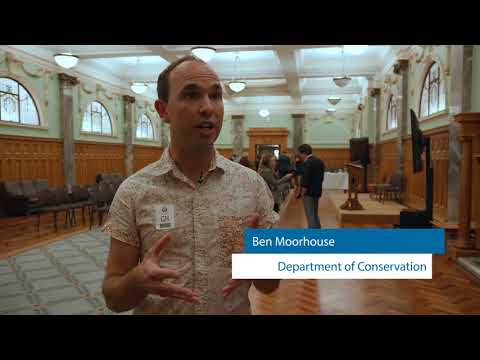 What Does Global Citizenship Education Mean to You? Année de publication: 2018 Auteur institutionnel: New Zealand National Commission for UNESCO At our 2018 Global Citizenship Education Awards (GCED) ceremony, hosted at Parliament by Associate Minister for Education Hon Jenny Salesa, people were asked what GCED meant to them.
 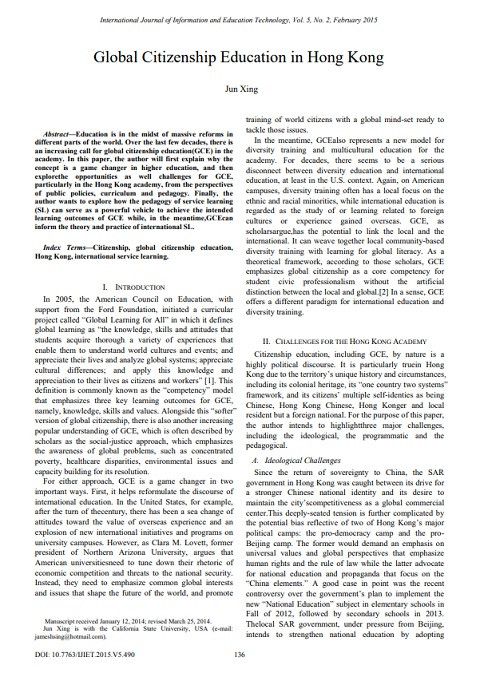 Global Citizenship Education in Hong Kong Année de publication: 2015 Auteur: Jun Xing Auteur institutionnel: IACSIT Press Education is in the midst of massive reforms in different parts of the world. Over the last few decades, there is an increasing call for global citizenship education(GCE) in the academy. In this paper, the author will first explain why the concept is a game changer in higher education, and then explorethe opportunities as well challenges for GCE, particularly in the Hong Kong academy, from the perspectives of public policies, curriculum and pedagogy. Finally, the author wants to explore how the pedagogy of service learning (SL) can serve as a powerful vehicle to achieve the intended learning outcomes of GCE while, in the meantime, GCEcan inform the theory and practice of international SL.
 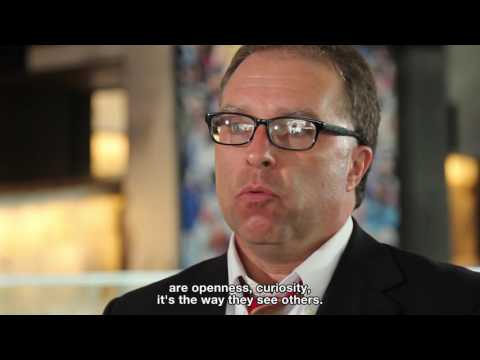 Citoyenneté mondiale: Citoyens du monde au 21e siècle Année de publication: 2016 Auteur institutionnel: Conseil Arts Canada Des participants de la Conférence nationale des écoles UNESCO se sont exprimés sur la définition de la citoyenneté mondiale et sur les qualités d'un citoyen du monde. L’événement avait lieu dans le cadre de la 56e Assemblée générale annuelle de la Commission canadienne pour l’UNESCO et avait pour but de promouvoir le rôle de chef de file de l'UNESCO dans l'Agenda 2030 pour l'éducation. Cette vidéo a été produite au Musée canadien pour les droits de la personne, à Winnipeg, au Manitoba.
 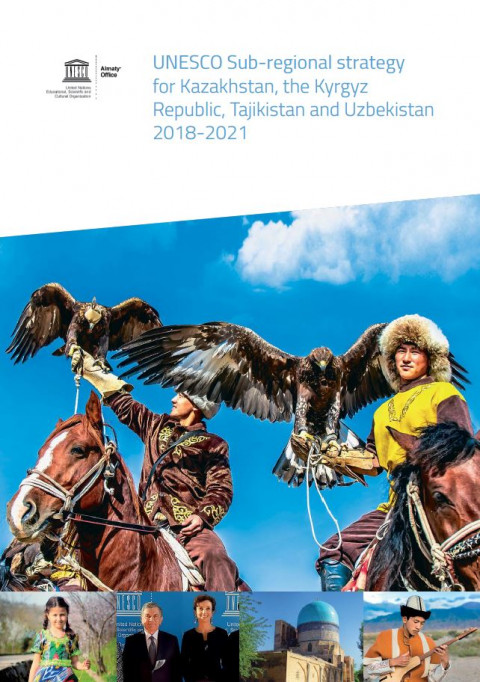 UNESCO Sub-regional Strategy for Kazakhstan, the Kyrgyz Republic, Tajikistan and Uzbekistan 2018-2021 Année de publication: 2019 Auteur institutionnel: UNESCO Almaty This document represents the strategic framework for UNESCO’s interaction with the governments and civil societies of Kazakhstan, the Kyrgyz Republic, Tajikistan and Uzbekistan, with other UN agencies and development partners aimed at responding most effectively to the development needs, priorities and aspirations of countries.