
Ressources
Explorez une large gamme de ressources sur le GCED afin d’approfondir votre compréhension et de renforcer vos activités de recherche, de plaidoyer, d’enseignement et d’apprentissage.
1,402 résultats trouvés
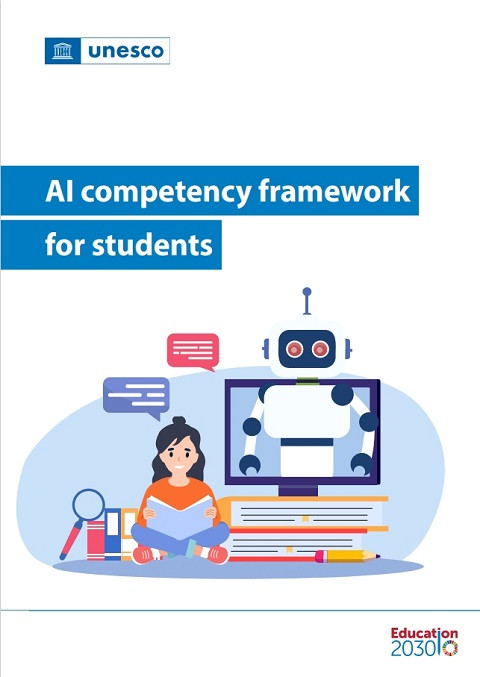 AI Competency Framework for Students Année de publication: 2024 Auteur: Fengchun Miao | Kelly Shiohira Auteur institutionnel: UNESCO Artificial intelligence is increasingly integral to our lives, necessitating proactive education systems to prepare students as responsible users and co-creators of AI. Integrating AI learning objectives into official school curricula is crucial for students globally to engage with AI safely and meaningfully.The UNESCO AI Competency Framework for Students aims to help educators in this integration, outlining 12 competncies across four dimensions:- A human-centred mindset- Ethics of AI- AI techniques and applications- AI system designThese competencies span three progression levels:- Understand- Apply- Create The framework details curricular goals and domain-specific pedagogical methodologies.Grounded in the vision of students as AI co-creators and responsible citizens, the publication emphasizes critical judgement of AI solutions, awareness of citizenship responsibilities in the AI era, foundational AI knowledge for lifelong learning, and inclusive, sustainable AI design.
 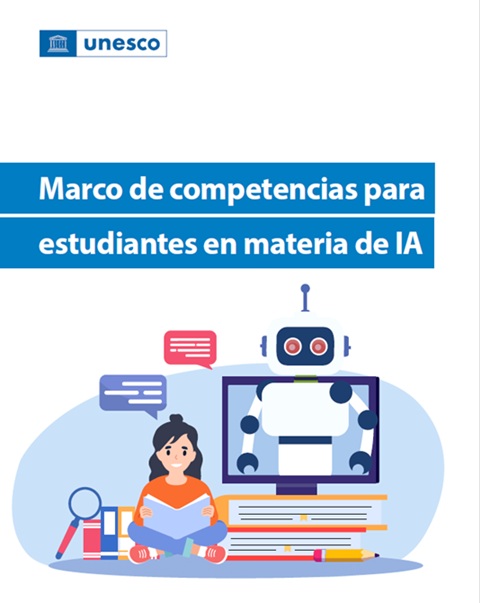 AI Competency Framework for Students Année de publication: 2025 Auteur: Fengchun Miao | Kelly Shiohira Auteur institutionnel: UNESCO Preparar a los estudiantes para ser ciudadanos responsables y creativos en la era de la IALa inteligencia artificial (IA) está cada vez más presente en nuestras vidas, lo que requiere sistemas educativos proactivos que preparen a los estudiantes para que sean usuarios responsables y cocreadores de la IA. Integrar los objetivos de aprendizaje de IA en los programas de estudio oficiales de las escuelas es fundamental para que los estudiantes de todo el mundo interactúen de forma segura y significativa con la IA.El objetivo del Marco de competencias para estudiantes en materia de IA de la UNESCO es ayudar a los educadores con esta integración, para lo cual describe 12 competencias que atraviesan cuatro dimensiones: una forma de pensar centrada en el ser humano, la ética de la IA, las técnicas y aplicaciones de la IA, la pedagogía de la IA, y la IA para el diseño de sistemas de IA. Estas competencias abarcan tres niveles de progresión: comprender, aplicar y crear. El marco detalla las metas curriculares y las metodologías pedagógicas específicas para cada dominio.Basado en una visión de los estudiantes como cocreadores de IA y ciudadanos responsables, el marco pone énfasis en el juicio crítico de las soluciones de IA, la conciencia de las responsabilidades ciudadanas en la era de la IA, el conocimiento fundacional de la IA para el aprendizaje a lo largo de la vida, y el diseño de IA inclusiva y sostenible.
 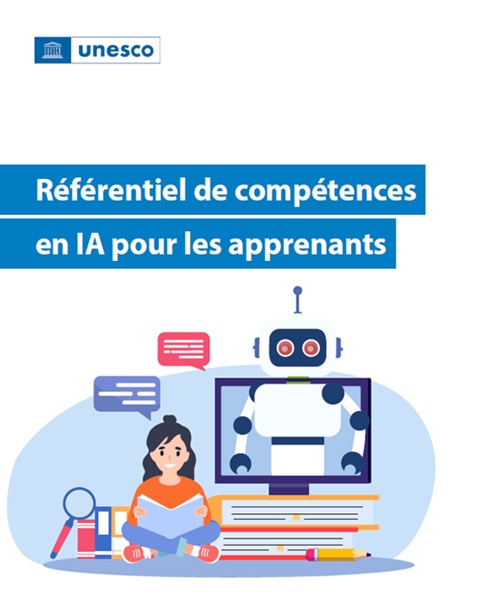 AI Competency Framework for Students Année de publication: 2025 Auteur: Fengchun Miao | Kelly Shiohira Auteur institutionnel: UNESCO Préparer les apprenants à devenir des citoyens responsables et créatifs à l’ère de l’IAL’intelligence artificielle (IA) fait tous les jours davantage partie intégrante de nos vies, ce qui implique d’avoir des systèmes éducatifs proactifs en mesure de préparer les élèves et les étudiants à être des utilisateurs responsables et des cocréateurs de l’IA. L’intégration d’objectifs d’apprentissage de l’IA dans les programmes scolaires officiels est essentielle pour que les apprenants du monde entier puissent s’intéresser en toute sécurité et de manière pertinente à l’IA.Le Référentiel de compétences en IA pour les apprenants de l’UNESCO vise à aider les éducateurs dans cette démarche, en décrivant 12 compétences réparties en quatre dimensions, à savoir une perspective centrée sur l’humain, l’éthique de l’IA, les techniques et applications de l’IA, et la conception de systèmes d’IA. Ces compétences se déploient selon trois niveaux de progression : Comprendre, Appliquer et Créer. Le référentiel détaille les objectifs du programme d’études et les méthodes pédagogiques spécifiques au domaine.Fondé sur une vision des élèves et des étudiants considérés comme cocréateurs de l’IA et citoyens responsables, le référentiel met l’accent sur le jugement critique vis-à-vis des solutions d’IA, la prise de conscience des responsabilités citoyennes à l’ère de l’IA, les connaissances fondamentales en matière d’IA pour l’apprentissage tout au long de la vie, ainsi que la conception d’une IA inclusive et durable.
 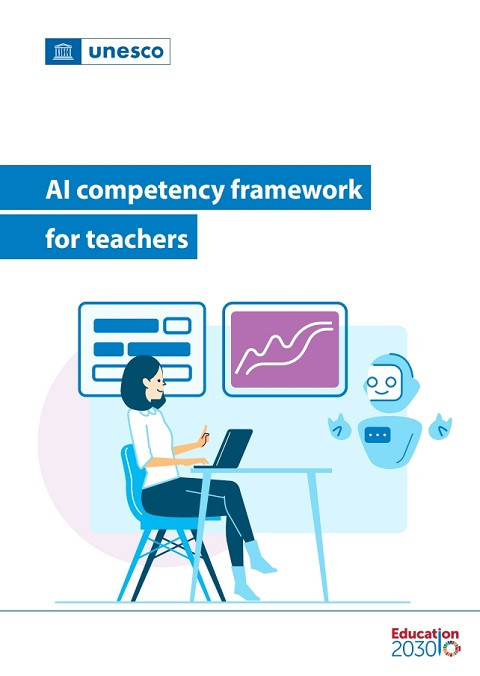 AI Competency Framework for Teachers Année de publication: 2024 Auteur: Fengchun Miao | Mutlu Cukurova Auteur institutionnel: UNESCO AI processes vast information, generates new content, and helps decision-making through predictive analyses. In education, AI has transformed the traditional teacher–student relationship into a teacher–AI–student dynamic.This shift requires a re-examination of teachers’ roles and the competencies they need in the AI era. Yet, few countries have defined these competencies or developed national programmes to train teachers in AI, leaving many educators without proper guidance.The AI competency framework for teachers addresses this gap by defining the knowledge, skills, and values teachers must master in the age of AI. Developed with principles of protecting teachers’ rights, enhancing human agency, and promoting sustainability, the publication outlines 15 competencies across five dimensions: Human-centred mindset, Ethics of AI, AI foundations and applications, AI pedagogy, and AI for professional learning. These competencies are categorized into three progression levels: Acquire, Deepen, and Create.As a global reference, this tool guides the development of national AI competency frameworks, informs teacher training programmes, and helps in designing assessment parameters. It also provides strategies for teachers to build AI knowledge, apply ethical principles, and support their professional growth.
  Normes de qualité des écoles vertes: pour des cadres d’apprentissage verts Année de publication: 2024 Auteur institutionnel: UNESCO Le changement climatique menace notre planète et notre avenir. Les écoles et autres institutions d'apprentissage sont des lieux centraux pour accélérer l'action climatique parmi les apprenants et les communautés locales. En donnant aux enseignants et aux élèves les moyens de comprendre le changement climatique dans leur propre contexte, ils contribuent à rendre les sociétés plus durables et plus résilientes face au climat. Cette publication fournit pour la première fois une norme de qualité pour la « vérdisation » des écoles et autres environnements d'apprentissage. Elle présente quatre domaines clés pour intégrer les principes de durabilité et l'action climatique : 1) la gouvernance scolaire, 2) les infrastructures et l'exploitation, 3) l'enseignement et l'apprentissage, et 4) l'engagement communautaire. Grâce au Partenariat pour une éducation verte, cette norme établit un langage commun pour tous les acteurs afin d'atteindre ensemble l'objectif mondial de verdir au moins 50 % des écoles dans tous les pays d'ici 2030. Les décideurs politiques et les ministères responsables des schémas d'accréditation éducatifs, ainsi que les éducateurs, les apprenants et les communautés, sont encouragés à utiliser la norme de qualité des écoles vertes et à rejoindre le mouvement des écoles prêtes pour le climat, afin de garantir que chaque apprenant soit équipé pour relever les défis climatiques.
  الإرشادات التوجيهية لتخضير مناهج التعليم والتعلّم من أجل العمل المناخيّ Année de publication: 2024 Auteur institutionnel: UNESCO This Guidance responds to the calls from young people for a holistic approach to climate change and sustainability in the curriculum. It outlines a common language on how quality climate change and sustainability can be reflected in the curriculum by setting expected learning outcomes per age group (from 5-year olds and up to 18+ age group, including a lifelong learning approach).This is crucial for accelerating country-level action and ensuring joint monitoring of progress. The objective is to have 90 per cent of all countries include climate change in their curricula by 2030, as established by the Greening Education Partnership.This Guidance aims to support countries, schools or individual practitioners in reassessing their ongoing practices to adopt a more action-oriented, holistic, scientifically accurate, justice-driven and lifelong learning approach to climate change.
 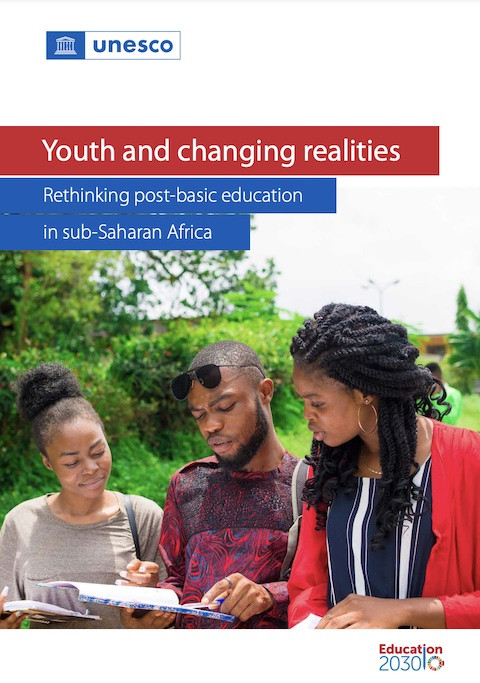 Youth and Changing Realities: Rethinking Post-basic Education in Sub-Saharan Africa Année de publication: 2022 Auteur institutionnel: Организация Объединенных Наций по вопросам образования, науки и культуры (UNESCO) Education should empower young people for full participation in their societies and education systems should be responsive to their voices, aspirations and actions. At this time of upheaval, it is more important than ever that youth voices are heard. This synthesis report analyses the perspectives of post-basic education of some young people from 20 countries in sub-Saharan Africa. Their voices express diverse experiences, aspirations and expectations. They describe ‘changing realities’ in which education and training opportunities often seem unable to meet their aspirations and new demands of the world of work and society. It focusses on four crucial themes for post-basic education, with reference to youth’s experiences: financing, socio-cultural barriers, skills for work and life, and educators’ capacities.The Education 2030 Framework for Action calls for youth, learners and their organizations to be full partners in the realization of SDG4; to encourage governments and other stakeholders to develop education programmes in consultation with young people; and to help shape policies for relevant and responsive education systems. This synthesis report makes an important contribution towards rethinking post-basic education in sub-Saharan Africa.
 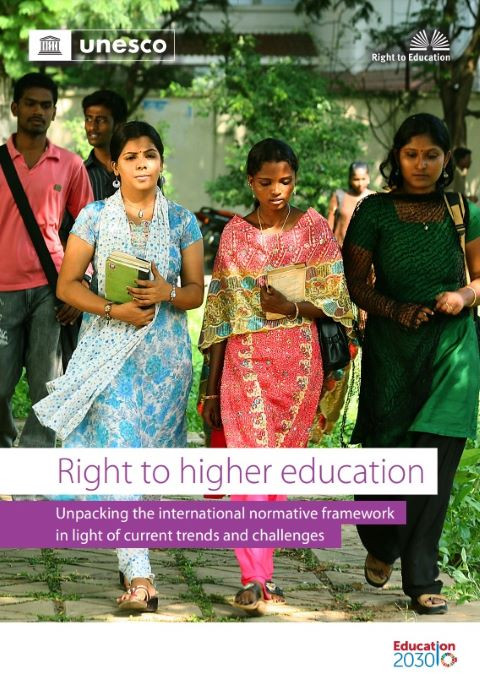 Right to Higher Education: Unpacking the International Normative Framework in Light of Current Trends and Challenges Année de publication: 2022 Auteur institutionnel: UNESCO | Right to Education Initiative (UK) The right to higher education is well-established in international human rights law. It requires states to progressively introduce free higher education and ensure that all have access on the basis of capacity. Yet, access to education is unequal from the very early years, which together with deep-rooted discrimination in education as well as differences in upbringing, often result in unfair admission procedures when reaching higher education. Drastic changes worldwide, due to rising inequalities, human movement, growing digitalization and the effects of the COVID-19 pandemic, are further challenging how this right can be concretely implemented. This publication seeks to bring clarity not only to existing obligations and rights, but also to unravel what aspects of the right to higher education might require further explanation in light of new contexts and challenges. It provides policy recommendations to guide states in their endeavour to ensure effective equal opportunities to higher education for all.
  Berlin Declaration on Education for Sustainable Development: Learn for Our Planet; Act for Sustainability Année de publication: 2022 Auteur institutionnel: UNESCO From 17 May to 19 May 2021 around 2800 people – politicians, business people, youth leaders, scientists, Non-governmental organizations, and many more - from 160 countries came together virtually at the UNESCO World Conference on Education for Sustainable Development (ESD) 2021. During the conference, they expressed their commitment to use the transformative power of education in order to address the global challenges we face. The Berlin Declaration was the main result of the conference. The Berlin Declaration on Education for Sustainable Development is an important document that emphasizes the significance of ESD for each and every one of us. It identifies concrete challenges the global community is facing and calls for changes that are urgently needed in order to fully integrate and strengthen ESD in all educational contexts.
  5th UNESCO Forum on Transformative Education for Sustainable Development, Global Citizenship, Health and Well-Being: Recommendations for Action Towards Transformative Education Année de publication: 2022 Auteur institutionnel: UNESCO In light of contemporary and emerging challenges such as climate change, violent and hateful ideologies, conflicts and risks of global pandemics, education must teach young people the knowledge, skills, values and attitudes to live cooperatively, be flexible, think critically, respect diversity, care for the environment, and be actively involved in finding solutions, both locally and globally. Transformative education – as enshrined in Target 4.7 of Sustainable Development Goal 4 – is critical in supporting individuals to develop these competencies. Transformative education involves teaching and learning that motivates and empowers learners to make informed decisions and actions at the individual, community and global levels. With a focus on sustainability, global citizenship, health and well-being for all, transformative education implies ensuring that curriculum, pedagogy, learning materials, schools and learning environments are meaningful for the social, political, economic, cultural and environmental contexts. To better understand concrete progress in transformative education, UNESCO and the Asia Pacific Centre of Education for International Understanding (APCEIU) co-organized the 5th UNESCO Forum on Transformative Education for Sustainable Development, Global Citizenship, Health and Well-being (29 November – 1 December 2021).The conference enabled a productive dialogue among a diverse range of actors from the fields of education for sustainable development (ESD), global citizenship education (GCED), education for health and wellbeing under the broader “banner” of transformative education.