
Ressources
Explorez une large gamme de ressources sur le GCED afin d’approfondir votre compréhension et de renforcer vos activités de recherche, de plaidoyer, d’enseignement et d’apprentissage.
2,668 résultats trouvés
 Using archival documents, memoir, and testimony to teach about Jewish families during and after the Holocaust Carson Phillips suggests the use of archival documents, memoir and recorded testimony to engage students in learning. Use the three survivor testimonies below, from Czechoslovakia, Hungary and Croatia, in conjunction with those in the Gurewitsch essay (pp. 48–55) for a rich and varied look at the fraught experiences of Jewish families struggling to survive and, ultimately, rebuild their lives. (By the publisher) Holocaust Education in Post-Communist Romania As Israeli historian Leon Volovici noted in a recent article, Romania today is marked by the concurrent presence of a prolific nationalistic media with strong anti-Semitic accents and a swell of events dedicated to the history of its Jews. This remarkable paradox is perhaps just one more example of the originality of Romania’s post-communist transition, the more so since the object of both trends is becoming less and less numerous every day: there are only about 9,000, mostly elderly Jews living in contemporary Romania. After 45 years of “relative silence” imposed by the communists and eight more years of “relevant silence” imposed by the neo-communists, as of 1998 the Holocaust is finally mentioned and discussed, but “in the third person”, as it were: it’s true, it happened, but not in Romania! (By the author) Entering the World of a Holocaust Victim: Schoolchildren Discuss a Ghetto Memoir – a Case Study Despite Adorno's famous dictum, the memory of the Shoah features prominently in the cultural legacy of the 20th century and beyond. It has led to a proliferation of works of representation and re-memorialization which have brought in their wake concerns about a 'holocaust industry' and banalization. This volume sheds fresh light on some of the issues, such as the question of silence and denial, of the formation of contemporary identities — German, East European, Jewish or Israeli, the consequences of the legacy of the Shoah for survivors and for the 'second generation,' and the political, ideological, and professional implications of Shoah historiography. One of the conclusions to be drawn from this volume is that the 'Auschwitz code’, invoked in relation to all 'unspeakable' catastrophes, has impoverished our vocabulary; it does not help us remember the Shoah and its victims, but rather erases that memory. (By the author) An Investigation of Conflict Management in Cambodian Villages: A Review of the Literature with Suggestions for Future Research Année de publication: 2001 Auteur: Caroline Hughes Auteur institutionnel: Centre for Peace and Development, Cambodia Development Resource Institute This literature review sets out a conceptual framework for the investigation of conflict management in Cambodian villages, and gives suggestions for further research. It places the study of conflict and conflict management in the framework of ideas of a “culture of peace”, and argues that this requires examining questions of both active procedures (agency) and their context (structure) in responses to conflict.
  [Video] Citizenship and Human Rights Education for Change Année de publication: 2019 Auteur institutionnel: Global Campus of Human Rights In increasingly selective, violent and intolerant times, it becomes crucial to reinforce our capacities to deal with topical, controversial and contested issues undermining our human dignity and to promote the supportive values of non-discrimination, democracy, intercultural dialogue and peace. Teaching and learning about democratic citizenship, human rights and EU common values represents an opportunity to react and counter the negative forces of our time.This MOOC aims to foster the promotion of Human Rights Education and EU common values through the transfer of knowledge about the definitions, frameworks and content of Human Rights Education as well as the analysis of existing and innovative practices on teaching styles, approaches and methods.
 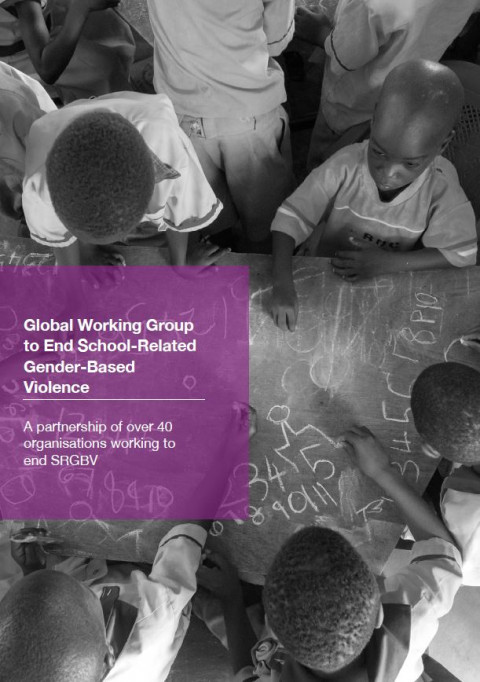 Global Working Group to End School-Related Gender-Based Violence Année de publication: 2017 Auteur institutionnel: United Nations Girls' Education Initiative (UNGEI) In August 2014, a coalition of governments, development organizations, civil society activists, UN agencies and research institutions came together to collaborate on ending gender-based violence in and around schools.The Global Working Group to End SRGBV has been a strong advocate to ensure that schools remain safe places for learning and that girls and boys have the opportunity to acquire the knowledge, skills and resources they need to reach their potential.To learn more about the group and its members, please go here:www.ungei.org/srgbv
  [Video] Transforming Education for Humanity Année de publication: 2017 Auteur institutionnel: Mahatma Gandhi Institute of Education for Peace and Sustainable Development (MGIEP) UNESCO MGIEP focuses on achieving the UN Sustainable Development Goal 4.7 towards education for building peaceful and sustainable societies across the world by developing programmes that promote socio-emotional learning, innovate digital pedagogies and empower the youth.
 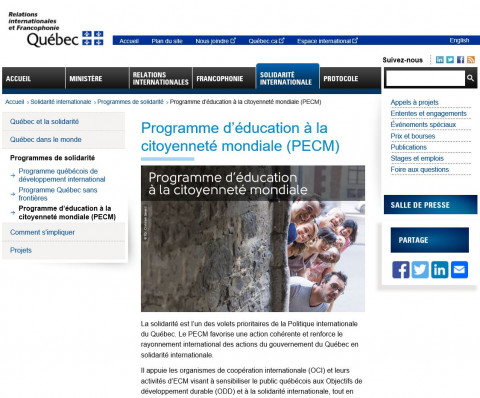 Programme d’éducation à la citoyenneté mondiale (PÉCM) Année de publication: 2018 Auteur institutionnel: Ministère des Relations internationales et de la Francophonie La solidarité est l’un des volets prioritaires de la Politique internationale du Québec. Le PECM favorise une action cohérente et renforce le rayonnement international des actions du gouvernement du Québec en solidarité internationale.Il appuie les organismes de coopération internationale (OCI) et leurs activités d’ECM visant à sensibiliser le public québécois aux Objectifs de développement durable (ODD) et à la solidarité internationale, tout en favorisant l’acquisition de connaissances, de valeurs et de comportements qui contribuent à la mise en place d’un monde plus juste, durable et équitable.
 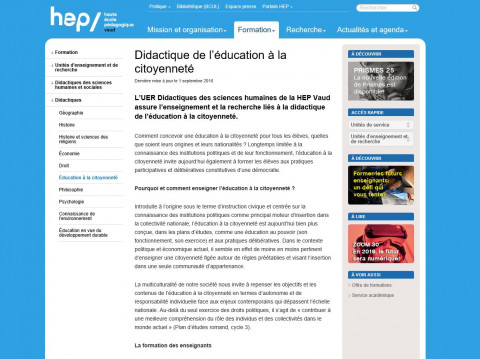 Didactique de l’éducation à la citoyenneté Année de publication: 2016 Auteur institutionnel: Haute école pédagogique Vaud L’UER Didactiques des sciences humaines de la HEP Vaud assure l’enseignement et la recherche liés à la didactique de l’éducation à la citoyenneté.Comment concevoir une éducation à la citoyenneté pour tous les élèves, quelles que soient leurs origines et leurs nationalités ? Longtemps limitée à la connaissance des institutions politiques et de leur fonctionnement, l’éducation à la citoyenneté invite aujourd’hui également à former les élèves aux pratiques participatives et délibératives constitutives d’une démocratie. Introduite à l’origine sous le terme d’instruction civique et centrée sur la connaissance des institutions politiques comme principal moteur d’insertion dans la collectivité nationale, l’éducation à la citoyenneté est aujourd’hui bien plus conçue, dans les plans d’études, comme une éducation au pouvoir (son fonctionnement, son exercice) et aux pratiques délibératives. Dans le contexte politique et économique actuel, il semble en effet de moins en moins pertinent d’enseigner une citoyenneté figée autour de règles préétablies et visant l’insertion dans une seule communauté d’appartenance.
  Éducation à la citoyenneté 3e année (Ressources pour l’éducation à la citoyenneté : L’enseignement intentionnel et direct des compétences essentielles à la citoyenneté) Auteur institutionnel: Concentus Fondation pour L'education a la citoyennete Les citoyens engagés remettent en question, examinent de manière critique, soutiennent et défendent les droits et responsabilités d’une démocratie sur des plans multiples. Ils travaillent à comprendre les problèmes, dissimulés ou manifestes, qui relèvent des enjeux de la citoyenneté et d’élaborer les plans d’action appropriés pour y apporter des solutions. Ils développent aussi leur compréhension des avantages et de la richesse que la diversité et le multiculturalisme apportent aux Canadiens.Les citoyens engagés s’efforcent d’aborder les questions depuis une variété de points de vue. Les élèves vont commencer à explorer les méthodes de résolution des conflits et à examiner et à pratiquer les actions qui contribuent à la paix et à l’ordre. L’exploration du raisonnement critique dans ce domaine de la citoyenneté encourage les élèves à essayer de comprendre un point de vue différent du leur.