
Ressources
Explorez une large gamme de ressources sur le GCED afin d’approfondir votre compréhension et de renforcer vos activités de recherche, de plaidoyer, d’enseignement et d’apprentissage.
1,180 résultats trouvés
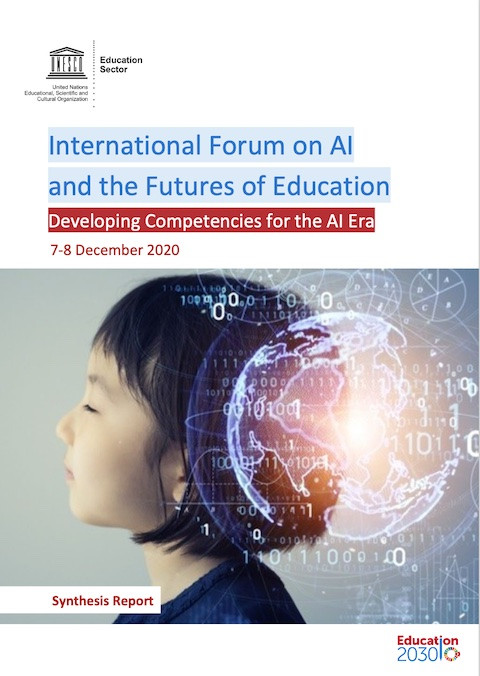 International Forum on AI and the Futures of Education: Developing Competencies for the AI Era Synthesis Report; 7-8 December 2020 Année de publication: 2021 Auteur: Fengchun Miao | Wayne Holmes Auteur institutionnel: UNESCO This synthesis report has been developed by the UNESCO Unit for Technology and Artificial Intelligence in Education within the Future of Learning and Innovation Team, drawing on the International Forum on AI and the Futures of Education held in Beijing and simultaneously online from 7 to 8 December 2020.The Forum underlined the importance of reviewing the very purpose of education, together with the opportunity for real transformation, and the role that AI might play. It is widely acknowledged that current educational practices and educational environment are very rigid, and that the future of education should be more flexible and responsive to changing circumstances and innovation. National education authorities should identify what skills young people need to enable them to live and thrive in the new realities of a constantly changing world, and what digital transformation makes possible in the national and international context. In short, new education models are needed to put students at the centre, to move away from a focus on memorizing content, to integrate the digital and the analogue, and to foster human cognitive, socioemotional and critical skills, all of which might – with foresight and careful attention – be enabled by AI and other digital technologies.
 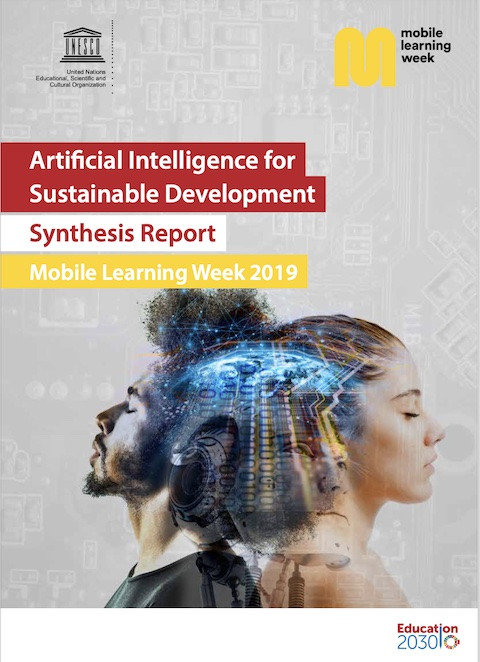 Artificial Intelligence for Sustainable Development: Synthesis Report; Mobile Learning Week 2019 Année de publication: 2019 Auteur institutionnel: UNESCO During the five-day event for Mobile Learning Week 2019, UNESCO gathered participants from around the world to share experiences, initiatives and plan joint actions with a view to harnessing artificial intelligence (AI) to achieve Sustainable Development Goal (SDG) 4. The report stems from the work that the speakers presented and the insights that all the participants shared at the event.
 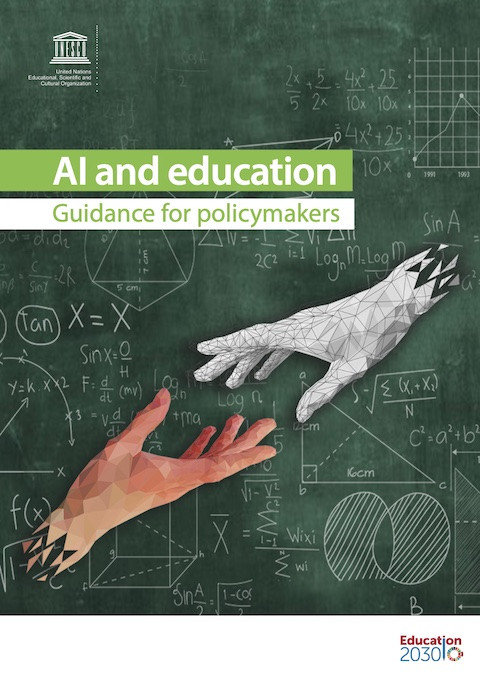 AI and Education: Guidance for Policy-Makers Année de publication: 2021 Auteur: Fengchun Miao | Wayne Holmes | Ronghuai Huang | Hui Zhang Auteur institutionnel: UNESCO Artificial intelligence (AI) is envisioned as a new tool to accelerate the progress towards the achievement of SDG 4. Policies and strategies for using AI in education are central to maximizing AI’s benefits and mitigating its potential risks. Fostering AI-ready policy-makers is the starting point of the policy development process.This publication offers guidance to policy-makers in understanding AI and responding to the challenges and opportunities in education presented by AI. Specifically, it introduces the essentials of AI such as its definition, techniques, technologies, capacities and limitations. It also delineates the emerging practices and benefit-risk assessment on leveraging AI to enhance education and learning, and to ensure inclusion and equity, as well as the reciprocal role of education in preparing humans to live and work with AI.The publication summarizes three approaches to the policy responses from existing practices: independent approach, integrated approach and thematic approach. In a further step, it proposes more detailed recommendations and examples for planning AI and education policies, aligned with the recommendations made in the 2019 Beijing Consensus on AI and Education. 人工智能与教育: 政策制定者指南 Année de publication: 2021 Auteur: Fengchun Miao | Wayne Holmes | Ronghuai Huang | Hui Zhang Auteur institutionnel: UNESCO 该文件为政策制定者提供关于人工智能在教育领域内应用于发展的相关知识,包括其定义与技术一级对教学和教育的影响,并为政策制定者提供相关政策建议。
 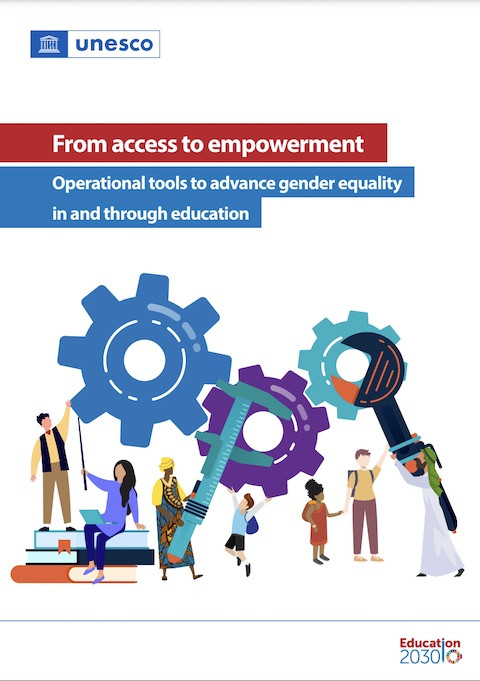 From Access to Empowerment: Operational Tools to Advance Gender Equality in and Through Education Année de publication: 2021 Auteur institutionnel: UNESCO This toolkit has been developed to strengthen individual and institutional capacity to integrate gender equality into education programmes in an effective manner. It has been prepared for all UNESCO Education Sector staff, including those at Headquarters, in Field/Regional/Cluster Offices and in Institutes as well as for implementing partners. This toolkit provides orientation and operational tools to meaningfully integrate gender into all education programmes. The first part provides a short introduction to key concepts on gender equality in and through education and an overview on how gender equality in education links to UNESCO’s vision and internationally agreed objectives. The second part provides practical guidance on how to mainstream gender equality into an education programme, how to design gender-transformative programmes and finally, how to monitor and evaluate gender results in education programmes. Del acceso al empoderamiento: Herramientas operativas para promover la igualdad de género en y a través de la educación Année de publication: 2021 Auteur institutionnel: UNESCO Esta guía se ha desarrollado para fortalecer la capacidad individual e institucional para integrar de forma efectiva la igualdad de género en los programas de educación. Fue elaborada para todo el personal del Sector de Educación de la UNESCO, incluyendo el personal ubicado en la Sede, en las Oficinas fuera de la Sede, regionales y multipaís, y en los Institutos, así como para los asociados en la ejecución de su trabajo. Esta guía ofrece herramientas orientativas y operativas para integrar de forma significativa la cuestión de género en todos los programas de educación. La primera parte ofrece una breve introducción a los conceptos clave de la igualdad de género en y a través de la educación y un resumen general de cómo la igualdad de género en la educación se vincula con la visión de la UNESCO y sus objetivos, aprobados a nivel internacional. La segunda parte ofrece una orientación práctica de cómo integrar la igualdad de género en los programas de educación, cómo elaborar programas transformadores en materia de género y, por último, cómo realizar el seguimiento y la evaluación de los resultados en materia de género en los programas de educación.
  Knowledge-Driven Actions: Transforming Higher Education for Global Sustainability; Independent Expert Group on the Universities and the 2030 Agenda Année de publication: 2022 Auteur: Adrian Parr | Agnes Binagwaho | Andy Stirling | Anna Davies | Cheikh Mbow | Dag Olav Hessen | Helena Bonciani Nader | Jamil Salmi | Melody Brown Burkins | Seeram Ramakrishna | Sol Serrano | Sylvia Schmelkes | Tong Shijun | Tristan McCowan Auteur institutionnel: UNESCO With 2030 less than a decade away, it is paramount to think critically and act urgently if we are to achieve the Sustainable Development Goals.Higher education institutions are uniquely positioned to contribute to the social, economic and environmental transformations that are required to tackle the world’s most pressing issues.This report thoroughly discusses the role of higher education institutions in contributing to the 2030 Agenda, through a focus on three interrelated themes: the need to move towards inter- and transdisciplinary modes of producing and circulating knowledge; the imperative of becoming open institutions, fostering epistemic dialogue and integrating diverse ways of knowing; and the demand for a stronger presence in society through proactive engagement and partnering with other societal actors. The report directs attention to the systemic barriers that have inhibited transformations in these three areas so far, and provides advice and examples on how to achieve this. The report calls on higher education leaders and actors to push for transformations within their institutions, using the report’s recommendations to critically reflect and act on their role for achieving the 2030 Agenda.
  The General History of Africa: A UNESCO Flagship Programme for Operational Strategy Priority Africa Année de publication: 2024 Auteur institutionnel: UNESCO As part of UNESCO’s Operational Strategy for Priority Africa (2022 – 2029), the General History of Africa (GHA) Flagship Programme responds to the challenge of reconstructing Africa and its diaspora historical memory and conscience by revisiting Eurocentric and colonial biases in the representation of their history and societies. It aims to advance a common identity and pride in Africa’s heritage, progress towards greater justice and an inclusive and fair future through the reappropriation and production of knowledge on Africa and its diaspora history in a manner that could contribute to the transformation of education in Africa and beyond. The GHA is aligned with the African Union Agenda 2063, The Africa We Want, the Charter for African Cultural Renaissance, and the United Nations 2030 Agenda for Sustainable Development.
  Empowering Students for Just Societies: A Handbook to Teach Integrity in Secondary Schools Année de publication: 2024 Auteur institutionnel: UNESCO | UN. Office on Drugs and Crime (UNODC) The importance of education lies in its power to shape the values of upcoming generations and equip them with the knowledge to make informed decisions. Contemporary challenges, including corruption must be addressed through education, transparency, accountability and the rule of law, among other efforts. This joint publication by UNODC and UNESCO is a response to this important issue. It is aimed at educators who are striving to inspire and prepare future generations to actively contribute to societies grounded in integrity, ethics and respect for the rule of law. The handbook builds on the first two launched in 2019. This publication highlights the transformative power of education in strengthening the knowledge, skills, attitudes and values necessary for addressing global challenges, especially those that stem from a lack of integrity, like corruption. It underlines the crucial role education plays in nurturing critical thinking, empathy, ethical behaviour, and a commitment to justice and equality among people. The handbook presents a catalogue of educational activities, lesson plans and outside the classroom resources designed to empower youth to reject corrupt practices and become agents of change, promoting integrity and upholding democratic values.
  المؤتمر العالمي لرعاية وتعليم الطفولة المبكرة: إعلان طشقند والتزامات العمل لتحويل رعاية وتعليم الطفولة المبكرة، 16 نوفمبر 2022 Année de publication: 2022 Auteur institutionnel: منظمة الأمم المتحدة للتربية والعلم والثقافة (UNESCO) من 14 إلى 16 نوفمبر 2022، تم عقد المؤتمر العالمي الثاني لرعاية وتعليم الطفولة المبكرة في طشقند في أوزبكستان. اجتمع أكثر من 2600 مشارك في المؤتمر من 147 دولة عضو، بما فيها الوزراء وشركاء التنمية والممارسين والعلماء والمجتمع المدني والمنظمات الخاصة، لإعادة التأكيد على حق كل طفل في تنمية الطفولة المبكرة والرعاية والتعليم الجيد.يحدد إعلان طشقند والتزامات العمل لتحويل رعاية وتعليم الطفولة المبكرة المبادئ التوجيهية والاستراتيجيات اللازمة للتحول العاجل لرعاية وتعليم الطفولة المبكرة لتسريع تحقيق الهدف 4.2 من أهداف التنمية المستدامة، والإجراءات الملموسة للدول الأعضاء والمجتمع الدولي والمنظمات غير الحكومية واليونسكو التي يجب مراقبتها ومراجعتها وتقييمها بانتظام.