
Ressources
Explorez une large gamme de ressources sur le GCED afin d’approfondir votre compréhension et de renforcer vos activités de recherche, de plaidoyer, d’enseignement et d’apprentissage.
2,668 résultats trouvés
 Realization of the Sustainable Development Goals by, for and with Persons with Disabilities (UN Flagship Report on Disability and Development 2018) Année de publication: 2018 Auteur institutionnel: United Nations (UN) Realization of the Sustainable Development Goals by, for and with persons with disabilities 'Disability and the 2030 Agenda for Sustainable Development' this report represents the first UN systemwide effort to examine disability and the Sustainable Development Goals (SDGs) of the 2030 Agenda for Sustainable Development at the global level. The report reviews data, policies and programmes and identifies good practices; and uses the evidence it reviewed to outline recommended actions to promote the realization of the SDGs for persons with disabilities. The report shows that despite the progress made in recent years, persons with disabilities continue to face numerous barriers to their full inclusion and participation in the life of their communities. It sheds light on their disproportionate levels of poverty, their lack of access to education, health services, employment, their under-representation in decision-making and political participation. This is particularly the case for women and girls with disabilities. Main barriers to inclusion entail discrimination and stigma on the ground of disability, lack of accessibility to physical and virtual environments, lack of access to assistive technology, essential services, rehabilitation and support for independent living that are critical for the full and equal participation of persons with disabilities as agents of change and beneficiaries of development. Data and statistics compiled and analysed in the present report indicate that persons with disabilities are not yet sufficiently included in the implementation, monitoring and evaluation of the SDGs.
 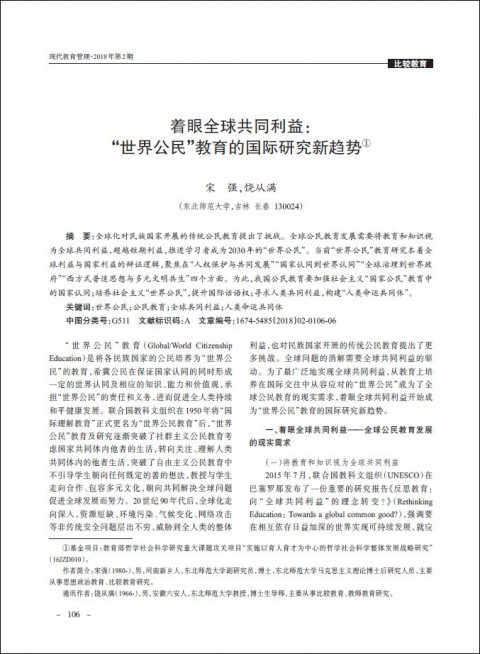 Focus on Global Common Good:The New International Research Trend on World Citizenship Education Année de publication: 2018 Auteur: Song Qiang | Rao Congman Globalization has posed challenges for national-states to develop traditional citizenship education. To develop the citizenship education in the world needs to regard education and knowledge as global common good, surpass short- term benefit,and promote learners to be world citizens by 2030. Start with the dialectical logic on global benefit and national benefit,the researches of world citizenship education focus on“human rights protection and joint development”,“from national identity to world identity”,“from global governance to world government”, and “western universal mind vs. multi- civilizations intergrowth”. Chinese citizenship education needs to reinforce the national identity in socialism national citizenship education; cultivateing socialism world citizenship and promoteing international discourse power;seek human common good and build community of common destiny for all mankind. 着眼全球共同利益:“世界公民”教育的国际研究新趋势 Année de publication: 2018 Auteur: Song Qiang | Rao Congman 全球化对民族国家开展的传统公民教育提出了挑战。全球公民教育发展需要将教育和知识视为全球共同利益,超越短期利益,推进学习者成为2030年的“世界公民”。当前“世界公民”教育研究本着全球利益与国家利益的辩证逻辑,聚焦在“人权保护与共同发展”“国家认同到世界认同”“全球治理到世界政府”“西方式普适思想与多元文明共生”四个方面。为此,我国公民教育要加强社会主义“国家公民”教育中的国家认同;培养社会主义“世界公民”,提升国际话语权;寻求人类共同利益,构建“人类命运共同体”。
 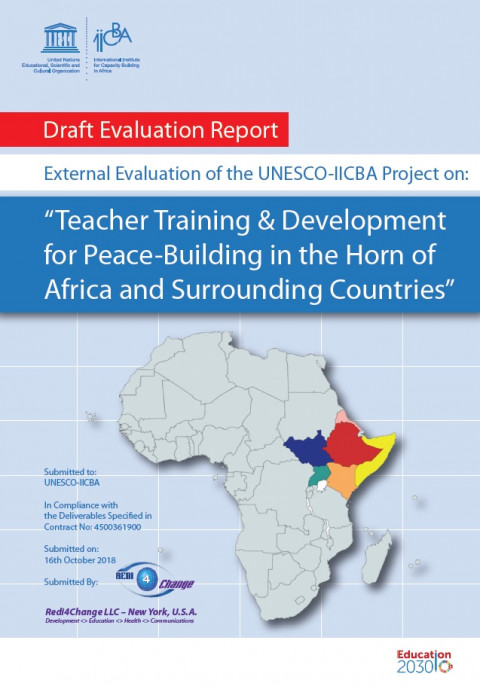 [Draft Evaluation Report] External Evaluation of the UNESCO-IICBA Project on: “Teacher Training & Development for Peace-Building in the Horn of Africa and Surrounding Countries” Année de publication: 2018 Auteur institutionnel: UNESCO International Institute for Capacity-Building in Africa (IICBA) The project on “Teacher Training and Development for Peace-Building in the Horn of Africa and Surrounding Countries” was designed by UNESCO-IICBA and financed by the Government of Japan. The project benefitted six conflict-affected countries; Ethiopia, Eritrea, Somalia, Kenya, Uganda, and South Sudan by building on the mandate and niche expertise of UNESCO-IICBA in teacher education, as well as benefiting from the empathetic insights and financing of the Government of Japan.This evaluation report analyses the design, implementation, and consolidation of the project to assess the likelihood that it can facilitate peace education as an effective and integral part of the national education systems. The project’s short timeframe and modest financing mean that the evaluation could not credibly deal with its outcomes and impact; but efforts are made to gauge the uptake and sustainability of this project as a vehicle for promoting peace education and so help to prevent violent conflict and cultivate a culture of peace in the countries concerned.
  The SDGs AND CITIES INTERNATIONAL HUMAN MOBILITY Année de publication: 2018 Auteur institutionnel: International Centre for the Promotion of Human Rights | (ICPHR) The Handbook is to address new situations – and responses to these situations – generated by the global phenomenon of human mobility in urban spaces. Democracies are being threatened by the sustained growth of social gaps and the exclusion of vast sectors of the population from political systems and benefits of development, placing structural limits on the exercise of human rights. In this context, where new tensions and problems have arisen such as massive displacements of the population, the appearance of diverse types of extremism, of wars and conflicts and climate change in turn place these social sectors under conditions of structural inequality, exclusion and discrimination, as the main victims of human rights violations. This Handbook was prepared and published with the support and assistance of the UNESCO Sector for Social and Human Sciences through its Regional Science Bureau in Montevideo and the Latin American and Caribbean Coalition of Cities against Racism, Discrimination and Xenophobia.
 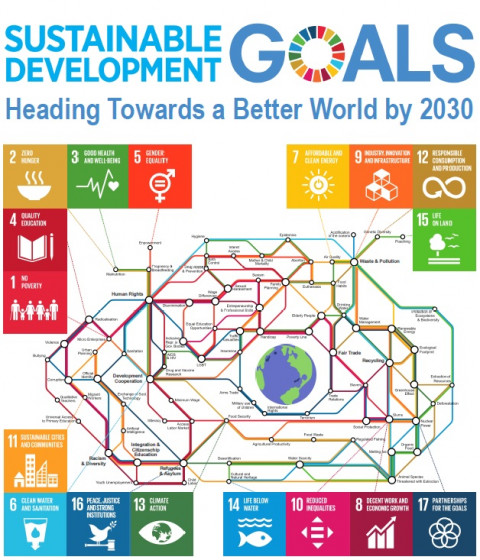 A metro map illustrated in the 17 sustainable development goals Année de publication: 2018 Auteur: Rembert Jonckheere Auteur institutionnel: ASPnet Flanders (Belgium) “Tackling one SDG… is tackling all of them!”This metro map is a complex illustration of the 17 sustainable development goals. With different kinds of topics as service stations and the SDG’s connecting them, it shows how the goals can relate to each other, and thus it emphasises their holistic nature. I do not pretend to be completely exhaustive or correct. Probably one can add more links and topics, but this map could be helpful in education or in other institutions as a source of inspiration to start up projects within the framework of the sustainable development goals.
  The United Nations World Water Development Report 2019: Leaving No One Behind Année de publication: 2019 Auteur institutionnel: UNESCO World Water Assessment Programme (WWAP) The UNESCO World Water Assessment Programme brings together the work of numerous UN-Water Members and Partners to produce the United Nations World Water Development Report series.The annual editions focus on strategic water issues. UN-Water Members and Partners as well as other experts contribute the latest knowledge on a specific theme.The 2019 Report seeks to inform policy and decision-makers, inside and outside the water community, how improvements in water resources management and access to water supply and sanitation services are essential to overcoming poverty and addressing various other social and economic inequities.In an increasingly globalized world, the impacts of water-related decisions cross borders and affect everyone. Extreme events, environmental degradation, population growth, rapid urbanization, unsustainable and inequitable consumption patterns, conflicts and social unrest, and unprecedented migratory flows are among the interconnected pressures faced by humanity, often hitting those in vulnerable situations the hardest through their impacts on water.Addressing the inequalities faced by disadvantaged groups requires tailored solutions that take account of the day-to-day realities of people and communities in vulnerable situations. Properly designed and adequately implemented policies, efficient and appropriate use of financial resources, as well as evidence-based knowledge on water resources and water-related issues are also vital to eliminating inequalities in access to safe drinking water and sanitation.Titled ‘Leaving No One Behind ’, the report reinforces the commitments made by the UN member states in adopting the 2030 Agenda for Sustainable Development and in recognizing the human rights to safe drinking water and sanitation, both of which are essential for eradicating poverty and for building prosperous, peaceful societies. Informe mundial de las Naciones Unidas sobre el desarrollo de los recursos hídricos 2019: no dejar a nadie atrás Année de publication: 2019 Auteur institutionnel: UNESCO World Water Assessment Programme (WWAP) El Programa Mundial de la UNESCO de Evaluación de los Recursos Hídricos reúne el trabajo de numerosos miembros y socios de ONU-Agua para producir la serie de informes de las Naciones Unidas sobre el desarrollo de los recursos hídricos en el mundo.Los informes anuales sobre el desarrollo de los recursos hídricos en el mundo se centran en cuestiones estratégicas relacionadas con el agua.Los miembros y socios de ONU-Agua, así como otros expertos, aportan los últimos conocimientos sobre un tema específico.La edición de 2019 del Informe Mundial de las Naciones Unidas sobre el Desarrollo de los Recursos Hídricos pretende informar a los responsables de las políticas y de la toma de decisiones, tanto dentro como fuera de la comunidad del agua, de hasta qué punto las mejoras en la gestión de los recursos hídricos y el acceso al suministro de agua y a los servicios de saneamiento son esenciales para superar la pobreza y afrontar varias otras desigualdades sociales y económicas.En un mundo cada vez más globalizado, los impactos de las decisiones relacionadas con el agua cruzan las fronteras y afectan a todas las personas. Los eventos extremos, la degradación del medio ambiente, el crecimiento demográfico, la rápida urbanización, unos patrones de consumo insostenibles e injustos y unos flujos migratorios sin precedentes son algunas de las presiones interrelacionadas a que se enfrenta la humanidad, y que a menudo golpean con mayor dureza a quienes se hallan en situaciones vulnerables a través de sus impactos en el agua.Abordar las desigualdades a que se enfrentan los grupos desfavorecidos requiere soluciones a medida, que tengan en cuenta las realidades del día a día de la gente y las comunidades en situaciones vulnerables. Políticas bien diseñadas y adecuadamente aplicadas, un uso eficiente y apropiado de los recursos financieros, así como un conocimiento de los recursos hídricos y las cuestiones relacionadas con el agua basado en la evidencia también son vitales para acabar con las desigualdades en el acceso al agua potable y al saneamiento seguros.El informe, titulado “No dejar a nadie atrás”, refuerza los compromisos asumidos por los Estados miembros de la ONU al adoptar la Agenda 2030 para el Desarrollo Sostenible y al reconocer los derechos humanos al agua potable y el saneamiento seguros, ambos esenciales para erradicar la pobreza y construir unas sociedades prósperas y pacíficas. Rapport mondial des Nations Unies sur la mise en valeur des ressources en eau 2019: ne laisser personne pour compte Année de publication: 2019 Auteur institutionnel: UNESCO World Water Assessment Programme (WWAP) Le Programme mondial de l’UNESCO pour l’évaluation des ressources en eau (WWAP) réunit les travaux de nombreux membres et partenaires d’ONU-Eau afin de donner naissance à la série des Rapports mondiaux des Nations Unies sur la mise en valeur des ressources en eau (WWDR).Chaque année, ces Rapports mettent en lumière les enjeux stratégiques actuels liés à l’eau et les membres et partenaires d’ONU-Eau ainsi que d’autres experts ont recours aux connaissances les plus récentes sur un thème spécifique.L’édition 2019 du Rapport sur la mise en valeur des ressources en eau a pour objectif d’informer les décideurs et les responsables politiques, qu’ils fassent ou non partie de la communauté de l’eau, au sujet de la nécessité d’améliorer la gestion des ressources en eau et l’accès aux services d’approvisionnement en eau et d’assainissement en vue de venir à bout de la pauvreté et des diverses autres formes d’inégalités sociales et économiques.À l’heure de la mondialisation, les répercussions des décisions portant sur l’eau traversent les frontières et concernent tout un chacun. Les phénomènes extrêmes, la dégradation de l’environnement, la croissance démographique, l’urbanisation rapide, les modes de consommation non durables et non équitables, les conflits et les mécontentements sociaux, ainsi que les flux migratoires sans précédent, constituent les défis interdépendants auxquels est confrontée l’humanité et qui touchent souvent le plus durement ceux en situation de vulnérabilité de par leurs impacts sur les ressources en eau.La lutte contre les inégalités auxquelles font face les groupes défavorisés requiert également des solutions adaptées qui tiennent compte des réalités quotidiennes des personnes et des communautés en situation de vulnérabilité. Des politiques correctement conçues et mises en oeuvre, une utilisation efficace et appropriée des ressources financières, ainsi que des connaissances factuelles relatives aux ressources et aux questions liées à l’eau, sont également indispensables de manière à mettre fin aux inégalités d’accès à l’eau potable et à l’assainissement.Ce rapport, intitulé « Ne laisser personne pour compte », renforce les engagements pris par les États membres de l’ONU lors de l’adoption du Programme de développement durable à l’horizon 2030 et de la reconnaissance des droits de l’homme à l’eau potable et à l’assainissement, qui sont tous deux indispensables à l’éradication de la pauvreté et à la mise en place de sociétés prospères et pacifiques.
  Research Report on Basic Education Policies for Ethnic Minorities in China Année de publication: 2010 Auteur institutionnel: UNESCO Beijing This report is a survey of the implementation of basic education policy research towards ethnic minority in the framework of "Improving the educational level and culturally sensitive education of ethnic minority groups". In 2010, based on the text analysis report of the basic education policy which has been formulated and implemented for ethnic minorities by the Chinese government, the objectives and tasks of the field research were determined. The field research was conducted on the twelve project sites of three provinces. Through field investigations and questonnaire surveys, six research groups completed twelve case study reports. Based on the contents of the 12-case research report, this report is formed and then proposes suggestions for improving and the next action plan.