
Ressources
Explorez une large gamme de ressources sur le GCED afin d’approfondir votre compréhension et de renforcer vos activités de recherche, de plaidoyer, d’enseignement et d’apprentissage.
2,199 résultats trouvés
 Combating Domestic Violence in Kyrgyzstan: Are Victims Protected? Année de publication: 2020 Auteur: Анна Зубенко Auteur institutionnel: Central Asian Bureau for Analytical Reporting (CABAR) The reform of the judicial system, thanks to which a number of new codes appeared in Kyrgyzstan, was aimed primarily at the humanization of legislation and the decriminalization of certain types of crimes. Domestic violence, in the framework of changing the legislation, on the contrary, was criminalized - it was included in the Code of Misconduct, which is part of the criminal law. But the de facto prosecution of perpetrators has become more difficult.
  Advantages and Risks of Introducing the “Multilingual and Multicultural Education” Program in Kyrgyzstan Année de publication: 2019 Auteur: Kanzada Zayirbekova Auteur institutionnel: Central Asian Bureau for Analytical Reporting (CABAR) According to the author, multilingual education makes it possible to simultaneously master the state, official and one of the foreign languages, and also creates cohesion in society and enhances the culture of interethnic communication, and all this strengthens interethnic relations.
 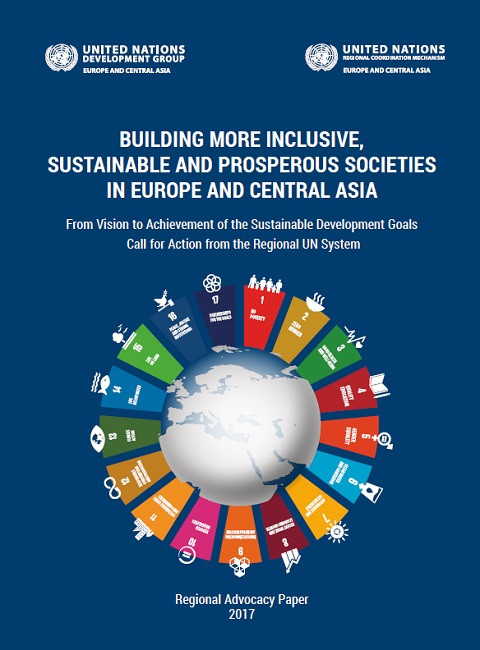 Building More Inclusive, Sustainable and Prosperious Societies in Europe and Central Asia: From Vision to Achievement of the Sustainable Development Goals Call for Action from the Regional UN System (Regional Advocacy Paper 2017) Année de publication: 2017 Auteur institutionnel: United Nations Development Group (UNDG) This regional advocacy paper provides key policy recommendations that can help countries of Europe and Central to overcome the existing development bottlenecks and boost the implementation of the 2030 Agenda, leaving no one behind. На пути к устойчивости и всеобщему процветанию в Европе и Центральной Азии: Переход от видения к реализации Целей в области у стойчивого развития Призыв к действию от региональной системы ООН (Региональный консультационный документ 2017) Année de publication: 2017 Auteur institutionnel: United Nations Development Group (UNDG) Этот региональный консультационный документ содержит ключевые политические рекомендации, которые могут помочь странам Европы и Центральной Азии преодолеть существующие узкие места в области развития и ускорить реализацию Повестки дня на период до 2030 года, не оставив никого позади.
  تعزيز رفاه الشباب عبر الصحة والتعليم: رؤى وفرص Année de publication: 2019 Auteur: Wing Yi Chan | Jennifer Sloan | Anita Chandra Auteur institutionnel: RAND Corporation أضحى الرفاه، باعتباره ركيزة أساسية في عمليات التخطيط وصناعة السياسات وتخصيص الموارد، ضرورةً لا غنى عنها لتنمية المجتمعات والدول التي تسير في درب الازدهار، مما دفعنا في هذا التقرير لدراسة المؤلفات الأكاديمية وغير الأكاديمية وثيقة الصلة بالموضوع لتحديد الأطر النظرية التي تحقق التكامل بين الصحة والتعليم داخل منظومة واحدة. Promoting Youth Well-Being Through Health and Education: Insights and Opportunities Année de publication: 2019 Auteur: Wing Yi Chan | Jennifer Sloan | Anita Chandra Auteur institutionnel: RAND Corporation Putting well-being at the heart of planning, policy making, and resource allocation is emerging as critical to the development of thriving communities and nations. We examined the academic and grey literature to identify theoretical frameworks that integrate health and education. We identified and described policies and programs supporting well-being around the world, and interviewed experts from each location to gain a deeper understanding of them.The report found that although wellbeing frameworks that integrate education and health exist, few of them have been examined rigorously to reveal how both educational and health outcomes can be achieved together.
 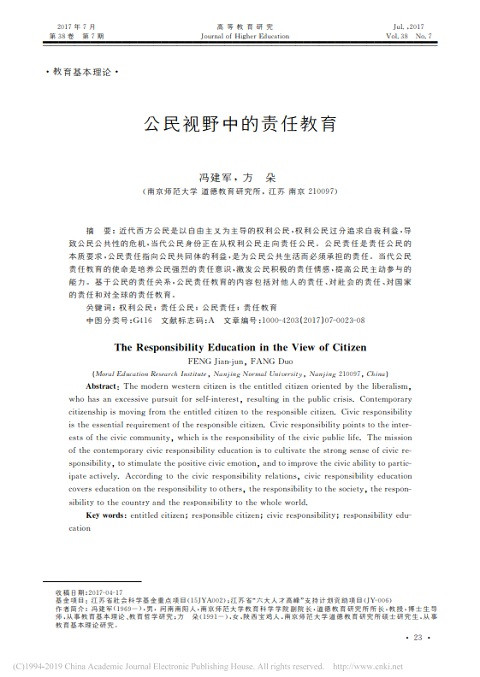 Responsibility Education in the View of Citizen Année de publication: 2017 Auteur: Feng Jianjun | Fang Duo Auteur institutionnel: Ohio State University Press The modern western citizen is the entitled citizen oriented by the liberalism, who has an excessive pursuit for self-interest, resulting in the public crisis. Contemporary citizenship is moving from the entitled citizen to the responsible citizen. Civic responsibility is the essential requirement of the responsible citizen. Civic responsibility points to the interests of the civic community, which is the responsibility of the civic public life. The mission of the contemporary civic responsibility education is to cultivate the strong sense of civic responsibility, to stimulate the positive civic emotion, and to improve the civic ability to participate actively. According to the civic responsibility relations, civic responsibility education covers education on the responsibility to others, the responsibility to the society, the responsibility to the country and the responsibility to the whole world. 公民视野中的责任教育 Année de publication: 2017 Auteur: Feng Jianjun | Fang Duo Auteur institutionnel: Ohio State University Press 近代西方公民是以自由主义为主导的权利公民,权利公民过分追求自我利益,导致公民公共性的危机,当代公民身份正在从权利公民走向责任公民。公民责任是责任公民的本质要求,公民责任指向公民共同体的利益,是为公民公共生活而必须承担的责任。当代公民责任教育的使命是培养公民强烈的责任意识,激发公民积极的责任情感,提高公民主动参与的能力。基于公民的责任关系,公民责任教育的内容包括对他人的责任、对社会的责任、对国家的责任和对全球的责任教育。
 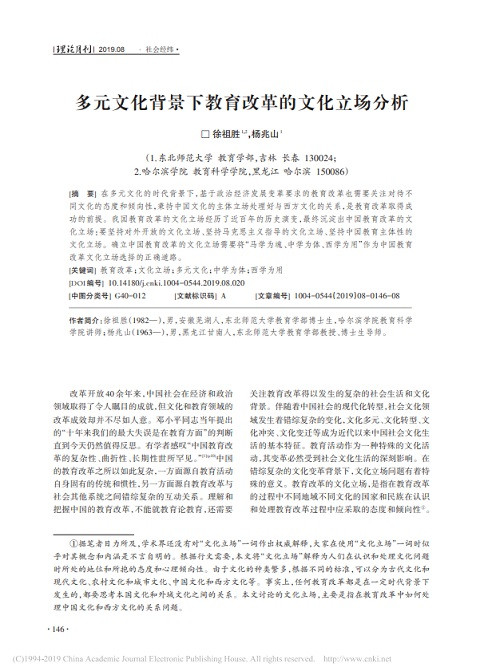 An Analysis of the Cultural Position of Educational Reform in the Context of Multiculturalism Année de publication: 2019 Auteur: Xu Zusheng | Yang Zhaoshan Auteur institutionnel: Theory Monthly In the context of the multicultural era, education reforms based on the requirements of political and economic development and reform also need to pay attention to attitudes and tendencies toward different cultures. Upholding the main position of Chinese culture and properly handling relationships with Western cultures are the prerequisites for successful education reform. The cultural standpoint of China’s educational reform has undergone nearly a hundred years of historical evolution, and finally precipitated the cultural position of China’s educational reform: we must adhere to the cultural position of opening to the outside world, the cultural standpoint of Marxist guidance, and the cultural position of Chinese educational subjectivity. To establish the cultural standpoint of China’s educational reform, it is necessary to take “Ma Xue as the soul, middle school as the body and western learning as the method” as the correct path for the cultural position of China’s educational reform. 多元文化背景下教育改革的文化立场分析 Année de publication: 2019 Auteur: Xu Zusheng | Yang Zhaoshan Auteur institutionnel: Theory Monthly 在多元文化的时代背景下,基于政治经济发展变革要求的教育改革也需要关注对待不 同文化的态度和倾向性,秉持中国文化的主体立场处理好与西方文化的关系,是教育改革取得成 功的前提。我国教育改革的文化立场经历了近百年的历史演变,最终沉淀出中国教育改革的文 化立场:要坚持对外开放的文化立场、坚持马克思主义指导的文化立场、坚持中国教育主体性的 文化立场。确立中国教育改革的文化立场需要将“马学为魂、中学为体、西学为用”作为中国教育 改革文化立场选择的正确道路。