
Ressources
Explorez une large gamme de ressources sur le GCED afin d’approfondir votre compréhension et de renforcer vos activités de recherche, de plaidoyer, d’enseignement et d’apprentissage.
2,668 résultats trouvés
 Beit Lohamei Haghetaot Educational materials produced by the Ghetto Fighters’ House are available for purchase. Teachers and planners thus have access to workshops, programmes, ceremonies and exhibitions. / Les matériels pédagogiques produits par la Maison des Combattants du Ghetto sont disponibles à l'achat. Les enseignants et les planificateurs ont ainsi accès à des ateliers, des programmes, des cérémonies et des expositions. Haus der Wannsee-Konferenz The Memorial and Educational Centre of the House of the Wannsee Conference provides school teachers with diverse ways to broach the persecution and murder of European Jews, the history of National Socialism and the aftermath. A permanent exhibition under expert guidance is proposed, multi-day seminars are conducted and online or downloadable activities and advice are available for helping teachers to approach this topic in class. / Le Centre commémoratif et éducatif de la chambre de la conférence de Wannsee fournit aux enseignants des écoles avec diverses façons d'aborder la persécution et assassiner des Juifs d'Europe, l'histoire du national-socialisme et les conséquences. Une exposition permanente sous la direction d'experts est proposé, des séminaires de plusieurs jours sont menées et des activités et des conseils en ligne ou téléchargeables sont disponibles pour aider les enseignants à aborder ce sujet en classe. Teaching about the Holocaust : Major educational predicaments, proposals for reform, and change - An international perspective Année de publication: 2013 Auteur: Zehavit Gross The aim of this article is to analyze the findings of a research project on how the Holocaust is taught around the world. The project analyzes central issues and educational events that occur while teaching the Holocaust "behind the classroom door," in public schools in different countries. Researchers from 10 nations participated in the project: Germany, Austria, Switzerland, Poland, Estonia, Scotland, Australia, the United States, Canada and Israel. One of the major findings of this research was that although the official establishment is very interested in teaching the subject of the Holocaust, teachers can find it hard to teach because of resistance by their students, who occasionally react in class with cynical, racist, anti-Semitic and antidemocratic remarks. In all the countries, researchers indicate three principal ways of handling the question of the Holocaust: education, teacher training, and research. (By the author) The challenges of Holocaust introduction and remembrance - particular and universal aspects in formal and informal interdisciplinary curricula in Israel and abroad Année de publication: 2011 Auteur: Nitza Davidovich | Dan Soen | Anat Hezkelovich In the present framework, an attempt was made to compare Holocaust instruction in Israel and in France. The comparison between the formal and informal curricula in both countries shows that both systems share this study's basic assumption concerning the inherent potential of teaching the Holocaust to the younger generation. Nevertheless, each country has a clear goal toward which it directs its students. The State of Israel, the Jewish state, perceives the Holocaust mainly through nationalist and Zionist eyes, directing the younger generation to learn particular lessons. The French model, in contrast, represents a shortened version ... devoted to the universal lessons of the Holocaust. But in the end, both systems would benefit by adopting some of the elements of the other. (By the author)
  Teaching the Holocaust : Practical approaches for ages 11-18 Année de publication: 2015 Auteur: Michael Gray Teaching the Holocaust is an important but often challenging task for those involved in modern Holocaust education. What content should be included and what should be left out? How can film and literature be integrated into the curriculum? What is the best way to respond to students who resist the idea of learning about it? This book, drawing upon the latest research in the field, offers practical help and advice on delivering inclusive and engaging lessons along with guidance on how to navigate through the many controversies and considerations when planning, preparing and delivering Holocaust education. Whether teaching the subject in History, Religious Education, English or even in a school assembly, there is a wealth of wisdom that will make the task easier for you and make the learning experience more beneficial for the student. (By the publisher)
 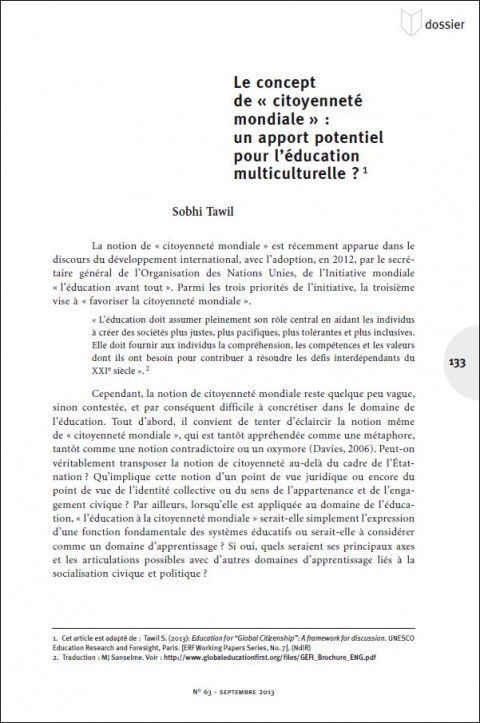 Does the Concept of ‘Global Citizenship’ Have the Potential to Input in Multicultural Education? Année de publication: 2013 Auteur: Sobhi Tawil Auteur institutionnel: Revue internationale d’éducation de Sèvres One of the three priorities of the Global Education First Initiative launched in 2012 by the United Nations is fostering global citizenship. However, this concept remains vague if left unchallenged, and as a result is difficult to implement in the field of education. It may be true that the growing globalisation and multiculturalism of contemporary societies is gradually transforming the concept and traditional role of citizenship, the legal reality of citizenship and its practises, but they still remain largely rooted in the idea of Nation-State. This article attempts to clarify the concept of global citizenship, its possible application in the field of citizenship education and its potential contribution to the enrichment of multicultural education. El concepto de “ciudadanía mundial” : ¿una posible aportación para la educación multicultural ? Année de publication: 2013 Auteur: Sobhi Tawil Auteur institutionnel: Revue internationale d’éducation de Sèvres Entre las tres prioridades de la iniciativa mundial “la educación ante todo” (Education first) lanzada en 2012 por las Naciones Unidas, podemos encontrar la idea según la cual conviene “favorecer la ciudadanía mundial”. Sin embargo, esta noción es de las más imprecisas, si no discutida y, por tanto, difícil de concretizar en el campo de la educación. Si no cabe duda de que la mundialización y la creciente multiculturalidad de las sociedades contemporáneas transforman paulatinamente la concepción y la práctica tradicional de la ciudadanía, la realidad jurídica de la ciudadanía así como su práctica, quedan establecidas fundamentalmente a nivel del Estado-Nación. Este artículo procura aclarar la noción de “ciudadanía mundial”, su posible aplicación en el dominio de la educación a la ciudadanía y su contribución potencial al enriquecimiento de la educación multicultural. Le concept de « citoyenneté mondiale » : un apport potentiel pour l’éducation multiculturelle ? Année de publication: 2013 Auteur: Sobhi Tawil Auteur institutionnel: Revue internationale d’éducation de Sèvres Parmi les trois priorités de l’initiative mondiale « l’éducation avant tout » (Education First) lancée en 2012 par les Nations-Unies, on trouve l’idée de « favoriser la citoyenneté mondiale ». Cependant, cette notion reste vague sinon contestée, et par conséquent difficile à concrétiser dans le domaine de l’éducation. S’il est vrai que la mondialisation et la multiculturalité croissante des sociétés contemporaines transforment progressivement la conception et la pratique traditionnelle de la citoyenneté, la réalité juridique de la citoyenneté, ainsi que sa pratique, restent encore largement ancrées au niveau de l’État-nation. Cet article tente de clarifier la notion de « citoyenneté mondiale », son application possible dans le domaine de l’éducation à la citoyenneté et sa contribution potentielle à l’enrichissement de l’éducation multiculturelle. L’enseignement de l’histoire et les mémoires douloureuses du XXe siècle. Enquête sur les représentations enseignantes This article discusses the teaching of sensitive topics related to the memory and history of the 20th century, mainly the issues of the extermination of Jews and the wars of national liberation. The survey, conducted between 2000 and 2003 at the Academie de Versailles, highlights the specific difficulties in this teaching from primary school to secondary school, in different disciplines ‒ literature, history and philosophy. The report also leads to an analysis of the representations that are formed on these subjects, both by students and teachers. (By the author - Translation) Quand les mémoires déstabilisent l’école. Mémoire de la Shoah et enseignement This work is based primarily on the subject of the Holocaust, but it attempts to define cross-cutting issues in the category of teaching “sensitive” subjects, assuming we can build a common paradigm. To do this, it brings together the perspectives of historians, philosophers, teachers and participating witnesses, inviting us to return to the fundamental questions underlying the act of transmission. Each contribution brings us to reflect on what it is we are trying to transmit, and suggests a systematic exploration of the difficulties inherent in these transmissions: the magnitude and complexity of the historical problem, the extreme moral and political exigencies, the intricate intermingling of memory, the historian’s work, and civic commitment. What to do with negative commemorations? We cannot forget, repent, deny or trivialize. We can only question our modern societies and their ambivalence. (By the author - Translation)