
Ressources
Explorez une large gamme de ressources sur le GCED afin d’approfondir votre compréhension et de renforcer vos activités de recherche, de plaidoyer, d’enseignement et d’apprentissage.
3,229 résultats trouvés
 2018년도 SDG4-교육2030 협의체 운영보고서 Année de publication: 2019 Auteur institutionnel: 유네스코한국위원회 2018년도 교육부, 유네스코한국위원회와 9개 교육전문기관(한국교육과정평가원, 유아정책연구소, 한국대학교육협의회, 한국직업능력개발원, 한국여성정책연구원, 국가평생교육진흥원, 유네스코 아시아태평양 국제이해교육원, 한국교육학술정보원, 한국교육개발원) 으로 구성된 SDG 4-교육2030 협의체 운영(회의, 포럼 등) 내용을 담은 보고서이다.
  2018 유네스코 평화누리 활동보고서 Année de publication: 2018 Auteur institutionnel: 유네스코한국위원회 ‘유네스코 평화누리 사업’은 2013년 ‘유네스코 볼론티어 프로젝트’라는 이름으로, 대학생들의 사회 참여를 높이고 역량을 강화하기 위해 시작되었다. 2018년 에는 유엔 지속가능발전목표의 17개 목표를 주제로, 청년들 스스로 자신들이 살아가는 지역사회 현장의 지속가능성을 위협하는 문제에 대한 개선방안을 기획하고 실행함으로써 청년들이 사회변화의 주체(agents of social innovation)로 성장할 수 있도록 지원하고 있다.유네스코한국위원회는 평화누리 사업을 통해 전국 대학(원)생 및 청년으로 구성된 동아리(5-20명)를 선발하여 소정의 활동지원금을 지원한다. 또한 유네스코 본부·한국위원회 관련 정보 및 공지 안내, 워크숍 및 활동보고회 개최, 각종 네트워크 활용 지원, 프로젝트 현장 지원 등 청년들의 성공적인 활동을 위해 함께 노력하고 있다.목표하는 활동 분야의 전문가나 대학 교수를 자문위원으로 위촉할 수 있고, 전체 인원 중 대표 및 부대표를 포함한 80%가 대학생이라면 기존·신설·연합·프로젝트 성 팀 모두 관계없이 지원 가능하다. 유네스코는 우리의 현재이자 미래인 청년들을 세계의 다양한 이슈에 대해 해결방안을 찾아내고 창의력을 이용해 변화를 만드는 필수적인 존재라고 보고 있으며 이에 유네스코한국위원회는 청년들이 사회문제에 보다 관심을 가지고 그들의 활동과 노력이 더 나은 사회를 만들 수 있도록 지지하고 지원하며 청년의 사회참여를 독려합니다. 많은 대학(원)생·청년들이 유네스코 평화누리 사업을 포함한 유네스코한국위원회의 청년 활동에 참여하여 유네스코의 이념에 함께 동참해주기를 바란다.
  Health and Education in the Greater Mekong Subregion: Policies, Institutions and Practices Année de publication: 2015 Auteur: Greater Mekong Subregion Development Analysis Network Auteur institutionnel: Cambodia Development Resource Institute (CDRI) The focus of the paper is thus on the institutional frameworks and their effectiveness in policy-making and implementation in health and education and not so much on assessing whether these polices themselves are appropriate. In assessing institutional effectiveness, the paper does not purport to be comprehensive but selective in that it looks at only a few key issues: national, especially public, resource commitments; intra-governmental coordination, both vertical and horizontal; the roles of non-state actors, including private sector, civil society organisations and civil society more generally.
 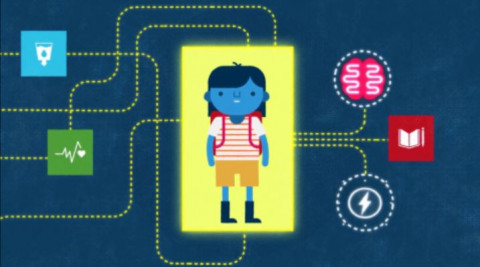 [Video] The Global Goals Food Project: Every Plate Tells a Story Année de publication: 2017 Auteur institutionnel: World’s Largest Lesson The World’s Largest Lesson brings the Global Goals to children all over the world, reaching over 130 countries and millions of children since its launch in September 2015.Produced by Project Everyone and delivered in partnership with UNICEF and many NGOs, private sector organisations and foundations, the World’s Largest Lesson reaches students through multiple channels. Ministries of Education are invited annually to take part. NGOs distribute digital content through their networks and education organisations, both for and non-profit, encourage participation through their communities.
 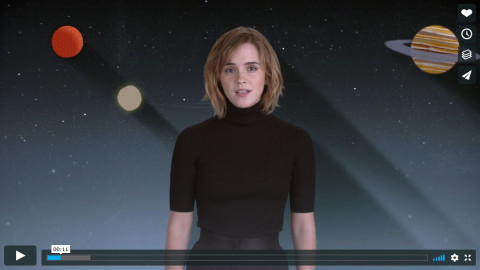 [Video] The World’s Largest Lesson Part 2 - With Thanks to Sir Ken Robinson and Emma Watson Année de publication: 2016 Auteur institutionnel: World’s Largest Lesson Sir Ken Robinson, Emma Watson and Aardman Animations invite children to get involved in the Global Goals for Sustainable Development by inventing, innovating and campaigning.To show the version with English subtitles please go to: vimeo.com/181766755
 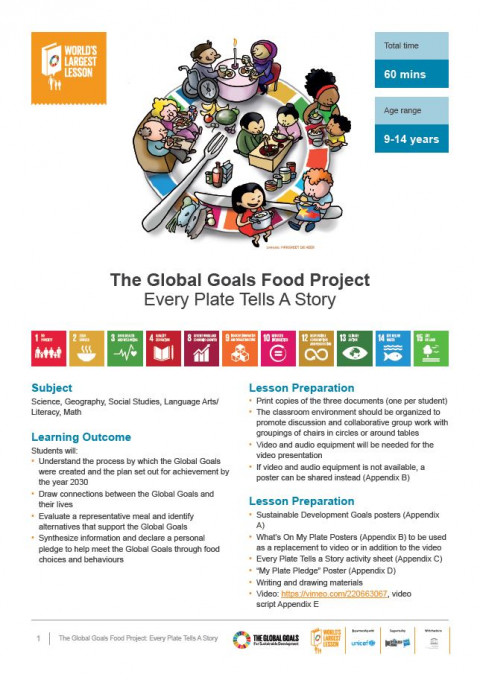 The Global Goals Food Project: Every Plate Tells a Story Année de publication: 2017 Auteur institutionnel: World’s Largest Lesson This lesson plan, “Every Plate Tells a Story,” provides a guided activity for teachers and students to work together in efforts to bring the Global Goals to classrooms and learning.The lesson begins by broadly introducing the term “goal” and invites students to make personal connections to people, places, and environments by considering goals in their lives. Learners build knowledge as they integrate understanding of the Global Goals and the processes in which they were designed.During the lesson, students will engage in a process of inquiry through dialogue, collaboration, and research and will establish concrete realizations of the sustainability of the food they eat. Multiple sources of evidence/formative assessments can be used throughout the lesson to document learning, guide conversation, and inform future instruction.
  Global Working Group to End School-Related Gender-Based Violence Année de publication: 2017 Auteur institutionnel: United Nations Girls' Education Initiative (UNGEI) In August 2014, a coalition of governments, development organizations, civil society activists, UN agencies and research institutions came together to collaborate on ending gender-based violence in and around schools.The Global Working Group to End SRGBV has been a strong advocate to ensure that schools remain safe places for learning and that girls and boys have the opportunity to acquire the knowledge, skills and resources they need to reach their potential.To learn more about the group and its members, please go here:www.ungei.org/srgbv
  [Video] SDG 4 Data to Get All Children in School and Learning by 2030 Année de publication: 2018 Auteur institutionnel: UNESCO Institute for Statistics (UIS) This video speaks in a simple and easy to understand language about the importance of data in achieving SDG 4. It is through data that success and failure can be identified and measure to build upon the successes or tackle the failures can be developed. Go straight to the source for global education data with the UNESCO Institute for Statistics http://on.unesco.org/SDG4web
  [Video] Learning about SDG 4 Année de publication: 2017 Auteur institutionnel: United Cities and Local Governments (UCLG) Life is continual learning, we learn to read to understand a constantly changing role, to participate and to live together. We learn in the classroom and beyond its world. Cities are places of opportunity but they can be also be places of exclusion. There are 758 million people over the age 15 in the world who can't read or write. Two out of three of them are women. Local governments because they are close to the people are able to respond to their needs and contribute to create equal educational opportunities. They work to ensure that facilities are ideal for learning and community life. They promote the adoption of sustainable life styles and provide education in values. Local government work with educators and administrations to ensure adequate resources and to improve education. In all these ways local governments contribute to achieve sustainable development goals for ensuring inclusive and quality education for all and promote lifelong learning.
  [Video] Transforming Education for Humanity Année de publication: 2017 Auteur institutionnel: Mahatma Gandhi Institute of Education for Peace and Sustainable Development (MGIEP) UNESCO MGIEP focuses on achieving the UN Sustainable Development Goal 4.7 towards education for building peaceful and sustainable societies across the world by developing programmes that promote socio-emotional learning, innovate digital pedagogies and empower the youth.