
Ressources
Explorez une large gamme de ressources sur le GCED afin d’approfondir votre compréhension et de renforcer vos activités de recherche, de plaidoyer, d’enseignement et d’apprentissage.
3,229 résultats trouvés
 Education for Sustainable Development in Central Asia: Analysis of Achievements, Challenges and Outlook Année de publication: 2018 Auteur: Tatiana Shakirova Auteur institutionnel: Regional Environmental Centre for Central Asia (CAREC) The article of the manager of the CAREC programme "Education for Sustainable Development" (ESD), Dr of Biology Tatiana Shakirova is devoted to the review of ESD process from 2002 to 2018, analysis of experience, lessons learned and challenges and perspectives for ESD development in Central Asia. Taking into consideration all the global and regional challenges in ESD, today CAREC is reconsidering and rethinking its role in ESD process in Central Asia. The main objective of the ESD Programme today is to provide a regional platform for dialogue, exchange of knowledge, experience, innovations and best educational practices/tools implemented at local/national/regional levels, and support CAREC's inter-program activities on education and capacity building, as well as intersectoral, interagency, interregional cooperation on ESD in the region with the involvement of all stakeholders and international expertise. Образование в Интересах Устойчивого Развития в Центральной Азии: Анализ Достижений, Вызовы и Взгляд в Будущее Année de publication: 2018 Auteur: Tatiana Shakirova Auteur institutionnel: Regional Environmental Centre for Central Asia (CAREC) Статья менеджера программы «Образование для устойчивого развития» (ОУР) РЭЦЦА, кандидата биологических наук Татьяны Шакировой посвящена обзору процесса ОУР с 2002 по 2018 годы, анализу опыта, уроков, а также вызовам и перспективам развития ОУР в Центральной Азии.Принимая во внимание глобальные и региональные вызовы в ОУР, сегодня РЭЦЦА пересматривает и переосмысливает свою роль в процессе ОУР в Центральной Азии. Основная цель Программы ОУР сегодня – это предоставление региональной площадки для диалога, обмена знаниями, опытом, инновациями и наилучшими образовательными практиками/ инструментами, реализованными на местном/национальном/региональном уровнях, и поддержка межпрограммной деятельности РЭЦЦА по образованию и повышению потенциала, а также обеспечение межсекторального, межведомственного, межрегионального сотрудничества по ОУР в регионе с привлечением всех заинтересованных сторон и международной экспертизы.
  Publications Series within the CAREC Environment and Health Program Année de publication: 2018 Auteur: Irina Bekmirzaeva Auteur institutionnel: Regional Environmental Centre for Central Asia (CAREC) This publication was prepared by CAREC Environment and Health Program which aims to inform and raise awareness and knowledge among interested stakeholders on the interrelationship between environment and medicine. These publications are primarily developed to respond to numerous requests from representatives of Central Asian countries working on environmental and health issues in the region. The narrative style, language and terminology of the information have been designed for a wider audience. All information presented in these publications is based on the CAREC’s expertise and experience, as well as data from World Health Organization (WHO), the United Nations Development Program (UNDP) and the United Nations Environment Program (UNEP) and other international organizations.In the next issues of CAREC Environment and Health Program publications, we will focus on selected environmental health issues, including air quality and health, water and health, waste and health, sustainable development goals (SDGs), etc. Серия информационных публикаций в рамках программы "окружающая среда и здоровье" Année de publication: 2018 Auteur: Irina Bekmirzaeva Auteur institutionnel: Regional Environmental Centre for Central Asia (CAREC) РЭЦЦА представляет серию публикаций, подготовленную в рамках Программы «Окружающая среда и здоровье», целью которой является информирование и повышение осведомленности и знаний по вопросам взаимосвязи и взаимозависимости экологии и медицины. Данные публикации разрабатываются, в первую очередь, для стран Центральной Азии. Они являются ответом на многочисленные запросы представителей стран ЦА, интересующихся вопросами охраны окружающей среды и здоровья в регионе. Стиль, язык и терминология, а также детальность информации были подобраны специально для широкой категории читателей. Вся представленная в публикациях информация базируется на экспертизе и опыте РЭЦЦА и данных Всемирной организации здравоохранения (ВОЗ), Программы развития ООН (ПРООН) и Программы ООН по окружающей среде (ЮНЕП) и других международных организаций.
  MODÈLES DE RECHERCHE: Démocratie, citoyenneté mondiale et éducation transformatoire Année de publication: 2018 Auteur: Paul R. Carr | Gina Thésée Auteur institutionnel: Chaire UNESCO Démocratie, citoyenneté mondiale et éducation transformatoire (DCMÉT) Les modèles conceptuels et théoriques présentés dans ce document ont été élaborés sur une période d’environ douze ans, commençant en 2005, par le titulaire (Paul R. Carr, Université du Québec en Outaouais) et la co-titulaire (Gina Thésée, Université du Québec à Montréal) de la Chaire UNESCO. Ces modèles ont été publiés dans diverses revues académiques, en anglais ou en français et ont été traduits et adaptés ici pour produire une représentation mise à jour et bilingue de la recherche sur l’éducation pour la démocratie que Carr et Thésée ont réalisée. Certains de ces modèles ont été affinés (et améliorés) avec le temps et sont des moyens qui aident à élucider, interroger et mettre en évidence le sens des trois thèmes qui sous-tendent la Chaire UNESCO DCMÉT. Research Models Laying the Foundation for the Unesco Chair: Democracy, Global Citizenship and Transformative Education (DCMÉT) Année de publication: 2018 Auteur: Paul R. Carr | Gina Thésée Auteur institutionnel: Chaire UNESCO Démocratie, citoyenneté mondiale et éducation transformatoire (DCMÉT) The conceptual and theoretical models presented in this document were developed over a roughly twelve-year period, starting in 2005, by the Chair (Paul R. Carr, Université du Québec en Outaouais) and Co-Chair (Gina Thésée, Université du Québec à Montréal) of the UNESCO Chair DCMÉT. These models have been published in diverse academic journals in either English or French, and have been translated and adapted herein to produce an updated and bilingual representation of the Education for Democracy research that Carr and Thésée have produced. In some cases, the models have been refined (and improved) over time, and they are presented as a means of attempting to elucidate, interrogate and highlight the meaning of the three themes that underpin the UNESCO Chair DCMÉT.
 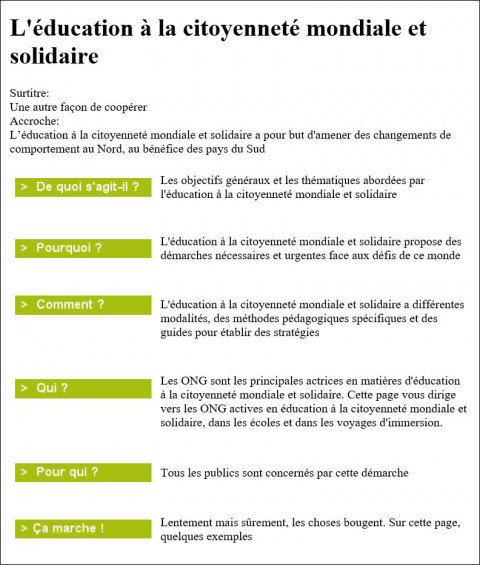 L'éducation à la citoyenneté mondiale et solidaire : Une autre façon de coopérer Auteur institutionnel: Les ONG membres d'ACODEV L’éducation à la citoyenneté mondiale et solidaire est un processus qui vise le changement social. Elle a pour but de permettre aux individus de s’approprier une conviction empreinte de solidarité internationale et de la manifester par des engagements concrets, individuels et collectifs. Objectifs généraux: Faciliter une compréhension globale des enjeux du développement et des mécanismes d’exploitation injustes qui engendrent des relations inégalitaires entre le Nord et le Sud ; Accompagner l’acquisition d’un regard conscient et critique de la réalité, tant au niveau de relations microsociales qu’au niveau macro ; Favoriser un meilleur dialogue entre les citoyens à travers une approche interculturelle basée sur le respect mutuel et l’égalité ; Promouvoir des valeurs, attitudes, et aptitudes liées à la solidarité
 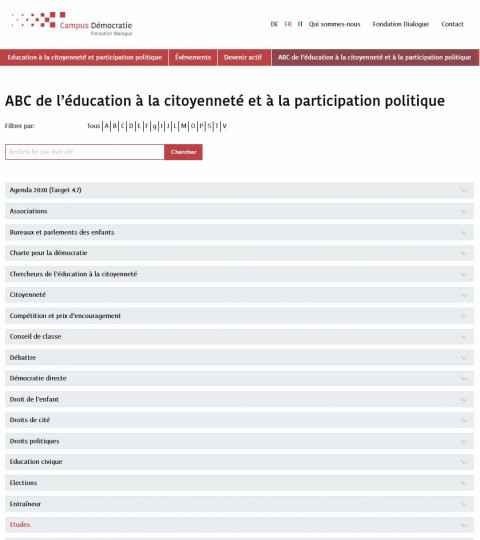 ABC de l’éducation à la citoyenneté et à la participation politique Année de publication: 2018 Auteur institutionnel: Campus pour la démocratie Les thèmes éducation à la citoyenneté et participation politique sont discutés de manière controversée. Pour des raisons de lisibilité, nous ne présentons ici que quelques définitions et modèles abrégés et renonçons à la prétention d’exhaustivité.
 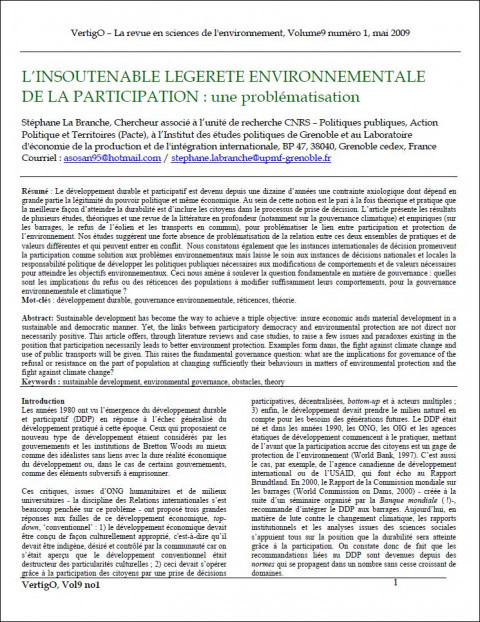 The Fragile Unsustainable Environmental Participation: A Problematization Année de publication: 2009 Auteur: Stéphane La Branche Auteur institutionnel: Université du Québec à Montréal (UQAM) | Éditions en environnement VertigO Sustainable development has become the way to achieve a triple objective: insure economic ands material development in a sustainable and democratic manner. Yet, the links between participatory democracy and environmental protection are not direct nor necessarily positive. This article offers, through literature reviews and case studies, to raise a few issues and paradoxes existing in the position that participation necessarily leads to better environment protection. Examples form dams, the fight against climate change and use of public transports will be given. This raises the fundamental governance question: what are the implications for governance of the refusal or resistance on the part of population at changing sufficiently their behaviours in matters of environmental protection and the fight against climate change? L’insoutenable légèreté environnementale de la participation: Une problématisation Année de publication: 2009 Auteur: Stéphane La Branche Auteur institutionnel: Université du Québec à Montréal (UQAM) | Éditions en environnement VertigO Le développement durable et participatif est devenu depuis une dizaine d’années une contrainte axiologique dont dépend en grande partie la légitimité du pouvoir politique et même économique. Au sein de cette notion est le pari à la fois théorique et pratique que la meilleure façon d’atteindre la durabilité est d’inclure les citoyens dans le processus de prise de décision. L’article présente les résultats de plusieurs études, théoriques et une revue de la littérature en profondeur (notamment sur la gouvernance climatique) et empiriques (sur les barrages, le refus de l’éolien et les transports en commun), pour problématiser le lien entre participation et protection de l’environnement. Nos études suggèrent une forte absence de problématisation de la relation entre ces deux ensembles de pratiques et de valeurs différentes et qui peuvent entrer en conflit. Nous constatons également que les instances internationales de décision promeuvent la participation comme solution aux problèmes environnementaux mais laisse le soin aux instances de décisions nationales et locales la responsabilité politique de développer les politiques publiques nécessaires aux modifications de comportements et de valeurs nécessaires pour atteindre les objectifs environnementaux. Ceci nous amène à soulever la question fondamentale en matière de gouvernance : quelles sont les implications du refus ou des réticences des populations à modifier suffisamment leurs comportements, pour la gouvernance environnementale et climatique ?