
Ressources
Explorez une large gamme de ressources sur le GCED afin d’approfondir votre compréhension et de renforcer vos activités de recherche, de plaidoyer, d’enseignement et d’apprentissage.
1,471 résultats trouvés
 세계시민교육 국내 이행현황 연구보고서: 유·초중등학교 교육과정을 중심으로 Année de publication: 2018 Auteur institutionnel: 유네스코 아시아태평양 국제이해교육원 “세계시민교육 국내 이행현황 연구보고서 - 유·초중등학교 교육과정을 중심으로”가 발간되었다. 본 연구보고서는 세계시민교육의 실행과 성과에 대한 국가 수준의 모니터링 및 평가 연구가 희소하다는 문제의식에 기초하여 작성된 결과물이다. 특히, 국내 17개 시·도교육청 산하 유치원, 초·중·고등학교 교육과정 활동에서 세계시민의 개념이 어떻게 반영 및 실행되고 있는지를 살펴보기 위하여 탐색적 연구를 설계하고 관련 자료 조사를 실시하는데 주안점을 두었다. 또한 연구조사 결과를 토대로 동 보고서는 향후 세계시민교육이 교육현장에서 보다 명확하게 이행되고 확산될 수 있도록 하는 정책적 제언도 담고 있다.
  SDG 4.7: 세계시민교육 지표수립을 위한 기초연구 Année de publication: 2018 Auteur institutionnel: 유네스코 아시아태평양 국제이해교육원 “SDG 4.7 세계시민교육 지표수립을 위한 기초연구 보고서”가 발간되었다. 본 연구보고서는 국제적으로 합의된 글로벌 지표의 부재로 현재까지 정의가 완료되지 않은 지속가능발전목표 (SDG) 4.7 지표 개발을 위한 기초 연구이다. 즉, 동 보고서는 세계시민교육 및 SDG 4.7 지표에 관한 기존의 국내·외 연구결과를 종합적으로 검토하여 글로벌 지표에 관한 주요 논의를 정리하고, 국내 지표 개발을 위한 함의를 도출하는 데에 목적을 두고 있다. 이를 위하여 유네스코 통계원 (UIS)의 최신 SDG 4.7.1 메타데이터 연구와 국내·외 연구결과에 기초하여 국내에서 활용할 수 있는 정보와 데이터를 검토하고 있다.
 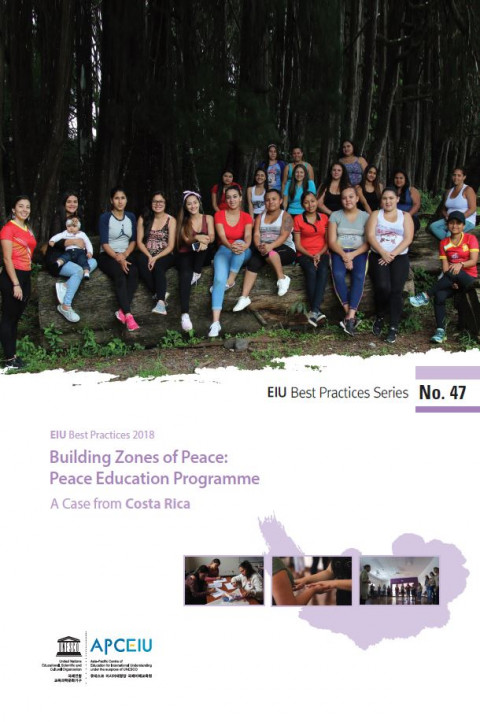 EIU Best Practices Series No. 47: Building Zones of Peace: Peace Education Programme; A Case from Costa Rica Année de publication: 2018 Auteur institutionnel: APCEIU Building Zones of Peace (BZP) is a non-formal peace and global citizen education programme created to promote peace and prevent violence in vulnerable urban communities in Costa Rica. The programme aims to encourage participants to develop a critical view of their contexts and explore different ways of taking action to transform the world we live in, and by recognizing how individual and collective efforts have a positive and direct impact in our personal, family and community spheres as well as nationally and globally.In 2017, BZP was conducted to a group of secondary education students ages 13 to 17. This year (2018), participants are young women, ages 18 to 22, all of the mothers who live in extreme poverty. These women have been selected by a governmental office whose aim is to reduce poverty by empowering them. Several resources and networks of support have been created in different areas such as health, employment, childcare and education to achieve this goal. In this sense, our programme was chosen to contribute significantly in this process.
  Reconciliation, Peace and Global Citizenship Education: Pedagogy and Practice Année de publication: 2019 Auteur institutionnel: APCEIU The Asia-Pacific Centre of Education for International Understanding launched the publication entitled Reconciliation, Peace and Global Citizenship Education: Pedagogy and Practices. This book is the result of the fruitful discussions and presentations made during the 4th International Conference on Global Citizenship Education held on 3-4 September 2019 in Seoul, Republic of Korea.The intention of this publication is not only to continue and deepen the discourses made by the speakers of the Conference, but also to provide the readers with opportunity to explore how pedagogy and practices of Global Citizenship Education can contribute to building peace and reconciliation across the globe. Part. I Global Citizenship Education for peace and reconciliation: OverviewLearning to live together and a life worth livingHow GCED can contribute to peace, reconciliation and sustainable developmentTransformative pedagogy for building peacePromoting peace through mindfulness programmes in schoolsGlobal memory, global citizenship and reconciliationThe role of Media and Information Literacy Part. II Global Citizenship Education for peace and reconciliation: Putting it into practiceFacing History and Ourselves in South AfricaClassrooms in Peace in ColombiaPreparing young people to be global citizens through integrated schools in Northern Ireland Part. III Global Citizenship Education for peace and reconciliation: Supporting effective implementationPolicy development and implementationChallenges in curriculum and textbook development for low-and middle-income country
  Kit de Herramientas de incidencia Juvenil sobre ECM Année de publication: 2019 Auteur institutionnel: Centro de Asia y el Pacífico de Educación para el Entendimiento Internacional (APCEIU) APCEIU ha publicado el Kit de Herramientas de incidencia Juvenil sobre Educación para la Ciudadanía Mundial (ECM) para proveer a líderes jóvenes con una guía de incidencia sobre ECM. Enfocado en jóvenes activistas que actualmente participan en programas de ECM alrededor del mundo, el kit ofrece una mirada de la ECM e incidencia, así como consejos y herramientas para implementar de forma efectiva una campaña de incidencia en los niveles local y global. Por otro lado, a través de compartir casos de incidencia juvenil en diversos entornos, este kit también brinda ejemplos de la vida real presentados por jóvenes que se interesan en la incidencia sobre ECM.ÍndiceCapítulo 1 - Qué es la Educación por la Ciudadanía Mundial (ECM)?Capítulo 2 - Qué es la incidencia por la ECM?Capítulo 3 - La juventud como un agente activo por la ECMCapítulo 4 - Compartiendo casos de incidencia juvenilCapítulo 5 - Iniciativas juveniles de ECM
  Набор инструментов для молодежи по адвокации обучения для глобального гражданства (GCED) Année de publication: 2019 Auteur institutionnel: Азиатско-тихоокеанский центр по воспитанию в духе международного взаимопонимания (APCEIU) APCEIU опубликовал набор инструментов для молодежи по адвокации обучения для глобального гражданства для того, чтобы обеспечить молодежным лидерам руководство по адвокации ОГГ (GCED). Этот набор, предназначен для молодежных активистов, которые в настоящее время участвуют в программах ОГГ (GCED) по всему миру, предлагает обзор ОГГ и информационно-адвокационной деятельности, а также советы и инструменты для эффективной реализации информационно-адвокационной кампании по ОГГ в локальном и глобальном контексте. Кроме того, посредством обмена историй адвокации молодежи в различных областях этот набор также предоставляет примеры из реальной жизни, которые могут быть легко использованы молодежью, заинтересованной в адвокации ОГГ. <Содержание> Набор инструментов для молодежи по адвокации обучения для глобального гражданства (GCED)Глава 1 - Что такое образование для глобального гражданства (ОГГ)?Глава 2. Что такое адвокация ОГГ?Глава 3 - Молодежь как активный агент для ОГГГлава 4 - Обмен историй молодежной адвокацииГлава 5 - Молодежные инициативы по ОГГ
  A Study on the Status of Implementation of Global Citizenship Education in Lifelong Education in South Korea Année de publication: 2019 Auteur institutionnel: APCEIU The Asia-Pacific Centre of Education for International Understanding published a report titled "A Study on the Status of Implementation of Global Citizenship Education in Lifelong Education in South Korea". In the recognition of the need for an analysis on the status of implementation for the effective and systematic implementation of Global Citizenship Education (GCED) in the Republic of Korea, APCEIU conducted a study on the status of the implementation of GCED embedded in the curriculum of primary and secondary schools in 2018. As a follow-up study, this research paper examines the practice of civic education in the field of lifelong learning for adults and the formation, status and implementation process of GCED in which it appears and explores the potential for activation.
 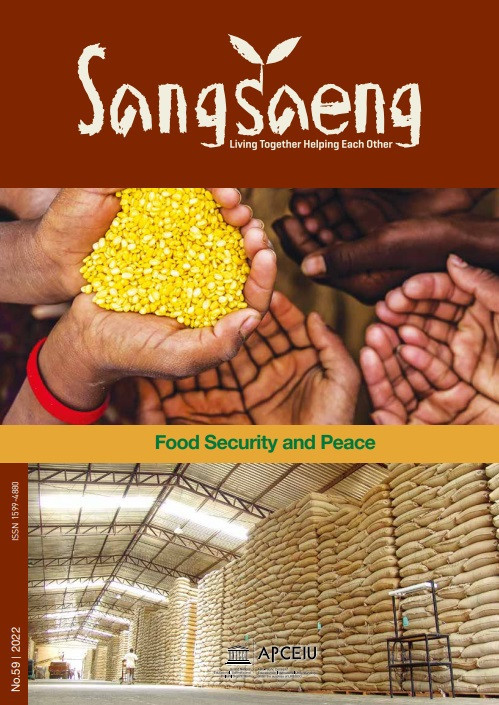 Food Security and Peace (SangSaeng no.59, 2022) Année de publication: 2023 Auteur institutionnel: APCEIU The food security issue is vital in pursuing the United Nations’ Sustainable Development Goals, which specifically include a goal of zero hunger. Hunger is both a cause and a result of conflicts. In this perspective, SangSaeng No. 59 focuses on the issue of “food security and peace” in order to examine the impacts of food insecurity and food crises and to explore possible alternatives or solutions to prevent conflicts and secure peace. Contents 03 Editor’s Note 04 Special ColumnRepositioning Youth for Responsible Citizenship / Michael Boakye-Yiadom and Raymond Chegedua Tangonyire, SJ. 08 FOCUS: Food Security and Peace 08 Conflict of Securing Food – ‘Food Insecurity is in Effect Creating an Existential Threat to Human Existence’ / Gavin E L Hall 12 Prioritizing Food Justice – Thinking About Water/Food Nexus for Latin America / Mayari Castillo 16 Feeding the Planet’s Survival – Climate Crisis and Food Security are Paramount Issues for Students to Connect with Nature / Simon Klein 21 Best Practices 21 Archipelagos of Certainty and Inclusion – Identifying Diverse Strategies to Make Learning Effective for Disabled / Eduardo Esteban Perez Leon 25 Adventure Education in Youth Work – Using Rick to Connect People and Nature to Unlearn Unhealthy Behaviours / Tina Trdin 30 InterviewRoad to Peace and Hope in Times of Crisis – Lee Chul Soo’s Works on Peace and Living Beings / APCEIU 36 Story TimeMessage of a Warlus / Marisol Bock 40 Peace in My MemoryPeace at Home / Ivy Joshia 44 Understanding the Asia and the PacificRenaissance of Traditional Archery in Asia / Lee Seunghwan 48 LetterMaking History with the EIU Photo Class Programme / Fanny Amalia Surya Tantular 50 APCEIU in Action
 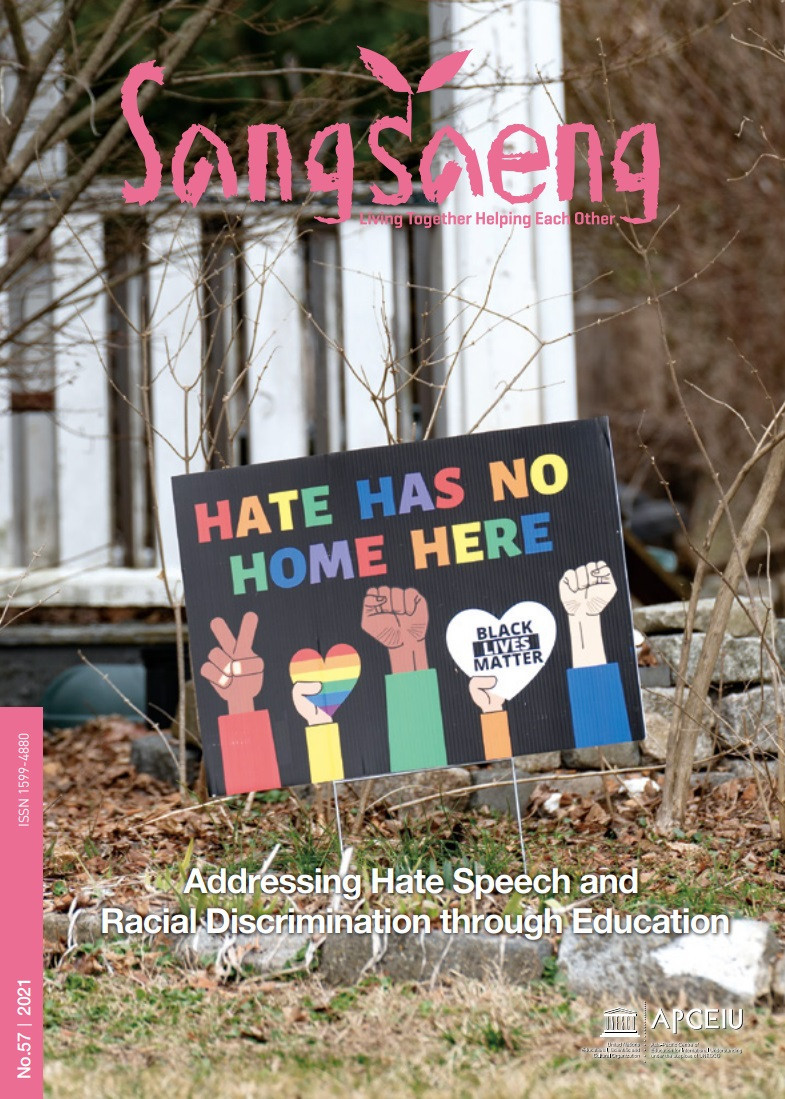 Addressing Hate Speech and Racial Discrimination through Education (SangSaeng no.57, 2021) Année de publication: 2023 Auteur institutionnel: APCEIU Today, humanity is faced with various multifaceted challenges such as climate change, increasing inequality, hate speech and racial discrimination. Moreover, the COVID-19 pandemic has crudely manifested those problems and further highlighted the acute need for concerted efforts to address them. In this context, SangSaeng No. 57 focuses on “Addressing Hate Speech and Racial Discrimination through Education” to provide readers with opportunities to reflect on these salient issues. Contents 03 Editor’s Note 04 Special ColumnFrom Hatred to Reconciliation - Learning from Rwanda / Freddy Mutanguha 08 FOCUS: Addressing Hate Speech and Racial Discrimination through Education08 Confronting Hate Speech - Thoughts, Challenges, Proposals from Educational Perspective / Gabriela Martini Armengol12 Missing Link in Global Citizenship Education – Taking into Account Identities, Alterities and Citizenships Hurt by Systemic and Chronic Racism / Gina Thesee16 Moving from Hate and Discrimination to Greater Humanity – Increasing Need for Empathy Education / Pat Dolan19 But What Can I Do? - Educational Responses to Hate Speech / Felisa Tibbitts 23 Best Practices23 Learning Democracy at Utoya - Young People’s Response to Hate and Extremism / Ingrid Aspelund26 Combatting Hate Speech – Experiences and Lessons from South Sudan / Marina Modi 29 Special Report29 Setting out Priorities for Addressing Hate Speech Through Educationt - Highlights of the Multi-Stakeholder Forum and Global Education Ministers Conference on Addressing Hate Speech through Education / UNESCO 32 Call for Global Action towards Transforming the World through Education - Highlights of the 5th UNESCO Forum on Transformative Education / APCEIU and UNESCO 35 Story TimeGrandfather’s Funeral / Sudipa Charkraverty 38 Peace in My MemoryPeace Turned into Pain / An anonymous contributor from Afghanistan 42 Understanding the Asia and the PacificMha Puja, Practicing Respect / Sharareh Bajracharya and Sanjeev Maharjan 45 Youth Network Youth Tackling Hate Speech and Racial Discrimination / GCED Youth Network Core Team 48 LetterReflections on Hate Speech and GCED / Sengpapah Holanouphab 50 APCEIU in Action
  21세기 대전환 시대 대학이 나아갈 길: 변혁 역량을 키워주는 세계시민교육 Année de publication: 2023 Auteur: 강경희 | 김윤철 | 김형숙 | 박순용 | 장준호 | 최윤정 | 한경희 Auteur institutionnel: 유네스코 아시아태평양 국제이해교육원 이 책은 대학에서 세계시민교육을 계획하거나 실행하고 있는 교수자가 참고할 만한 내용을 담고 있다. 전공 분야 별로 세계시민교육 수업을 어떻게 설계하고 진행할 수 있는지 등을 포함해 대학 세계시민교육의 방향과 내용에 관한 제안을 실천 사례를 바탕으로 제시하고 있다. 목차:펴내는 글1장. 대학 세계시민교육의 의의와 방향2장. 교양대학의 세계시민교육3장. 대학 사회과학분야의 세계시민교육4장. 대학 공학분야의 세계시민교육5장. 대학 미술분야의 세계시민교육6장. 초등 교사교육의 세계시민교육7장. 중등 교사교육의 세계시민교육: 사회과를 중심으로부록참고문헌