
Ressources
Explorez une large gamme de ressources sur le GCED afin d’approfondir votre compréhension et de renforcer vos activités de recherche, de plaidoyer, d’enseignement et d’apprentissage.
3,790 résultats trouvés
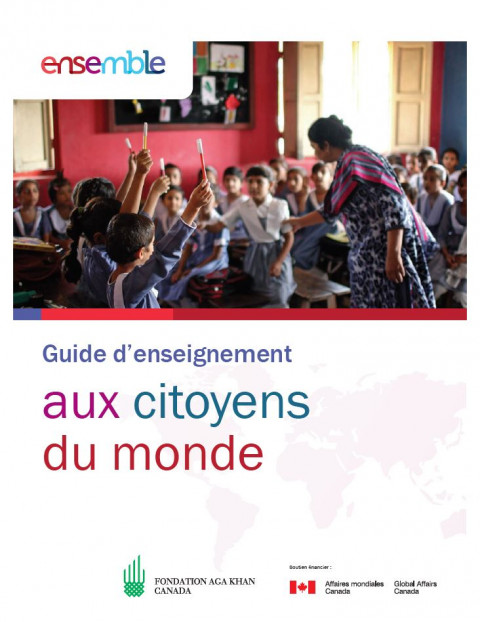 Guide d’enseignement aux citoyens du monde Année de publication: 2016 Auteur institutionnel: La Fondation Aga Khan Cette ressource est destinée aux corps enseignant des niveaux intermédiaire et secondaire et a pour but d’instruire les jeunes sur le développement international et les thèmes qui y sont liés, notamment la citoyenneté mondiale. Les activités qui y sont présentées visent à approfondir les connaissances des élèves sur l’interdépendance des pays, les facteurs qui exacerbent les inégalités à l’échelle mondiale et les solutions efficaces et durables pour réduire la pauvreté dans le monde. Nous espérons que le contenu incitera les élèves à agir de façon concrète pour améliorer la vie des gens dans le monde entier.
  Pour une démocratie engagée: Vox Populi et l'éducation à la citoyenneté dans les écoles du Québec Année de publication: 2017 Auteur: Ariane Godbout Auteur institutionnel: Fondation Jean-Charles-Bonenfant Au tournant des années 2000, les acteurs politiques du Québec ont décidé d'intégrer l'éducation à la citoyenneté dans le nouveau Programme de Formation de l'École québécoise. Cette mesure, qui visait à contrer le désengagement des jeunes de la sphère politique, a cependant posé de nombreux problèmes aux acteurs du milieu scolaire lorsqu'est venu le temps de la mettre en pratique, au point où l'on envisage maintenant de retirer des pans importants de cette composante du cursus des élèves québécois. L'essai proposé vise à comprendre l'origine de ces obstacles et à proposer des manières dont l'Assemblée nationale et le Directeur Général des Élections du Québec, avec le programme Vox Populi, pourraient mieux appuyer les acteurs du milieu scolaire en matière d'éducation à la citoyenneté.
  Human rights education at Holocaust memorial sites across the European Union : An overview of practices Année de publication: 2011 Auteur institutionnel: European Union Agency for Fundamental Rights Most European Union (EU) Member States have memorial sites and museums that both preserve the memory of the Holocaust and encourage visitors, in particular young people, to reflect on current human rights issues. In this handbook, the European Union Agency for Fundamental Rights (FRA) provides examples of the various ways in which memorial sites link the history of the Holocaust to human rights, ensuring that the past resonates in the present and its lessons are brought to bear on difficult contemporary issues against its backdrop. The report offers a sampling of educational programmes at selected historical sites and museums that either address human rights directly or approach, in a more general way, the dignity of human life and the equality of all human beings. (By the publisher)
  Education on the Holocaust and on Anti-Semitism : An overview and analysis of Educational Approaches Année de publication: 2006 Auteur institutionnel: OSCE. Office for Democratic Institutions and Human Rights (ODIHR) This study provides both the background on what is already being done in the field of Holocaust education and the identification of good practices to support future efforts by OSCE states and civil society. It also highlights new challenges that need to be addressed in education on both the Holocaust and on anti-Semitism. The first part of the study is based on information provided to the ODIHR by national ministries of education; national delegations of the Task Force for International Cooperation on Holocaust Education, Remembrance and Research (ITF); experts; educators; Jewish communities; and NGOs, in response to a questionnaire sent out by the ODIHR between December 2004 and April 2005. Comprehensive recommendations regarding Holocaust education conclude this first part of the overview. The second part of this report constitutes a first step in this regard: using country overviews on four OSCE states, it highlights the need to supplement Holocaust education in response to new forms of anti-Semitism and provides a number of relevant recommendations. (By the publisher)
  Moral and Civic Teaching in French Schools, a Consistant Transversality? Année de publication: 2017 Auteur: Anne-Claire Husser Auteur institutionnel: Éthique en éducation et en formation This paper will examine the issues of the French « moral and civic education » syllabus, enforced in September 2015, and analyse the difficulties that hinder its implementation in schools. Considering the cross-sectionnal dimension of the learning goals outlined in this program, we will give special consideration to the way French teachers may fit to teaching approaches and methods developed within the framework of Belgian and Quebec didactic researches in a context where moral education is considered as a teaching specialty unlike France. L’enseignement moral et civique dans les établissements scolaires français, une transversalité consistante? Année de publication: 2017 Auteur: Anne-Claire Husser Auteur institutionnel: Éthique en éducation et en formation Deux ans après l’entrée en vigueur du nouvel enseignement moral et civique, le présent article se propose de revenir sur les enjeux de ce nouveau programme et sur les difficultés spécifiques de sa mise en oeuvre dans le système scolaire français. Compte tenu de la dimension fortement transversale des objectifs de formation poursuivis par la réforme, il convient en particulier d’interroger les conditions d’appropriation par les enseignants français d’outils et démarches développées dans le cadre d’une didactique de l’enseignement moral en Belgique et au Québec où il constitue, contrairement à la France, une discipline de spécialisation pour les professeurs.
  Seeing, Hearing and Feeling: How Can a Visit to Auschwitz Encourage Young People to Practise Citizenship? In 2005 the first national educational visit to Auschwitz took place for Scottish pupils aged between 16 and 17 years. This study examines the impact this had on pupils in Fife Region, the third largest local authority in Scotland. Soon after this visit, pupils formed ‘The Auschwitz Experience Group’, and over a year organized the ‘Anne Frank and You Festival’, a large-scale community initiative that focused on citizenship issues. The research sought pupil feedback on the educational visit and identified key issues of importance for teachers and cultural managers who work alongside education services. (By the author)
  Making Democracy an Ethic and a Pedagogy Année de publication: 2017 Auteur: Christophe Point Auteur institutionnel: Éthique en éducation et en formation This article presents the argument that an ethics of democracy in the school requires an appropriate pedagogy. This pedagogy cannot be limited to theoretical content or to an assortment of civic actions because democracy is not composed either of a particular set of facts, concepts or dates, or of an undetermined social behaviour. According to the approach of John Dewey, who places inquiry at the center of his definition of democracy, we wish to demonstrate a double benefit from pragmatist thinking. For ethics, in defining democracy as a habit of collective thinking, we wish to construct values that can be shared by all participants in the school environment. For pedagogy, this habit of inquiry can lend itself to all subjects taught at school without limiting itself to a particular discipline. Finally, we will propose a modeling of this democratic education for a step-by-step didactic progression. Faire de la démocratie une éthique et une pédagogie Année de publication: 2017 Auteur: Christophe Point Auteur institutionnel: Éthique en éducation et en formation Cet article présente l’argument suivant : une éthique de la démocratie à l’école nécessite une pédagogie appropriée. Cette dernière ne peut se limiter à un contenu théorique ou à un éventail de gestes civiques, car la démocratie ne se réduit ni à un ensemble de faits, concepts ou dates particulières, ni à un comportement social vague. Suivant la démarche de John Dewey qui place l’enquête au centre de sa définition de la démocratie, nous souhaitons montrer un double bénéfice de la pensée pragmatiste. Pour l’éthique, en définissant la démocratie par une habitude de pensée collective, nous voulons construire des valeurs pouvant être partagées par l’ensemble des acteurs du milieu scolaire. Pour la pédagogie, cette habitude de l’enquête peut alors se prêter à toutes les disciplines enseignées à l’école sans se limiter à un domaine particulier. Enfin, nous proposons une modélisation de cet enseignement démocratique pour une progression didactique par étapes. Gathering the voices: Disseminating the message of the Holocaust for the digital generation by applying an interdisciplinary approach The aim of the Gathering the Voices project is to gather testimonies from Holocaust survivors who have made their home in Scotland and to make these testimonies available on the World Wide Web. The project commenced in 2012, and a key outcome of the project is to educate current and future generations about the resilience of these survivors. Volunteers from the Jewish community are collaborating with staff and undergraduate students in Glasgow Caledonian University in developing innovative approaches to engage with school children. These multimedia approaches are essential, as future generations will be unable to interact in person with Holocaust survivors. By students being active participants in the project, they will learn more about the Holocaust and recognize the relevance of these testimonies in today’s society. Although some of the survivors have been interviewed about their journeys in fleeing from the Nazi atrocities, for all of the interviewees, this is the first time that they have been asked about their lives once they arrived in the United Kingdom. The interviews have also focused on citizenship and integration into society. The project is not yet completed, and an evaluation will be taking place to measure the effectiveness of the project in communicating its message to the public. (By the author)