
Ressources
Explorez une large gamme de ressources sur le GCED afin d’approfondir votre compréhension et de renforcer vos activités de recherche, de plaidoyer, d’enseignement et d’apprentissage.
1,407 résultats trouvés
 지속가능발전교육(ESD): 로드맵 Année de publication: 2022 Auteur institutionnel: 유네스코 보다 공정하고 지속가능한 세상을 만드는 데 교육의 기여를 증진시키고자 채택한 이 로드맵은 세계가 직면한 긴급한 도전 과제를 설명하고, 새로이 수립된 체계인 ‘지속가능발전교육: 지속가능발전목표 달성을 향해’(Education for Sustainable Development: Towards achieving the SDGs), 즉 지속가능발전교육 2030의 이행을 강조한다. 지속가능발전교육 2030은 정책, 교육환경, 교육자 역량 구축, 청년 및 지역사회 차원의 실천이라는 5가지 우선 실천 영역에서의 이행을 강화시킬 것이다. 이들 활동은 17개 SDGs의 성공적인 달성과 더불어, 시급한 지속가능성 관련 도전과제들에 대응하는 데 필요한 개인과 사회의 큰 변혁을 위해 교육이 보다 핵심적인 역할을 담당할 것을 강조한다. 또한 이 로드맵은 지속가능발전교육 2030 체계 이행에서의 핵심 영역들을 강조한다. ESD는 2030 의제, 특히 SDG 4번 목표의 핵심요소이자 여타 SDGs의 핵심 추동력으로서 광범위하게 인식되고 있다.
 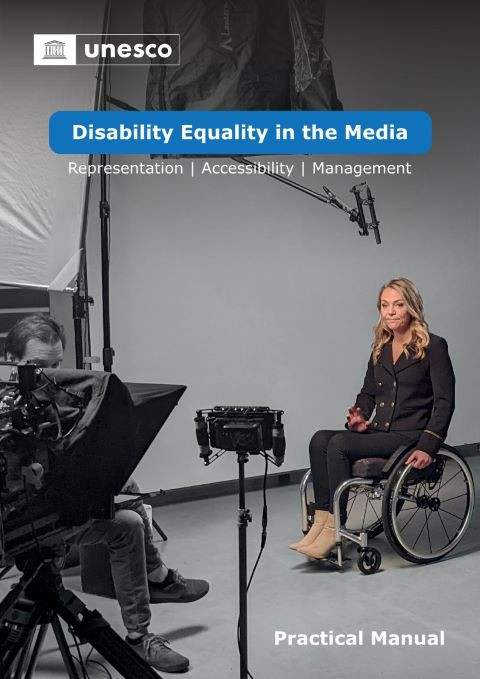 L’égalité des personnes handicapées dans les médias : représentation, accessibilité, gestion; manuel pratique Année de publication: 2025 Auteur institutionnel: Organisation des Nations Unies pour l'éducation, la science et la culture (UNESCO) Promouvoir l’égalité des personnes handicapées dans les médias Malgré tous les changements positifs qui se produisent dans les salles de rédaction et les postes de direction, la diversité dans les médias reste un défi. Lorsque certains groupes sont laissés de côté, les médias ne présentent pas tous les aspects d'une histoire, manquent de perspectives diverses et d'idées novatrices. Par conséquent, le public ne reçoit pas une image complète, et les promesses de représentation juste et précise ne sont souvent pas tenues, ce qui affecte la perception que nous avons les uns des autres dans la société. C'est le cas des personnes handicapées, qui représentent 16 % de la population mondiale mais demeurent l'un des groupes les plus marginalisés. La couverture médiatique les néglige souvent, et lorsque leurs histoires sont racontées, elles sont souvent encadrées par des stéréotypes. Cela crée non seulement des obstacles, mais les prive également de leurs droits. Pour remédier à cette situation, les organisations médiatiques devraient renforcer les politiques éditoriales et la représentation, améliorer les conditions d'emploi et favoriser un environnement plus inclusif pour les professionnels handicapés.Le manuel pratique et la master classe fournissent des conseils concrets aux équipes éditoriales sur la manière d’assurer un traitement équitable et impartial du handicap. Pour les producteurs de contenus, ils décrivent comment rendre les contenus et les services médiatiques accessibles. Pour les responsables et les décideurs, ils incitent au changement, en démontrant comment l’égalité des personnes handicapées peut contribuer à la croissance du secteur des médias et créer de nouvelles sources de revenus.Le présent travail contribue à la mise en œuvre de la Convention des Nations Unies relative aux droits des personnes handicapées (2006) et promeut la liberté d’expression, le développement des médias et l’accès à l’information pour une participation véritable des personnes handicapées au débat public. Igualdad para las personas con discapacidad en los medios: representación, accesibilidad, gestión : manual práctico Année de publication: 2025 Auteur institutionnel: Organización de las Naciones Unidas para la Educación, la Ciencia y la Cultura (UNESCO) Promover la igualdad para las personas con discapacidad en los mediosA pesar de todos los cambios positivos que suceden en las salas de prensa y con los roles de liderazgo, la diversidad en los medios continúa presentando un desafío. Cuando se excluyen ciertos grupos, los medios omiten mostrar todos los ángulos de una historia, las distintas perspectivas y las ideas innovadoras. Por lo tanto, la audiencia no recibe la información completa y las promesas de una representación certera, generalmente, no son suficientes, lo que afecta nuestra percepción del otro en la sociedad. Es el caso de las personas con discapacidad, que constituyen un dieciséis por ciento de la población global, pero aún es uno de los grupos más marginados. La cobertura de los medios con frecuencia los ignora y cuando se cuentan sus historias, por lo general, se enmarcan en un estereotipo. Esto no solo crea obstáculos, sino que además les niega el ejercicio de sus derechos. A fin de abordar esta situación, los medios deben ampliar las políticas editoriales y aumentar la representación, mejorar las condiciones de empleo y promover un entorno más inclusivo para profesionales con discapacidad.El Manual Práctico y la Master Class brindan consejos útiles para los equipos editoriales sobre el modo de asegurar que la cobertura de las personas con discapacidad sea justa y no esté sesgada. Para los generadores de contenido, se detalla de qué manera hacer que el contenido y los servicios mediáticos sean accesibles. Para gerentes y quienes estén a cargo de tomar decisiones, este material alienta a realizar cambios, demostrando cómo la igualdad de las personas con discapacidad puede contribuir al crecimiento de la industriaz mediática y generar nuevas fuentes de ingreso.Este trabajo contribuye a implementar la Convención Internacional de las Naciones Unidas sobre los Derechos de las Personas con Discapacidad de 2006 y promueve la libertad de expresión, el desarrollo de los medios y el acceso a la información, a fin de que las personas con discapacidad participen significativamente en el debate público. Disability Equality in the Media: Representation, Accessibility, Management; Practical Manual Année de publication: 2025 Auteur institutionnel: UNESCO Promoting Disability Equality in the Media Despite all the positive changes happening in newsrooms and leadership roles, diversity in the media remains a challenge.When certain groups are left out, the media fails to present all angles of a story, missing diverse perspectives and innovative ideas. Consequently, audiences do not receive the full picture, and promises of fair and accurate representation often fall short, affecting our perceptions of each other in society. It is the case of persons with disabilities, who make up 16 percent of the global population but remain one of the most marginalized groups. Media coverage frequently overlooks them, and when their stories are told, they are often framed through stereotypes. This not only creates barriers but also denies them their rights. To address this, media organizations should enhance editorial policies and representation, improve employment conditions, and foster a more inclusive environment for professionals with disabilities.The Practical Manual and Master Class provide hands-on advice to editorial teams on how to ensure fair and unbiased coverage of disability. For content producers, it details how to make media content and services accessible. To managers and decision makers, the material inspires change, demonstrating how disability equality can contribute to media industry growth and create new revenue streams.This work contributes to the implementation of the United Nations Convention on the Rights of Persons with Disabilities (2006) and promotes freedom of expression, media development, and access to information for the meaningful participation of persons with disabilities in public debate.
 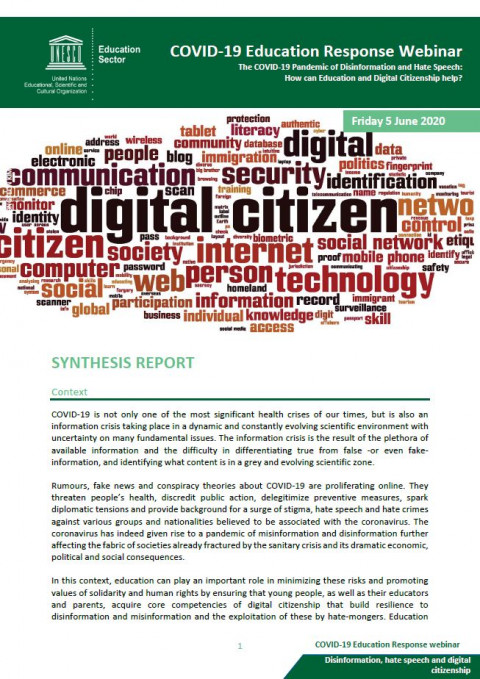 The COVID-19 Pandemic of Disinformation and Hate Speech: How can Education and Digital Citizenship Help? ; Synthesis Report Année de publication: 2020 Auteur institutionnel: UNESCO COVID-19 is not only one of the most significant health crises of our times, but is also an information crisis taking place in a dynamic and constantly evolving scientific environment with uncertainty on many fundamental issues. The information crisis is the result of the plethora of available information and the difficulty in differentiating true from false -or even fake- information, and identifying what content is in a grey and evolving scientific zone.In this context, education can play an important role in minimizing these risks and promoting values of solidarity and human rights by ensuring that young people, as well as their educators and parents, acquire core competencies of digital citizenship that build resilience to disinformation and misinformation and the exploitation of these by hate-mongers. Education can also help young people engage in the online environment in a safe, sensitive, critical, ethical and accountable way as well as encourage them to play a role in pioneering educational initiatives that contribute to promoting digital citizenship.
 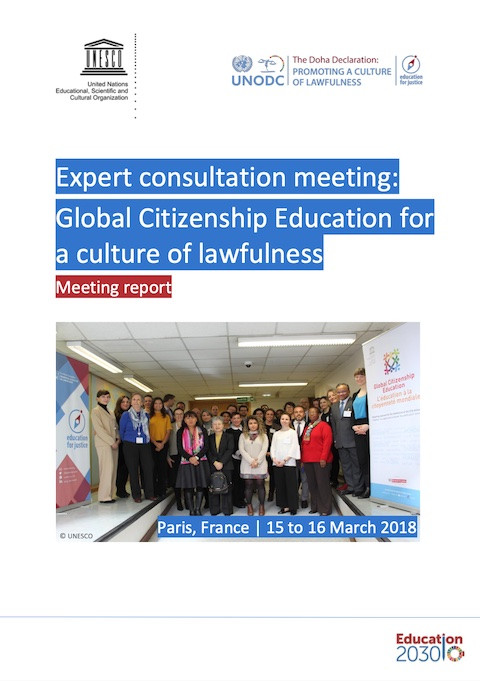 Expert Consultation Meeting: Global Citizenship Education for a Culture of Lawfulness, Paris, France, 15 to 16 March 2018; Meeting Report Année de publication: 2018 Auteur institutionnel: UNESCO | UN. Office on Drugs and Crime (UNODC) In the context of a UNESCO/UNODC partnership on “Global Citizenship Education for a Culture of Lawfulness”, an expert consultation meeting was held in Paris on March 15 and 16 of 2018. The purpose of the partnership is to strengthen the capacities of educational systems to promote the rule of law. To this end, the partnership aims to empower and equip learners to act and engage in society as constructive and ethically responsible agents of change, supporting peace, justice, and strong institutions. This notably contributes to the achievement of the 2030 Agenda for Sustainable Development, and in particular Sustainable Development Goals 4 and 16. Additionally, the partnership intends to enable learners to be both motivated and capable to respond resiliently to crime and violence. The meeting had three broad objectives:To help clarify the conceptual foundation of the partnership;to identify the measures that can be taken in the education sector to promote a culture of lawfulness;and to identify effective educational approaches. Thus, the meeting is meant to elucidate core concepts and identify promising educational approaches in the promotion of a culture of lawfulness by asking fundamental questions, including: What constitutes the rule of law and a culture of lawfulness? How do we create demand for the rule of law? How do we ensure learners apply these principles? How do we ensure they survive in a context where there is no rule of law?
  Social Contract Pedagogy: A Dialogical and Deliberative Model for Global Citizenship Education; Background Paper for the Futures of Education Initiatives Année de publication: 2020 Auteur: Richard Desjardins | Carlos Alberto Torres | Susan Wiksten Auteur institutionnel: UNESCO We propose that together Social Contract Pedagogy (SCP) and Global Citizenship Education (GCE) offer a comprehensive vision including key principles and core elements that are important for rethinking education and shaping the future of the world. We introduce the novel concept of Social Contract Pedagogy (SCP) as a means to adapt the social contract in liberal democracies which has been (conceptually) located at the level of the state, to the level of the classroom and other pedagogically relevant contexts. A key feature of this pedagogy is the negotiation of values and norms in ways that maintain cohesion and inclusion and avoids too much power in the hands of sectarian extremes (of any kind) which tend to impose their views on others, oppress and exclude. This includes using fake news, denying scientific debates and/or any extremely politicized interpretations of evidence and facts to obfuscate or deny consequences of individual and group choices and behavior, but also ‘othering’ of any kind whether from the political right or the political left. In our view, this is an essential premise for the education of democratic citizens. Citizenship education of this kind is seen as essential for the survival and growth of liberal democracies in the future.
  Overview of Information Literacy Resources Worldwide Année de publication: 2013 Auteur: Forest Woody Horton Auteur institutionnel: UNESCO This publication aims to bring together Information Literacy contributions in forty-two languages from all of the different geographic regions around the world in order to provide inclusive and multilingual Information Literacy resources for Library and Information Science professionals, teachers, researchers, and students.
  Supporting Learning Recovery One Year into COVID-19: The Global Education Coalition in Action Année de publication: 2021 Auteur institutionnel: UNESCO | Global Education Coalition The Global Education Coalition, launched by UNESCO, is a platform for collaboration and exchange to protect the right to education during this unprecedented disruption and beyond.This is the annual report of the Coalition, which builds on the inaugural report published in September 2020, and covers the activity between March 2020 and March 2021.
 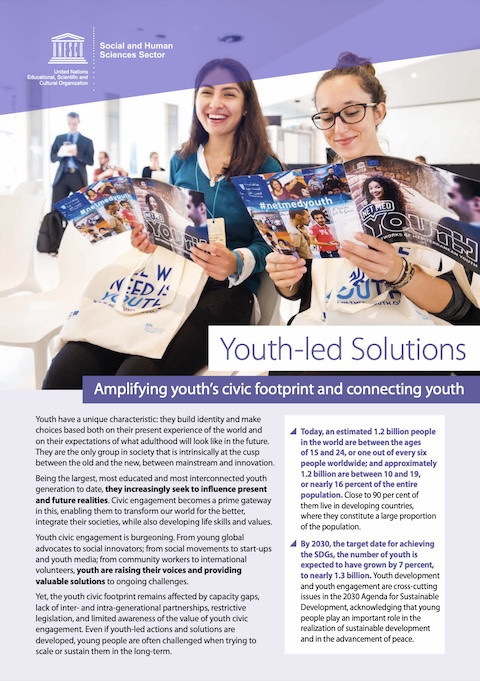 Soluciones impulsadas por las juventudes: Ampliar la huella cívica de las personas jóvenes y ponerles en contacto Année de publication: 2019 Auteur institutionnel: Organización de las Naciones Unidas para la Educación, la Ciencia y la Cultura (UNESCO) La Organización de las Naciones Unidas para la Educación, la Ciencia y la Cultura (UNESCO) cree en el valor de la participación cívica de las personas jóvenes y en las soluciones que generan . Con el fin de colaborar de forma productiva con las juventudes, trabajamos con ellas considerándolas generadoras del cambio y socias, no meras beneficiarias, en consonancia con nuestra Estrategia Operacional sobre la Juventud (2014-2021). Aplicamos estrategias y programas de punta que contribuyen a conformar un ecosistema propicio para una participación cívica significativa, eficaz y sostenible de las personas jóvenes.