
Ressources
Explorez une large gamme de ressources sur le GCED afin d’approfondir votre compréhension et de renforcer vos activités de recherche, de plaidoyer, d’enseignement et d’apprentissage.
3,229 résultats trouvés
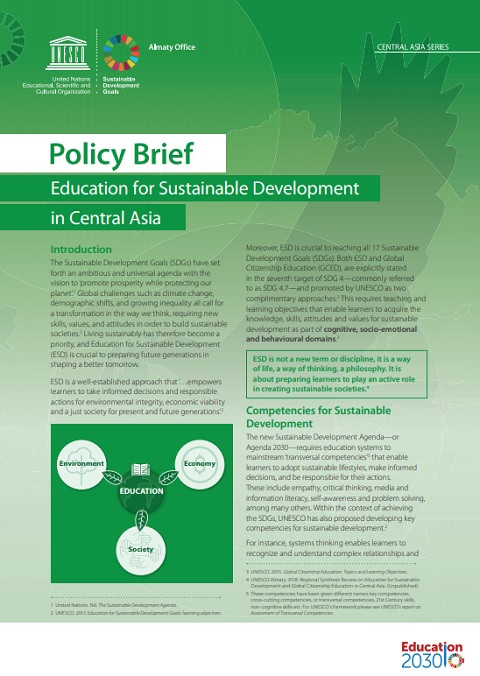 Policy Brief: Education for Sustainable Development in Central Asia Année de publication: 2019 Auteur institutionnel: UNESCO Almaty Education for Sustainable Development(ESD) is crucial to reaching all 17 Sustainable Development Goals (SDGs). Both ESD and Global Citizenship Education (GCED) are explicitly stated in the seventh target of SDG4 and promoted by UNESCO as two complimentary approaches. This requires teaching and learning objectives that enable learners to acquire the knowledge, skills, attitudes and values for sustainable development as part of cognitive, socio-emotional and behavioural domains. This policy brief explores the challenges, promising practices, and policy recommendations when it comes to mainstreaming ESD in Central Asia’s education systems. Аналитическая записка: Образование в интересах устойчивого развития в Центральной Азии Année de publication: 2019 Auteur institutionnel: UNESCO Almaty ОУР имеет решающее значение для достижения всех установленных 17 ЦУР. Как ОУР, так и Образование в духе глобальной гражданственности (ОГГ) непосредственно указаны в седьмой задаче ЦУР 4 как два взаимодополняющих подхода. Для этого перед преподаванием и обучением необходимо ставить задачи, которые позволяют учащимся приобретать знания, навыки, подходы и ценности для устойчивого развития в рамках когнитивных, социальноэмоциональных и поведенческих аспектов. В настоящей аналитической записке излагаются проблемы, примеры применения многообещающих практик и рекомендации по внедрению ОУР в системы образования стран Центральной Азии.
  Handbook on Measuring Equity in Education Année de publication: 2018 Auteur institutionnel: UNESCO Institute for Statistics (UIS) This handbook is aimed at professionals involved in the measurement and monitoring of equity in education, which includes not only those working on the SDGs but also any stakeholders in the field of education: technical staff in ministries of education and national statistical offices, education practitioners,members of nongovernmental organizations (NGOs) active in the field of education and researchers. This material provides a conceptual framework for measuring equality in learning; offers methodological guidance on how to calculate and interpret indicators; and investigates the extent to which measuring equity in learning has been integrated into country policies, national planning and data collection and analysis.
  Values of Kazakhstan Society in the Sociological Dimension Année de publication: 2020 Auteur: Gulnara Ismukhanova | Dina Sharipova | Botagoz Turekhanova | Botagoz Rakisheva | Gulnar Nasimova | Saltanat Ermakhanova | Shugla Kylybayeva | Tolganai Umbetalieva | Leonid Gurevich Auteur institutionnel: Friedrich-Ebert-Stiftung Kazakhstan Office The book provides a structured analysis of the values of modern Kazakhstani society, based both on well-known classical models and on original author’s approaches. The book is based on a sociological study conducted on a national representative sample and which allowed us to describe the value portrait of Kazakhstanis taking into account the specifics of social groups and regions. The key vectors of transformation of values in Kazakhstan are identified against the backdrop of global trends and in the context of the national strategy of spiritual modernization.The book is addressed to scientists, politicians, government and public figures, representatives of the business community, journalists, teachers and university students and is of interest to anyone who seeks to understand the complex structure of social and cultural processes in modern Kazakhstan. Ценности казахстанского общества в социологическом измерении Année de publication: 2020 Auteur: Gulnara Ismukhanova | Dina Sharipova | Botagoz Turekhanova | Botagoz Rakisheva | Gulnar Nasimova | Saltanat Ermakhanova | Shugla Kylybayeva | Tolganai Umbetalieva | Leonid Gurevich Auteur institutionnel: Фонд имени Фридриха Эберта в Казахстане В книге предпринят структурированный анализ ценностей современного казахстанского общества, базирующийся как на известных классических моделях, так и на оригинальных авторских подходах. В основе книги – социологическое исследование, проведенное на национальной репрезентативной выборке и позволившее описать ценностный портрет казахстанцев с учетом специфики социальных групп и регионов. Определены ключевые векторы трансформации ценностей в Казахстане на фоне мировых трендов и в контексте национальной стратегии духовной модернизации.Книга адресована ученым, политикам, государственным и общественным деятелям, представителям деловых кругов, журналистам, преподавателям и студентам вузов и представляет интерес для всех, кто стремится понять сложную структуру социальных и культурных процессов в современном Казахстане.
  유네스코학교 길라잡이: 밑동부터 차근차근 Année de publication: 2020 Auteur: 김다영 | 박현주 | 유성상 | 임재민 | 정다정 Auteur institutionnel: 유네스코한국위원회 본 자료는 유네스코학교 담당 신규교사를 위한 길라잡이로, 유네스코학교 담당교사들이 직접 집필에 참여하였다. 유네스코학교 연간운영계획 예시 및 실제 현장사례와 함께 세계시민교육 관련 교육자료가 풍성하게 담겨있다.
 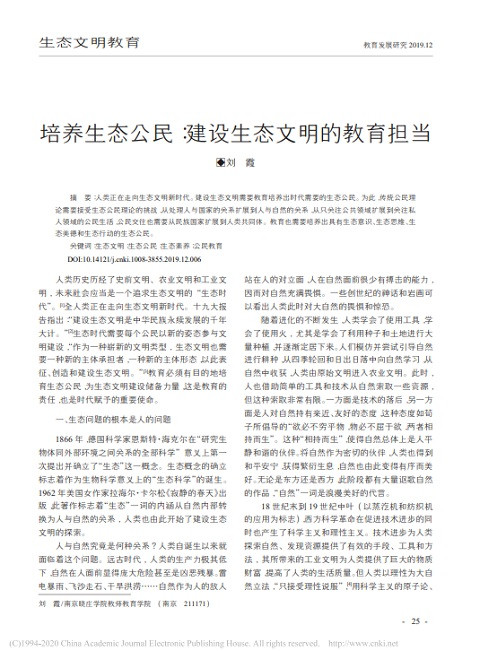 Cultivating Ecological Citizens: Education for Building Ecological Civilization (Research in Educational Development; No. 12) Année de publication: 2019 Auteur: Liu Xia Auteur institutionnel: Shanghai Academy of Educational Sciences | Shanghai Higher Education Mankind is heading for a new era of ecological civilization. The construction of ecological civilization requires education to cultivate the ecological citizens of the times. This requires the traditional citizenship theory to accept the challenge of Eco-Citizenship theory, from dealing with the relationship between people and the state to the relationship between man and nature, from focusing only on the public sphere to the private sphere of citizen life, citizen exchanges also need to expand from the nation-state to the human community. Education needs to cultivate eco-citizens with ecological awareness, ecological thinking, ecological virtues, and ecological action with ecological literacy. 培养生态公民:建设生态文明的教育担当 (生态文明教育; No. 12) Année de publication: 2019 Auteur: Liu Xia Auteur institutionnel: Shanghai Academy of Educational Sciences | Shanghai Higher Education 人类正在走向生态文明新时代。建设生态文明需要教育培养出时代需要的生态公民。为此,传统公民理 论需要接受生态公民理论的挑战,从处理人与国家的关系扩展到人与自然的关系,从只关注公共领域扩展到关注私 人领域的公民生活,公民交往也需要从民族国家扩展到人类共同体。教育也需要培养出具有生态意识、生态思维、生 态美德和生态行动的生态公民。
  평화견문록: 평화와 공존을 위한 세계시민교육; 교과통합형 세계시민교육 수업자료집 Année de publication: 2019 Auteur: 강방식 | 강은하 | 김경훈 | 김웅 | 김준구 | 김지광 | 여지화 | 윤상철 | 임재민 | 정미선 | 정애경 Auteur institutionnel: 서울특별시교육청 민주시민생활교육과 본 자료는 학생들의 평화감수성 함양을 위해 학생들이 일상적인 삶에서 경험할 수 있는 소재를 활용한 세계시민교육 수업활동집이다. 학생들은 다양한 관점을 연결하는 교과통합형 세계시민교육을 통해 문제해결력과 비판적 사고를 함양할 수 있다.
  االستراتيجية التعاونية لمجموعة العشرين فيما يخص الهدف 7.4 من النقطة رقم 4 من أهداف التنمية المستدامة: مراقبة التقدم نحو التعليم في مجال التنمية المستدامة والمواطنة العالمية ; موجز السياسة Année de publication: 2020 Auteur: Charlotte Holland | Dinah Bennett | Abdul Ghaffar Mughal | Huan NI Auteur institutionnel: Think 20 (T20) Saudi Arabia ان جائحة كوفيد-19 تلعب دورا مهما في التذكير بأن هناك حاجة إلى إيجاد حلول عالمية وتضمانية بين الأمم لمعالجة التحديات العالمية. ومن ضمن تلك التحديات المفصلية ضمن أهداف التنمية المستدامة السبعة عشر (17) وفقًا لأجندة 2030 للتنمية المستدامة. ويهدف ملخص السياسة هذا إلى استغلال خبرات وتجارب شراكة مجموعة العشرين من أجل تسريع المراقبة عالية الجودة للهدف 4.7 من النقطة رقم 4 من أهداف التنمية المستدامة. ويقترح إنشاء هياكل تنظيمية تسمح بالمزيد من التتبع الشامل لدمج التعليم التنموي المستدام والمواطنة العالمية ضمن السياسات وتعليم المعلمين والمناهج الدراسية وتقييم المتعلمين بجميع المستويات التعليمية.