
Ressources
Explorez une large gamme de ressources sur le GCED afin d’approfondir votre compréhension et de renforcer vos activités de recherche, de plaidoyer, d’enseignement et d’apprentissage.
3,448 résultats trouvés
 L’individualisation de l’intervention dans les organismes communautaires : Levier ou barrière à la prise en charge démocratique ? Année de publication: 2009 Auteur: Jean-François René Auteur institutionnel: Nouvelles pratiques sociales Cet article a pour objectif de questionner la tendance à l’individualisation de l’intervention dans de nombreux organismes communautaires, et de cerner un peu mieux en quoi cela interfère sur le développement de pratiques démocratiques au sein de ces organisations. Depuis le début de la présente décennie, dans bien des organismes communautaires, il appert que peu de temps est consacré aux pratiques démocratiques et aux modes plus collectifs d’action. Différents facteurs entrent en ligne de compte : débordement des groupes face aux demandes ; lectures que l’on fait des problèmes vécus par les personnes rejointes ; formalisation de l’intervention ; accentuation de la pression étatique quant à l’intégration des services. Dans ce contexte, quelles pistes d’action faut-il explorer ? C’est à cette question que s’attarde cet article, en se centrant sur la place et le pouvoir que pourraient prendre les personnes rejointes au sein de ces organismes.
  An Investigation of Conflict Management in Cambodian Villages: A Review of the Literature with Suggestions for Future Research Année de publication: 2001 Auteur: Caroline Hughes Auteur institutionnel: Centre for Peace and Development, Cambodia Development Resource Institute This literature review sets out a conceptual framework for the investigation of conflict management in Cambodian villages, and gives suggestions for further research. It places the study of conflict and conflict management in the framework of ideas of a “culture of peace”, and argues that this requires examining questions of both active procedures (agency) and their context (structure) in responses to conflict.
 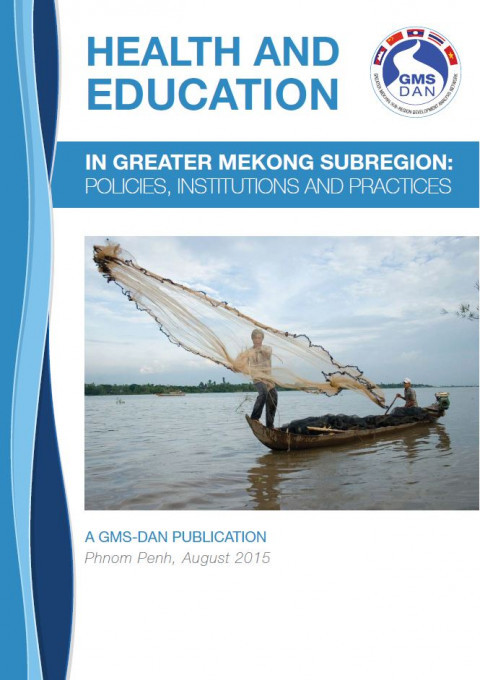 Health and Education in the Greater Mekong Subregion: Policies, Institutions and Practices Année de publication: 2015 Auteur: Greater Mekong Subregion Development Analysis Network Auteur institutionnel: Cambodia Development Resource Institute (CDRI) The focus of the paper is thus on the institutional frameworks and their effectiveness in policy-making and implementation in health and education and not so much on assessing whether these polices themselves are appropriate. In assessing institutional effectiveness, the paper does not purport to be comprehensive but selective in that it looks at only a few key issues: national, especially public, resource commitments; intra-governmental coordination, both vertical and horizontal; the roles of non-state actors, including private sector, civil society organisations and civil society more generally.
  Resilience, violent extremism and religious education Année de publication: 2013 Auteur: Joyce Miller Cet article essaie d'apporter une justification éducative au projet REsilience financé par le gouvernement anglais, et dont l'objet est de traiter de sujets controversés par l'éducation religieuse (RE). Ce projet est mené par le Conseil d'éducation religieuse de l'Angleterre et du pays de Galles. La présence de l’extrémisme violent d’inspiration religieuse au sein des programmes scolaires, dans les définitions mais aussi aux niveaux politique et éducatif, soulève un certain nombre de problèmes. Impact of Radical Islamisation of Education on Pakistani Society Année de publication: 2012 Auteur: Muhammad Safeer Awan This article traces the history, rather briefly, of how the national educational policies and curricula in social sciences and humanities have been changed to serve the jihadist ideology in Pakistani society. The crumbling social order in Pakistan is not only an indication of the bad governance but also the systemic inculcation of ideologies of hatred and extremism among a whole generation of schoolchildren and college graduates. It is a society where extremism, not only of the radical Islamists but also of the average person, is on the rise. Impact of Radical Islamisation of Educaion on Pakistani Society Année de publication: 2012 Auteur: Muhammad Safeer Awan Cet article revient brièvement sur la façon dont les politiques éducatives nationales et les programmes scolaires en sciences sociales et en sciences humaines ont été modifiés au profit de l'idéologie djihadiste présente au sein de la société pakistanaise. Au Pakistan, le délitement de l'ordre social n'est pas seulement révélateur de la mauvaise gouvernance, il dénonce également de l’enseignement systématique d'idéologies haineuses et extrémistes auprès d'une génération entière d'élèves et d'étudiants. C'est une société où l'extrémisme, pas seulement celui porté par les islamistes radicaux mais aussi celui provenant de n'importe quel individu moyen, ne cesse de croître.
  Intelligence, Global Terrorism and Higher Education: Neutralising Threats or Alienating Allies? Année de publication: 2016 Auteur: Tania Saeed, David Johnson This article draws on narratives of Muslim students, their experiences of existing counterterrorism policies, to examine the effects of the new security framework. It asks whether there is another way – a broader framework in which intelligence agencies and academic institutions can pool resources, not to improve statecraft, but to respond more effectively to threats, both known and unknown. Intelligence, Global Terrorism and Higher Education: Neutralising Threats or Alienating Allies? Année de publication: 2016 Auteur: Tania Saeed, David Johnson Fondé sur les récits des étudiants musulmans et leurs expériences des politiques antiterroristes existantes, cet article a pour objectif d’examiner les impacts du nouveau cadre de sécurité. Selon l’article, il faudrait envisager un cadre élargi dans lequel les agences de renseignement et les institutions académiques peuvent mettre en commun des ressources non pas pour améliorer l'art de gouverner, mais plutôt pour répondre plus efficacement aux menaces, à la fois connues et inconnues.
 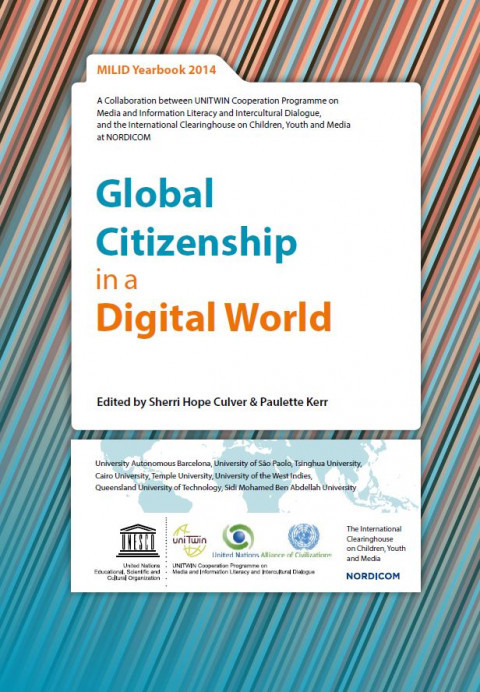 Global Citizenship in a Digital World (The MILID Yearbook, 2014) Année de publication: 2014 Auteur: Sherri Hope Culver | Paulette Kerr Auteur institutionnel: International Clearinghouse on Children, Youth and Media (Sweden) | NORDICOM | University of Gothenburg The theme of the 2014 Yearbook is Global Citizenship in a Digital World. Global citizenship assumes ease of participation in global spaces in which persons are media and information literate and are equipped with competencies and attitudes to deal with the multi-faceted nature of a mediated world in which information is no longer bound by space or time. The unprecedented access to and use of media and Internet technologies for communication and collaboration especially among youth, suggest that effective strategies must be found to enable active critical inquiry and effective media production. The proliferation of mediated spaces throughout education environments, as well as personal and professional environments, does not in itself guarantee that citizens will consider their role as global citizens as they create and consume media. This awareness must be cultivated, encouraged and taught.The 2014 MILID Yearbook brings together a range of reviewed articles, which articulate the theme of global citizenship from varied perspectives and regions of the world. The articles represent different expressions on media and information literacy from researchers and practitioners who offer bold new strategies, share research findings and best practices, and share musings and reflections.
 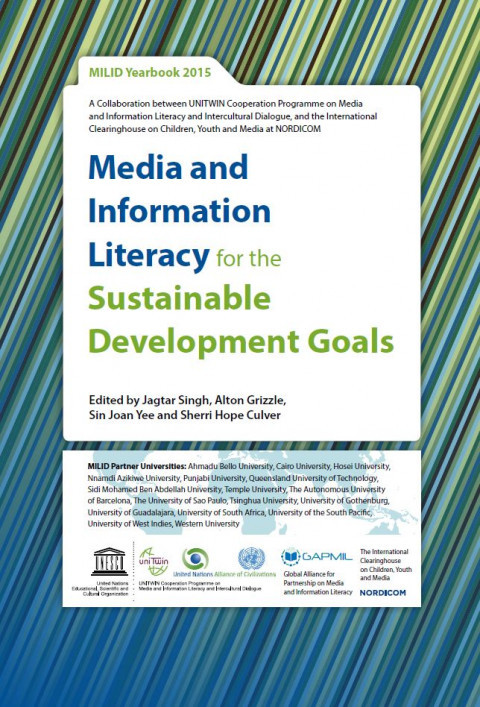 Media and Information Literacy for the Sustainable Development Goals (The MILID Yearbook 2015) Année de publication: 2015 Auteur: Jagtar Singh | Alton Grizzle | Sin Joan Yee | Sherri Hope Culver Auteur institutionnel: International Clearinghouse on Children, Youth and Media (Sweden) In the year 2000, governments and development partners all over the world agreed on eight global development targets called the Millennium Development Goals (MDGs). The year 2015 is a pivotal year as it marks the end of the period during which the MDGs were to be reached and the year in which new global development targets are to be set. These new targets are referred to as the Post-2015 Sustainable Development Goals (SDGs). This process is in its highest gear with ongoing debates and consultative meetings/initiatives globally both online and offline. While much progress has been made, achievement of the MDGs has been mixed across countries. The centrality of information and communication to development is irrefutable. The MILID Yearbook provides a case for media and information literacy (MIL) as a tool for open and inclusive sustainable development.The 2015 edition of the MILID Yearbook displays how media and information literacy can be helpful in facilitating progress and achievement of the sustainable development goals. It is sincerely hoped that the articles in this yearbook will go a long way to sensitize the stakeholders about the role and value of MIL in sustainable development of one and all across frontiers.