
Ressources
Explorez une large gamme de ressources sur le GCED afin d’approfondir votre compréhension et de renforcer vos activités de recherche, de plaidoyer, d’enseignement et d’apprentissage.
3,790 résultats trouvés
 Multicultural education: Israeli and German adolescents' knowledge and views regarding the Holocaust This study probes a unique case of multicultural education of Israeli and German students regarding the Holocaust. Their knowledge level of German history leading to the rise of Hitler and the Nazi party to power, knowledge about the Holocaust, the relation between their knowledge of attitudes toward the "other" (German/Israeli) group, and their reaction to a racist-dictatorial regime are explored. The findings were that German adolescents’ (high school students’) knowledge regarding the events leading to the rise of the Nazi party was greater than that of the Israeli adolescents. However, the knowledge of Israelis was greater regarding the Holocaust. A positive correlation was found between the knowledge levels and their attitudes toward the other groups (German/Israeli) and toward resistance to the possible rise of a dictatorial regime. The findings point to the fact that multicultural education, which combines attitudinal, cognitive and instrumental goals, can succeed in promoting non-racist views. (By the author)
 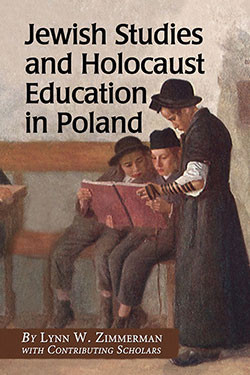 Jewish Studies and Holocaust Education in Poland This volume examines how people in Poland learn about Jewish life, culture and history, including the Holocaust. The main text provides background on concepts such as culture, identity and stereotypes, as well as on specific topics such as Holocaust education and curriculum, various educational institutions, and the connection of arts and cultural festivals to identity and culture. It also gives a brief overview of Polish history and Jewish history in Poland, as well as providing insight into how the Holocaust and Jewish life and culture are viewed and taught in present-day Poland. This background material is supported by essays by Poles who have been active in the changes that have taken place in Poland since 1989. A young Jewish-Polish man gives insight into what it is like to grow up in contemporary Poland, and a Jewish-Polish woman who was musical director and conductor of the Jewish choir Tslil gives her view of learning through the arts. Essays by Polish scholars active in Holocaust education and curriculum design give past, present and future perspectives of learning about Jewish history and culture. (By the publisher)
  Auschwitz in museums - Representing and teaching the Holocaust in the twenty-first century Année de publication: 2007 Auteur: S.Lassig | K.H.Pohl 'Auschwitz' in Museums: Representing and Teaching the Holocaust in the Twenty-first is a select extract from the book "How the Holocaust Looks Now International Perspectives". The book offers a series of essays that explore the historical culture the holocaust has engendered in Europe, Israel and the USA, the politics of its reception and representation, the motivations for and effectiveness of commemorating it, and the creative and didactic practices it has generated in contemporary literature, art, and thought.
  Promoting the culture of dialogue between cultures in the Arab world Année de publication: 2013 Auteur: Selim El Sayegh Auteur institutionnel: UNESCO Beirut The major challenge of the Arab uprisings resides in the youth drive. Accounting for 60 per cent of the Arab population, Youth have been calling for political and economic reforms. During the revolts, these claims have become more radical seeking a fundamental change. This gradual evolution, from a relatively partial change to a more absolute comprehensive one, ushers in a new era with a different intellectual construct. With the ousting of dictatorships, all civil society forces are unleashed with huge actual and potential resources mobilized to contribute to building up the new order. Groups of solidarity, communities, parties, associations, and organizations of all nature among many others put forward new ideas and adequate action plans. Liberty thus acclaimed becomes the outcry for dignity, honor and pride. Never before in the Arab world has the individual had such a central place as it does today. An individual fully grasping the possibilities of restored liberty and recognized dignity gives birth to a new citizen acting in a new paradigm; a new citizen that seeks a transcendence of the ego to relate the individual to the common good. This fresh paradigm empowers the individual as a citizen in the name of equality, while simultaneously recognizing the right of difference of each citizen when it comes to belonging to a culture or sub‐culture. The right to be different involves more than the right to differ and to dispute and by the same token, the obligation of peaceful settlement. The right to be different, by belonging to a culture or a sub‐culture means in a new era of liberty and dignity, the obligation to conduct a transformation of the patterns generating disputes and conflicts among cultures. Henceforth, the issue of promoting the culture of intercultural dialogue in the aftermath of the Arab revolts represents major characteristics that will be reflected hereafter. Promouvoir la culture du dialogue entre les cultures dans le monde Arabe Année de publication: 2013 Auteur: Selim El Sayegh Auteur institutionnel: UNESCO Beirut Le défi majeur des soulèvements arabes réside dans le lecteur de la jeunesse. Comptabilisation de 60 pour cent de la population arabe, de la jeunesse ont été réclame des réformes politiques et économiques. Pendant les révoltes, ces créances sont devenues plus radicales à la recherche d'un changement fondamental. Cette évolution progressive, d'un changement relativement partielle à l'une complète plus absolue, ouvre la voie à une nouvelle ère avec une construction intellectuelle différente. Avec l'éviction des dictatures, toutes les forces de la société civile se déchaînent avec d'énormes ressources réelles et potentielles mobilisées pour contribuer à l'édification du nouvel ordre. Des groupes de solidarité, les communautés, les partis, les associations et organisations de toute nature parmi beaucoup d'autres mettent en avant de nouvelles idées et plans d'action adéquats. Liberté ainsi acclamé devient le cri de la dignité, l'honneur et la fierté. Jamais auparavant dans le monde arabe a l'individu avait une telle place centrale comme il le fait aujourd'hui. Un individu de saisir pleinement les possibilités de la liberté restaurée et reconnue la dignité donne naissance à un nouveau citoyen agissant dans un nouveau paradigme; un nouveau citoyen qui cherche une transcendance de l'ego de relier l'individu au bien commun. Ce nouveau paradigme permet l'individu en tant que citoyen au nom de l'égalité, tout en reconnaissant en même temps le droit à la différence de chaque citoyen en ce qui concerne l'appartenance à une culture ou sous-culture. Le droit d'être différent implique plus que le droit à la différence et à contester et par le fait même, l'obligation de règlement pacifique. Le droit à la différence, par l'appartenance à une culture ou d'une sous-culture signifie une nouvelle ère de liberté et de dignité, l'obligation de procéder à une transformation des modèles de génération de différends et les conflits entre les cultures. Dès lors, la question de la promotion de la culture du dialogue interculturel dans la foulée des révoltes arabes représente les principales caractéristiques qui seront reflétées ci-après.
  Global Citizenship Education: How Much Do We Care? Année de publication: 2018 Auteur institutionnel: European confederation of Relief and Development NGOs (CONCORD) While Global Citizenship Education is recognised by many as a powerful tool to resolve the current global challenges our world is facing, the level of investment by national governments remains limited. Why is that? To answer this situation, CONCORD launches its new report “Global Citizenship Education – How much do we care?“. Based on a research across all EU Member States (+ Norway), this publication reveals the level of funding dedicated to Global Citizenship Education (GCE) in Europe between 2011 and 2015. Analysing the quantitative sources of investments by national governments as well as the qualitative narrative around GCE (How is GCE named? What is its framework of action?), this report digs into the complex world of GCE and provides a full picture of its current states in Europe. The report is composed of 2 parts:– a general overview and analysis– a comparative part made of an analysis per country of all EU member states (+ Norway), including interesting details on GCE definitions, concepts, funding trends.Strong of these analysis, the report draws conclusions and recommendations on where possible improvements at policy and advocacy level can be made. Éducation à la Citoyenneté Mondiale en Europe: Combien compte-t-elle pour nous? Année de publication: 2018 Auteur institutionnel: European confederation of Relief and Development NGOs (CONCORD) Cette étude analyse le niveau des financements de l’éducation à la citoyenneté mondiale par les gouvernements nationaux à travers les États membres de l’UE, ainsi que la Norvège, entre 2011 et 2015. Le postulat de l’idée transparaît dans son intitulé « combien compte-telle pour nous ». En effet, un des indicateurs déterminants de l’engagement d’un pays en faveur d’une solidarité mondiale et d’une sensibilisation de ses propres citoyens aux interdépendances mondiales est le montant de financements publics dédiés à l’Education à la Citoyenneté Mondiale (mentionnée ci-après ECM). Le montant des fonds nationaux dédiés à l’ECM est directement lié à d’autres facteurs aux niveaux national et international, qui conditionnent l’ampleur du soutien et des engagements des gouvernements en faveur de l’ECM. Ainsi, au-delà de l’analyse des données liées aux financements, cette étude vise à explorer les contextes dans lesquels opèrent les gouvernements et les ONG, afin de brosser un tableau complet de l’état de l’ECM en Europe.
  Informative Kit on Global Citizenship Education (GCE) for Policy Makers: Boosting Global Citizenship Education Using Digital Storytelling Année de publication: 2017 Auteur institutionnel: European Union (EU) | European Commission This informative kit aims to equip policy makers with all the necessary knowledge about the role that Global Citizenship Education (GCE) can play in contemporary society. This document will summarize GCE, its principles, capabilities and advantages and will provide best cases regarding its application. The goal is to convince policy makers into adopting GCE in the training and education curricula. Furthermore, it presents the Digital Storytelling (DS) method and its benefits as a tool to teach GCE more effectively.
  Manifeste pour une éducation à la citoyenneté planétaire: Pour vivre ensemble à 10 milliards, changeons l'éducation Année de publication: 2015 Auteur institutionnel: Collectif Paris-Education 2015 Face à l’ampleur, l’urgence, la diversité et la complexité des problématiques engendrées par le modèle de développement de nos sociétés contemporaines, nous sommes donc obligés, dans l’urgence, de nous pencher sur les questions d’éducation et de formation des générations futures qui devront affronter des réalités biophysiques, économiques et politiques inédites, dont nous commençons à peine à entrevoir l’ampleur. Ce qui est dès lors en jeu, avec l’avenir de l’homme et de la Terre, c’est l’humain, ce qu’il deviendra, ce qu’il sera capable de porter comme projet pour l’humanité.Quelles qualités d’humains devons-nous faire advenir pour que ces réalités inédites puissent être rencontrées demain, sans que l’humanité bascule dans la violence et le dépeçage égoïste de la planète? Quels enfants voulons-nous laisser à notre Terre?Cette urgence impose un changement d’échelle dans la transformation des systèmes éducatifs, des contenus et des méthodes d’enseignement. Malgré la volonté et la compétence de nombreux acteurs de l’école, force est de constater que les actions menées pour une éducation plus en cohérence avec les enjeux climatiques et, plus largement, sociétaux restent à la marge. Elles sont réalisées par des individus clairvoyants. Il est temps d’enclencher la vitesse supérieure.
  [Video] GLOBAL CITIZENSHIP EDUCATIONAL PROGRAM Année de publication: 2018 Auteur institutionnel: EducacionBA To build a fairer, more equitable and sustainable future, the "Global Citizenship" educational program is created to promote the Sustainable Development Goals through quality education enhanced by digital technologies and by fostering 21st century skills. Through a digital platform, school contents and monitoring, evaluation and planning tools, children learn by playing, carrying out missions, creating strategies and being protagonists of their learning.It has an extensive potential to reach an ambitious scope of 2.000 teachers and 50.000 students. During 2018 a pilot test was carried out with 6 precursory schools. In the platform, teachers are provided with tools to develop and undertake meaningful and innovative educational projects with their students. Students are offered school contents that challenge and empower them as key players. They are encouraged to learn through play, to carry out missions, to devise strategies, and to lead projects which reinforce learning processes and encourage their creativity and commitment.