
Ressources
Explorez une large gamme de ressources sur le GCED afin d’approfondir votre compréhension et de renforcer vos activités de recherche, de plaidoyer, d’enseignement et d’apprentissage.
1,407 résultats trouvés
 Educación para Todos (EPT) en América Latina y el Caribe: Balance y Desafíos post-2015, 30-31 de Octubre del 2014, Lima, Perú: Declaración de Lima Année de publication: 2014 Auteur institutionnel: Organización de las Naciones Unidas para la Educación, la Ciencia y la Cultura (UNESCO) The Ministers of Education of Latin America and the Carribean (LAC), high-level government officials, UN agencies, representatives of civil society organizations and development partners, gathered at th meeting on "Education for All (EFA) in Latin America and the Carribean: Assessment of progress and post-2015 challenges", in Lima, Peru, from 30 to 31 October 2014. Having deliberated on progress towards EFA in the region, the Muscat Agreement adopted at the Global EFA Meeting (GEM) in Muscat, Oman, 12-14 May 2014, and the outcome document of the UN General Assembly Open Working Group for Sustainable Development Goals, and having examined the unfinished EFA tasks in the region, as well as the challenges and priorities that will configure the post-2015 education agenda for the region, the Lima Statement was adopted. L'Education pour tous (EPT) en Amérique latine et dans les Caraïbes: Évaluation des Progrès et Enjeux de l'après-2015, 30-31 Octobre 2014, Lima, Pérou: Déclaration de Lima Année de publication: 2014 Auteur institutionnel: Organisation des Nations Unies pour l'éducation, la science et la culture (UNESCO) The Ministers of Education of Latin America and the Carribean (LAC), high-level government officials, UN agencies, representatives of civil society organizations and development partners, gathered at th meeting on "Education for All (EFA) in Latin America and the Carribean: Assessment of progress and post-2015 challenges", in Lima, Peru, from 30 to 31 October 2014. Having deliberated on progress towards EFA in the region, the Muscat Agreement adopted at the Global EFA Meeting (GEM) in Muscat, Oman, 12-14 May 2014, and the outcome document of the UN General Assembly Open Working Group for Sustainable Development Goals, and having examined the unfinished EFA tasks in the region, as well as the challenges and priorities that will configure the post-2015 education agenda for the region, the Lima Statement was adopted. Education for All (EFA) in Latin America and the Caribbean: Assessment of Progress and Post-2015 Challenges, 30-31 October 2014, Lima, Peru: Lima Statement Année de publication: 2014 Auteur institutionnel: UNESCO The Ministers of Education of Latin America and the Carribean (LAC), high-level government officials, UN agencies, representatives of civil society organizations and development partners, gathered at th meeting on "Education for All (EFA) in Latin America and the Carribean: Assessment of progress and post-2015 challenges", in Lima, Peru, from 30 to 31 October 2014. Having deliberated on progress towards EFA in the region, the Muscat Agreement adopted at the Global EFA Meeting (GEM) in Muscat, Oman, 12-14 May 2014, and the outcome document of the UN General Assembly Open Working Group for Sustainable Development Goals, and having examined the unfinished EFA tasks in the region, as well as the challenges and priorities that will configure the post-2015 education agenda for the region, the Lima Statement was adopted. Education for All (EFA) in Latin America and the Caribbean: Assessment of Progress and Post-2015 Challenges, 30-31 October 2014, Lima, Peru: Lima Statement Année de publication: 2014 Auteur institutionnel: Organisation des Nations Unies pour l'éducation, la science et la culture (UNESCO) Les ministres de l'éducation de l'Amérique latine et les Caraïbes (ALC), les responsables gouvernementaux de haut niveau, les organismes de l’ONU, des représentants d'organisations de la société civile et les partenaires au développement, réunis à e réunion sur "l'Éducation Pour Tous (EPT) en Amérique latine et les Caraïbes : évaluation des progrès et des défis de l'après-2015 ", à Lima, Pérou, du 30 au 31 Octobre 2014. après en avoir délibéré sur les progrès vers l'EPT dans la région, l'accord Muscat adopté lors de la Réunion Mondiale sur l'EPT (RME) à Muscat, Oman, 12-14 mai 2014, et le document final du Groupe de travail à composition Assemblée générale de l'ONU pour les objectifs de développement durable, et après avoir examiné les tâches inachevées de l'EPT dans la région, ainsi que les défis et les priorités qui configureront l'ordre du jour de l'éducation post-2015 pour la région, la Déclaration de Lima a été adopté. Rapport relatif à l'enquête sur la mise en oeuvre de la Feuille de route pour l'éducation artistique Année de publication: 2010 Auteur institutionnel: Organisation des Nations Unies pour l'éducation, la science et la culture (UNESCO) The Road Map for Arts Education is a reference document that aims to explore the role of arts education in meeting the need for creativity and cultural awareness in the 21st Century, while placing emphasis on the strategies required to introduce or promote arts education in the learning environment. Within this conceptual framework, all UNESCO Member States interested in initiating or developing arts education practices can mould their own national policy guidelines, adapted to their socio-cultural specificities. With the Road Map, UNESCO advocates the essential role of arts education within societies, to create a common ground of understanding for all stakeholders. The development of the Road Map for Arts Education was a lengthy and comprehensive consultation process. The document was first elaborated by a group of experts and UNESCO, then presented at the First World Conference on Arts Education (Lisbon, 2006) and later revised and updated, following recommendations from NGOs and Member States. The Road Map was finally distributed to the UNESCO Member States in November 2007 in English and French and then translated into Spanish and Russian following popular demand. More than a year after this distribution, UNESCO launched a wide-ranging survey in order to assess the implementation of the Road Map in its 193 Member States. Through its National Commissions, the Organization relayed this document to Ministries of both Education and Culture. The aim of this exercise was threefold: to learn whether the Road Map was being applied and to what extent it was influencing policy decisions at national level; to act as a reminder of the importance of the UNESCO reference document and encourage its use; finally, to assess the situation of arts education in the responding countries. Thus, this survey not only acted as a catalyst for the implementation of the Road Map, but also provided precious knowledge on arts education around the world. The Member States’ responses also contributed greatly to the Second World Conference on Arts Education (Seoul, May 2010), inspiring one of its main themes and the topics for a number of workshops. They also encouraged a more integral participation of these States in the conference through preparatory consultations. Discours de Mme Irina Bokova, Directrice générale de l'UNESCO, à l'occasion de la Présentation du Rapport Mondial de l'UNESCO: Investir dans la Diversité Culturelle et le Dialogue Interculturel Année de publication: 2010 Auteur institutionnel: UNESCO. Director-General, 2009-2017 (Bokova, I.G.) This address was delivered by Irina Bokova, Director-Geneeral of UNESCO on the occasion of the presentation of the UNESCO world report in investing in cultural diversity and intercultural dialogue during UNESCO week at the Shanghai World Expo 2010. In this address she highlited the importance of cultural diversity and intercultural communication, and requested the protection of Chinese cultural heritage by Chinese governments.
 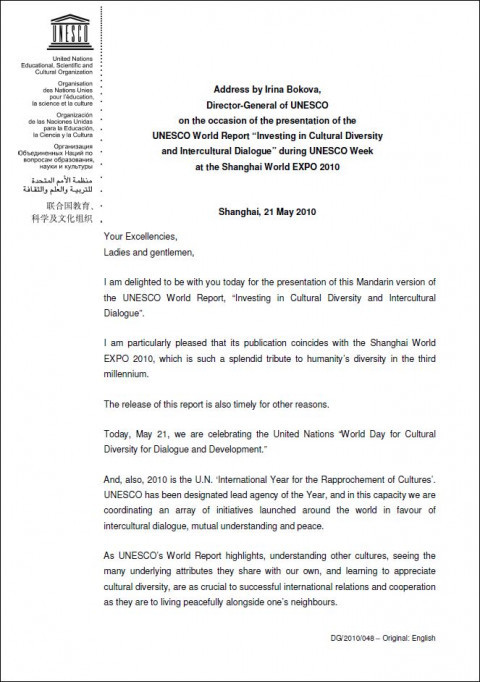 Address by Irina Bokova, Director-General of UNESCO on the occasion of the Presentation of the UNESCO World Report: Investing in Cultural Diversity and Intercultural Dialogue, during UNESCO Week at the Shanghai World EXPO 2010; Shanghai, 21 May 2010 Année de publication: 2010 Auteur institutionnel: UNESCO. Director-General, 2009-2017 (Bokova, I.G.) This address was delivered by Irina Bokova, Director-Geneeral of UNESCO on the occasion of the presentation of the UNESCO world report in investing in cultural diversity and intercultural dialogue during UNESCO week at the Shanghai World Expo 2010. In this address she highlited the importance of cultural diversity and intercultural communication, and requested the protection of Chinese cultural heritage by Chinese governments. Discours de Mme Irina Bokova, Directrice Générale de l'UNESCO à l'occasion de la Présentation du Rapport Mondial de l'UNESCO: Investir dans la Diversité Culturelle et le Dialogue Interculturel, au cours de la Semaine de l'UNESCO à l'EXPO Shanghai 2010 Année de publication: 2010 Auteur institutionnel: UNESCO. Director-General, 2009-2017 (Bokova, I.G.) Cette adresse a été prononcé par Irina Bokova, Directrice Geneeral de l'UNESCO à l'occasion de la présentation du rapport mondial de l'UNESCO à investir dans la diversité culturelle et le dialogue interculturel pendant la semaine de l'UNESCO à l'Exposition Universelle de Shanghai 2010. Dans cette adresse, elle a souligné l'importance de la diversité culturelle et la communication interculturelle, et a demandé la protection du patrimoine culturel chinois par les gouvernements chinois.
 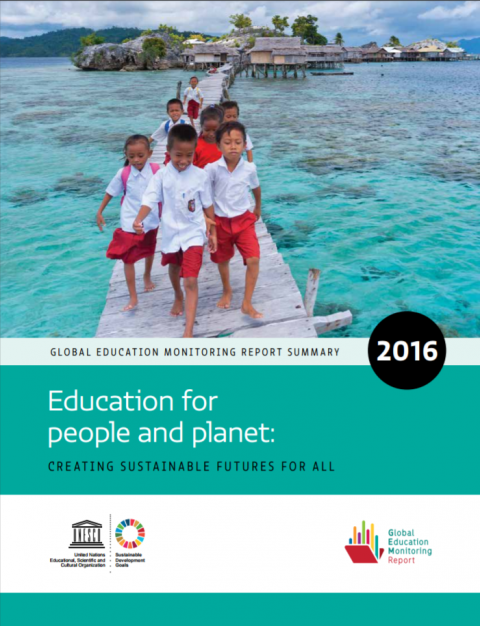 L'Education pour les peuples et la planète: créer des avenirs durables pour tous, résumé du rapport mondial de suivi sur l'éducation, 2016 Année de publication: 2016 Auteur institutionnel: Organisation des Nations Unies pour l'éducation, la science et la culture (UNESCO) The GEM Report provides an authoritative account of how education is the most vital input for every dimension of sustainable development. Better education leads to greater prosperity, improved agriculture, better health outcomes, less violence, more gender equality, higher social capital and an improved natural environment. Education is key to helping people around the world understand why sustainable development is such a vital concept for our common future. Education gives us the key tools – economic, social, technological, even ethical – to take on the SDGs and to achieve them. These facts are spelled out in exquisite and unusual detail throughout the report. Yet the report also emphasizes the remarkable gaps between where the world stands today on education and where it has promised to arrive as of 2030. [Summary] Education for People and Planet: Creating sustainable Futures for All, Global Education Monitoring Report, 2016; Summary Année de publication: 2016 Auteur institutionnel: UNESCO Education for People and Planet: Creating Sustainable Futures for All explores the complex relationship between education and the new 2030 Agenda for Sustainable Development, covering six fundamental pillars – Planet, Prosperity, People, Peace, Place and Partnerships. This report shows that education will not deliver its full potential unless participation rates increase dramatically and sustainable development guides education system reform. It also warns of the destructive impact that climate change, conflict, unsustainable consumption and the increasing gap between rich and poor have on education. A huge transformation is needed if we are to create sustainable futures for all.