
Ressources
Explorez une large gamme de ressources sur le GCED afin d’approfondir votre compréhension et de renforcer vos activités de recherche, de plaidoyer, d’enseignement et d’apprentissage.
3,229 résultats trouvés
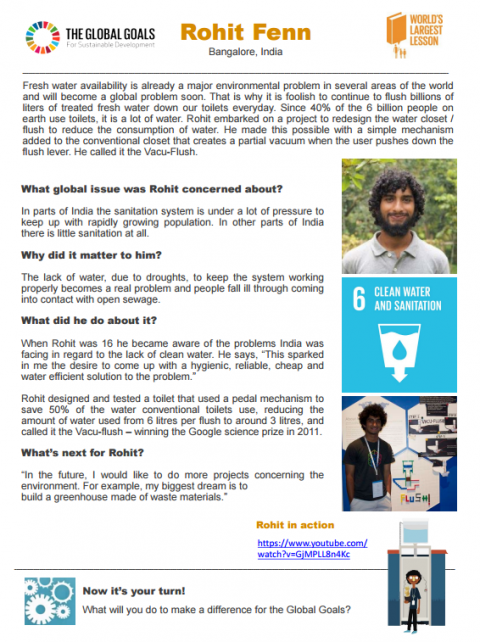 Rohit Fenn Auteur institutionnel: United Nations Children's Fund (UNICEF) Fresh water availability is already a major environmental problem in several areas of the world and will become a global problem soon. That is why it is foolish to continue to flush billions of liters of treated fresh water down our toilets everyday. Since 40% of the 6 billion people on earth use toilets, it is a lot of water. Rohit embarked on a project to redesign the water closet / flush to reduce the consumption of water. He made this possible with a simple mechanism added to the conventional closet that creates a partial vacuum when the user pushes down the flush lever. He called it the Vacu-Flush.
  Clean Water for All Auteur institutionnel: United Nations Children's Fund (UNICEF) World’s Largest Lesson is a collaborative education project to support the announcement of the United Nations Global Goals for Sustainable Development. Learning outcome of the project: • Define water pollution • State or outline some of the causes of water pollution • Describe the global inequality of access to clean water
  Предлагаемая тематическая программа по образованию в области водных ресурсов в рамках Десятилетия образования в интересах устойчивого развития ООН (ДОУР, 2005-2014 ГГ.) Année de publication: 2006 Auteur institutionnel: International Hydrological Programme (IHP) Water education is a very important component of UNESCO’s overall effort in water, including within the International Hydrological Programme. The UNESCO Executive Board has called for a UNESCO-wide strategy for water education at all levels. This document reviews the evolution of water education within UNESCO, and draws attention to the Draft Action Plan for the UN Decade on Education for Sustainable Development (DESD), which includes 12 Thematic Programmes one of which would be devoted to “Education for Sustainable Water Management”. The IHP would be expected to play an important role in such a UNESCO-wide effort for water education.
  Status of water education in the context of the UN Decade of Education for Sustainable Development (DESD, 2005-2014) Année de publication: 2007 Auteur institutionnel: International Hydrological Programme (IHP) This document reports on the thematic programme “Education for Sustainable Water Management” of the UN Decade of Education for Sustainable Development (DESD), which is to be implemented under the leadership of UNESCO-IHP. As a follow-up to 166 EX/Decision 3.6.1 of the Executive Board of UNESCO and Resolution XVII-12 of the Intergovernmental Council of IHP, an intersectoral Working Group on Water Education was constituted and is operational. The Working Group developed a draft Work Plan, which is presented in Annex V for the endorsement of the Bureau. Situation de l'éducation relative à l'eau dans le contexte de la Décennie des Nations Unies pour l'éducation au service du développement durable (DEDD, 2005-2014) Année de publication: 2007 Auteur institutionnel: International Hydrological Programme (IHP) Ce document rend compte du programme thématique «Education pour une gestion durable de l'eau» de la Décennie des Nations Unies pour l'éducation au service du développement durable (DEDD), qui sera mis en œuvre sous la direction du PHI de l'UNESCO. Conformément à la décision 166 EX / 3.6.1 du Conseil exécutif de l'UNESCO et à la Résolution XVII-12 du Conseil intergouvernemental du PHI, un groupe de travail intersectoriel sur l'éducation relative à l'eau a été créé et est opérationnel. Le groupe de travail a élaboré un projet de plan de travail qui est présenté à l'annexe V pour approbation par le Bureau. Programa temático propuesto sobre la educación relativa al agua en el marco del Decenio de las Naciones Unidas de la Educación para el Desarrollo Sostenible (2005-2014) Année de publication: 2006 Auteur institutionnel: International Hydrological Programme (IHP) Water education is a very important component of UNESCO’s overall effort in water, including within the International Hydrological Programme. The UNESCO Executive Board has called for a UNESCO-wide strategy for water education at all levels. This document reviews the evolution of water education within UNESCO, and draws attention to the Draft Action Plan for the UN Decade on Education for Sustainable Development (DESD), which includes 12 Thematic Programmes one of which would be devoted to “Education for Sustainable Water Management”. The IHP would be expected to play an important role in such a UNESCO-wide effort for water education. Proposition de programme thématique sur l'éducation relative à l'eau dans le cadre de la décennie des Nations Unies pour L'Education au Service du Développement Durable (DEDD, 2005-2014) Année de publication: 2006 Auteur institutionnel: International Hydrological Programme (IHP) Water education is a very important component of UNESCO’s overall effort in water, including within the International Hydrological Programme. The UNESCO Executive Board has called for a UNESCO-wide strategy for water education at all levels. This document reviews the evolution of water education within UNESCO, and draws attention to the Draft Action Plan for the UN Decade on Education for Sustainable Development (DESD), which includes 12 Thematic Programmes one of which would be devoted to “Education for Sustainable Water Management”. The IHP would be expected to play an important role in such a UNESCO-wide effort for water education.
  Natural disaster preparedness and education for sustainable development Année de publication: 2007 Auteur institutionnel: UNESCO Bangkok Natural Disaster Preparedness and Education for Sustainable Development provides details of the development of culturally appropriate and locally relevant educational material for natural disaster preparedness that targets key stakeholder groups and integrates Education for Sustainable Development (ESD) principles and strategies. It is expected to develop and strengthen a regional network to implement and further ESD initiatives throughout the region by promoting education for natural disaster preparedness as well as ESD. This will underpin an identified key area of the Hyogo Framework for Action 2005-2015: Building the Resilience of Nations and Communities to Disasters. The publication articulates the lessons learned by the four in-country project teams (i.e., the Maldives, Thailand, Indonesia and India) and two collaborating organizations (i.e., Asia/Pacific Cultural Centre for UNESCO and Bangladesh Red Crescent Society) in developing materials in collaboration with community groups in the Asia-Pacific region. It provides insights into effective techniques to develop locally relevant educational materials, and highlights some of the challenges in that field. Guide de mise en œuvre écoles éducation à l'environnement primaire et secondaire Année de publication: 2005 Auteur institutionnel: China. Ministry of Environmental Protection L'ONU a proposé le développement durable et l'éducation environnementale dans l'Agenda 21 comme un objectif d'éducation pour le XXIe siècle. Dans de nombreux pays développés, l'éducation environnementale est devenue une partie importante de l'éducation qui est compatible avec le développement social. La Chine est également confrontée à de graves problèmes environnementaux qui font plus de demandes pour le mode de développement économique et le niveau de protection de l'environnement. Depuis les années 1980, bien que l'éducation environnementale a été effectuée dans les écoles primaires et secondaires, sa concentration était plus que la transmission des connaissances de l'environnement. Afin de nourrir l'idée de développement durable pour les étudiants et les encourager à prendre des mesures pour un avenir durable, le Ministère de l'éducation de la RPC a officiellement intégré l'éducation environnementale dans le cadre de la fondation des écoles primaires et secondaires. Ce guide vise à fournir des conseils concrets pour les enseignants et autres éducateurs à organiser des activités pour favoriser la compréhension globale du système environnemental des élèves et de développer leurs capacités à prendre des responsabilités pour la protection de l'environnement dans la vie sociale. Il donne également des conseils pour les services administratifs de l'école pour gérer et soutenir ces activités, d'exploiter et de développer de multiples ressources en éducation à l'environnement, et d'appliquer des méthodes et des stratégies pour l'éducation environnementale. En outre, il fournit des méthodes d'évaluation de l'éducation environnementale en tant que point de départ pour ajuster et améliorer la mise en œuvre de l'éducation environnementale. 中小学环境教育实施指南 Année de publication: 2005 Auteur institutionnel: China. Ministry of Environmental Protection The UN proposed sustainable development and environmental education in Agenda 21 as an educational goal for the twenty-first century. In many developed countries, environmental education has become an important part of education that is compatible with social development. China is also facing serious environmental problems that make more demands for mode of economic development and level of environment protection. Since the 1980s, although environmental education has been carried out in primary and secondary schools, its concentration was no more than imparting environmental knowledge. In order to nurture the idea of sustainable development for students and encourage them to take action for a sustainable future, the Ministry of Education of PRC has formally incorporated environmental education in the foundation course of primary and secondary schools. This guide aims to provide concrete advice for teachers and other educators to organize activities to foster students’ comprehensive understanding of the environmental system and develop their capacities to take responsibilities for environment protection in social life. It also gives advice for the school’s administrative departments to manage and support these activities, to exploit and develop multiple environmental education resources, and to apply different methods and strategies to environmental education. In addition, it provides methods of evaluating environmental education as a starting point to adjust and improve the implementation of environmental education.