
Ressources
Explorez une large gamme de ressources sur le GCED afin d’approfondir votre compréhension et de renforcer vos activités de recherche, de plaidoyer, d’enseignement et d’apprentissage.
2,162 résultats trouvés
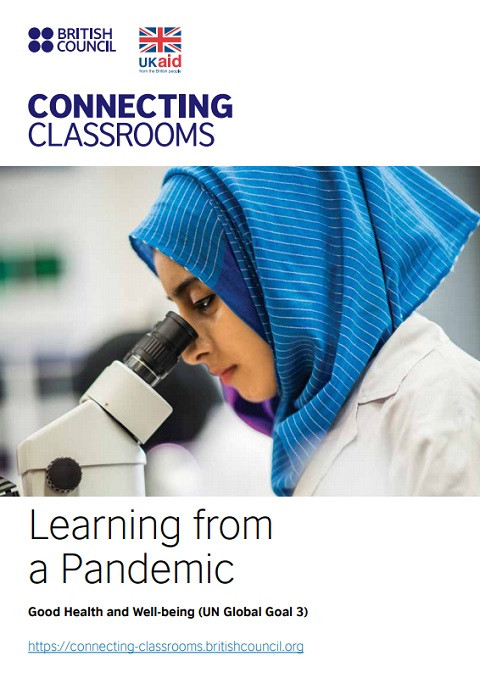 Connecting Classrooms: Learning From a Pandemic; Good Health and Well-Being (UN Global Goal 3) Année de publication: 2020 Auteur institutionnel: British Council | UK aid This resource will help you make a contribution to a recovery curriculum in schools, and beyond this, by providing interesting, engaging and relevant content that encourages pupils to recall, discuss and process some of their thoughts, feelings and memories. Over the course of six lessons, pupils will have opportunities to develop an understanding of:• Covid-19 in the context of some of the world’s most common communicable diseases and pandemics from the past• how communicable diseases like Covid-19 may start and spread, and how this is investigated• relevant prevention strategies to foster positive physical and mental health and well-being.In doing so, pupils will have the opportunity to develop core skills in critical thinking and problem solving, citizenship, student leadership, creativity and imagination and aspects of digital literacy. This learning unit is also designed to support the United Nations’ Global Goals for Sustainable Development (SDGs), in particular Goal 3: Good health and well-being.
 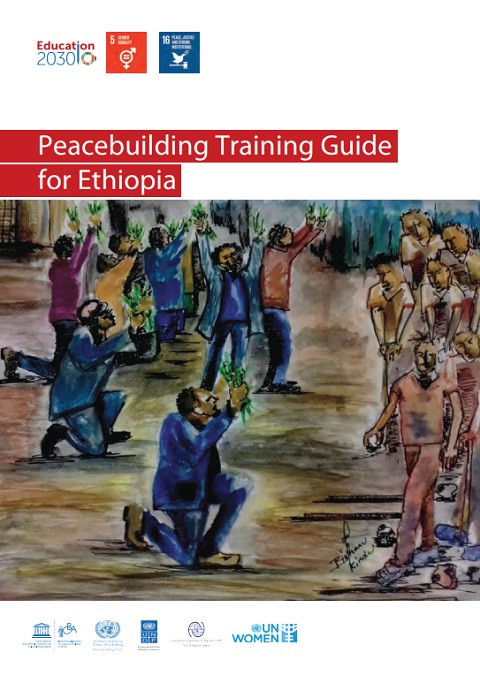 Peacebuilding Training Guide for Ethiopia Année de publication: 2020 Auteur institutionnel: UNESCO International Institute for Capacity-Building in Africa (IICBA) This publication is a training guide for a variety of stakeholders, both inside and outside the education system, in Ethiopia on peace and resilience building. It is an adapted and updated guide for the Ethiopian context. The training guide aims to inform and empower the reader in why and how to educate others for peacebuilding. It provides a foundation of con¬ict analysis and peacebuilding and describes a learner-centered approach to peace education and community engagement. The goal of the training guide is for the reader to become a facilitator with the disposition, knowledge, skills and commitment to support others in developing their full potential as peace-builders.
  PEERs for Peace!: A Community-Based Resource Guide for Peace Education Année de publication: 2016 Auteur: Tyler Hook | Kathleen Kardos | Athena Lao | Sharanya Vasudevan | Erin Wall Auteur institutionnel: UNESCO International Institute for Capacity-Building in Africa (IICBA) | University of Pennsylvania This peace education resource guide is designed for teachers of upper primary grades in sub‐Saharan African countries to help them foster the development of peaceful skills, attitudes, and practices in their students and empower students to use peaceful tools to respond productively to conflict. Throughout the seven units in this peace education resource guide, students will explore the concepts of problem solving, empathy, effective communication, and respect (PEER) and how they relate to conflict in various areas of their lives, including families, schools, communities, governments, and more.
  디지털 시대 시민되기: 초등학교 고학년 (디지털 시민교육 시리즈 2nd) Année de publication: 2019 Auteur: 김양은 | 배은주 | 박정원 | 김영환 | 김형태 | 심성호 Auteur institutionnel: 방송통신위원회 | 한국정보화진흥원 본 자료는 초등 고학년(5~6학년) 대상 디지털시민교육을 위한 교육자료이다. 6가지의 역량별로 교수학습지도안과 학생 활동지로 구성되어 있다.
  디지털 시대 시민되기: 중학생, 고등학생 (디지털 시민교육 시리즈 2nd) Année de publication: 2019 Auteur: 김양은 | 배은주 | 박정원 | 김영환 | 김형태 | 심성호 Auteur institutionnel: 방송통신위원회 | 한국정보화진흥원 본 자료는 중고등학생 대상 디지털시민교육을 위한 교육자료이다. 6가지의 역량별로 교수학습지도안과 학생 활동지 등으로 구성되어 있다.
  Innovating Technical and Vocational Education and Training: A Framework for Institutions Année de publication: 2020 Auteur institutionnel: UNESCO International Centre for Technical and Vocational Education and Training (UNEVOC) Global developments including the transition to greener economies, the application of digital technologies in the world of work, and the COVID-19 pandemic, amongst others, are changing the way we live and work. These developments are driving technical and vocational education and training (TVET) systems to improve their capacity to identify the future skills demands and to expand access to skills development opportunities. As TVET adapts itself to the impacts of significant social, environmental, and economic disruptions, innovative practices emerge with the potential to rejuvenate the future of skills development. Schools, training centres and colleges have the potential to play a leading role to drive innovation in their local skills and innovation ecosystem.This practical guide provides a systematic, institution-wide, measurable and evidence-based methodology that enables TVET institutions to streamline innovation into their strategic planning, products and services, ecosystem engagement, and teaching and learning processes.
  Action Against Hate Speech: A Resource for Teaching and Learning About Hate Speech Année de publication: 2017 Auteur institutionnel: Tony Blair Institute for Global Change | Generation Global This module is designed to prepare students for dialogue around the issue of hate speech. It builds upon other work on human rights, and explores the balancing act between freedom of expression and freedom from insult. Additionally, it prepares students for dialogue on these issues in our facilitated videoconferences and on our safe, secure, online community. This material helps you and your students to get involved in educating, advocating, and acting against hate speech in your communities.
  La famille Tout-Écran: Conseils en éducation aux médias et à l’information Année de publication: 2019 Auteur institutionnel: Centre pour l’éducation aux médias et à l’information (CLEMI) | Réseau Canopé L’Éducation aux Médias et à l'Information (EMI) devient une exigence républicaine au cœur du Parcours citoyen, un enjeu éducatif et sociétal incontournable dans un environnement où le numérique est omniprésent.Dans un monde globalisé et complexifié, la définition et la compréhension de la source de l’information constituent une priorité pour déjouer les tentatives de manipulation et de désinformation.Les enjeux sociétaux de l’EMI dépassent les murs de l’école et doivent mobiliser tous les acteurs pour renforcer le continuum entre temps scolaire et hors temps scolaire.Ce guide bénéficie de l’expertise des professionnels du CLEMI et de son réseau de pédagogues, de partenaires institutionnels, associatifs et médiatiques. Issu de cette mobilisation, cet ouvrage est le produit d’un groupe de travail dédié aux pratiques informationnelles des jeunes, composé de membres représentant du ministère de l’Éducation nationale et de la Jeunesse, du ministère de la Culture, France Télévisions, Radio France, le CSA, CNRS Images, Ceméa, la Ligue de l’enseignement, la CNAF, Jets d’encre et l’Icem-Pédagogie Freinet.
  디지털 시대 시민되기: 초등학교 저학년 (디지털 시민교육 시리즈 2nd) Année de publication: 2019 Auteur: 김양은 | 배은주 | 박정원 | 김영환 | 김형태 | 심성호 Auteur institutionnel: 방송통신위원회 | 한국정보화진흥원 본 자료는 초등 저학년(3~4학년) 대상 디지털시민교육을 위한 교육자료이다. 6가지의 역량별로 교수학습지도안과 학생 활동지로 구성되어 있다.
  Action: Guidelines for Prevention of Violent Extremism Année de publication: 2018 Auteur: Carolyn Nash | Yulia Nesterova | Kenneth Primrose | Wing Yu Alice Chan | Raul A. Rios | María José Velásquez Flores | Aniqah Zowmi Auteur institutionnel: Mahatma Gandhi Institute of Education for Peace and Sustainable Development (MGIEP) The UNESCO MGIEP #YouthWagingPeace guidebook was launched by Director General of UNESCO at its 39th General Conference, 2017. The guidebook was a culmination of reaching out to 2000+ youth, and integrating 130+ submissions from 57 countries.After analysing these voices and experiences, and supplemented by the literature, the guide put forth a set of tangible action guidelines for education stakeholders.In this abridged version, stakeholders will find a curated set of critical ideas and lessons gleaned from the full guide, designed to be as accessible as possible. The hope is that teachers, parents, mentors, school administrators, policymakers, and anyone else committed to realizing positive change will find these Action Guidelines an effective resource for guiding immediate and effective actions in their communities.The Action Guidelines for Prevention of Violent Extremism is designed to identify engagement opportunities for all stakeholders. Some require time, preparation, and resources. Others are small steps that will help create safer societies and stronger communities. No action is too small to contribute to building a more resilient and just world.