
Ressources
Explorez une large gamme de ressources sur le GCED afin d’approfondir votre compréhension et de renforcer vos activités de recherche, de plaidoyer, d’enseignement et d’apprentissage.
3,790 résultats trouvés
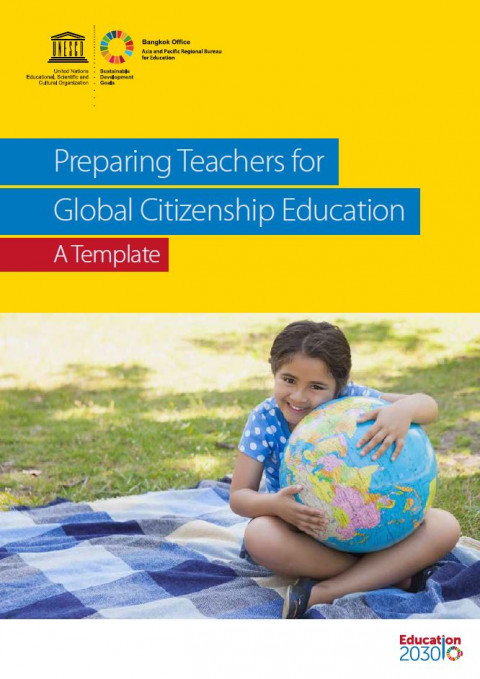 Preparing Teachers for Global Citizenship Education: A Template Année de publication: 2018 Auteur institutionnel: UNESCO Bangkok The UNESCO Asia-Pacific Regional Bureau for Education in Bangkok, Thailand, has taken up the task to promote GCED through a project that focuses on teachers who are key players in transferring appropriate values, knowledge and skills to their students. With support from the Korean Funds-in-Trust, one output of the project is this guide: Preparing Teachers for Global Citizenship Education: A Template.This publication provides useful information on integrating GCED concepts, principles and activities into curricula and teaching practices covering a broad spectrum of issues and pedagogies. It contains exemplars illustrating how GCED can be integrated into various subject areas. Diverse resources and materials listed in the document also offer readers a wide range of references. Underscoring the pragmatic objective of this work is the need for teachers to become global citizens themselves. Подготовка учителей к образованию в духе глобальной гражданственности: Шаблон Année de publication: 2018 Auteur institutionnel: UNESCO Bangkok Подготовка учителей к воспитанию в духе глобальной гражданственности: данный Шаблон - это ответ на вопрос преподавателей и методистов о практической информации и советом о том, как они могут внедрять воспитание в духе глобальной гражданственности (ВГГ) в свои педагогические практики. Эта публикация представляет собой концептуальную основу для трансформационного образования, иллюстрирует искусство преподавания ВГГ с примерами творческой педагогики, предоставляет примеры для демонстрации того, как ВГГ можно интегрировать в разные тематические области и отсылает читателей к богатому списку ресурсов.
  La citoyenneté mondiale en Afrique subsaharienne Année de publication: 2015 Auteur: Akemi Yonemura Auteur institutionnel: Éducation des Adultes et Développement Les apprenants doivent aujourd’hui bien comprendre les défis locaux, nationaux et mondiaux afin de pouvoir exercer une infl uence sur le développement politique, social, culturel, économique et environnemental, tant au sein de leurs sociétés que dans la vie privée. L’UNESCO a fait la promotion de l’éducation pour la paix et le développement durable en tant qu’objectifs fondamentaux de son programme d’éducation, se concentrant pour cela sur une éducation transformatrice par le biais de l’éducation à la citoyenneté mondiale (ECM). Cet article se penche sur l’ECM en Afrique subsaharienne dans le contexte du calendrier de l’éducation pour l’après-2015, et s’intéresse tout particulièrement à l’éducation des adultes.
  Mission impossible ? Créer un cadre de suivi pour l’éducation à la citoyenneté mondiale Année de publication: 2015 Auteur: Amy Skinner Auteur institutionnel: Éducation des Adultes et Développement Il faut considérer l’éducation à la citoyenneté mondiale (ECM) comme un processus complexe et multidimensionnel. L’ECM peut être une force transformatrice au niveau personnel, au niveau local et au niveau du système. Parvenir à effectuer un suivi de l’ECM en tenant compte de cette complexité serait d’une grande utilité. Cet article présente les résultats d’une recherche sur le suivi et explique les défi s que représente la mise en place d’un cadre de suivi.
  Genocide & The Shoah (The Holocaust) : Intellectual Tools for Education & Public Policy Decision The article reviews anti-Semitism from a multi-disciplinary perspective by focusing on the influence of American anti-Semitism on the German Nazis; exploring the endurance of anti-Semitism in Germany via its intellectual and scholastic elite; and exploring the political psychology of Hitlerism prior to the Second World War. The article then examines the problem that although anti-Semitism may be a necessary condition of genocide, it is not a sufficient one. This required the understanding of the jump from anti-Semitism, that is repressive and dominating, to the decision to exterminate a population of human beings completely. This also required a more carefully exploration of the specific features of the Nazi decision process as well as its framework of social control. With this background, the article focuses on developing the theoretical and methodological intellectual skills that have been developed in the context of the policy sciences in order to provide an approach to the challenges generated by the problems of mass murder and genocide, which would guide policy makers to more realistic, timely and effective interventions. The article then explores distinctive but interrelated intellectual tasks that are required for research to guide inquiry and policy making and which include a disciplined commitment to the clarification of the value goals implicated by the problems of mass murder and genocide. These intellectual tasks require a careful specification of the trends in past decisions that have sought, in some measure of efficacy, to respond to these problems. They would also require an understanding of the scientific conditions that have shaped the nature of these trends in order to be able to forecast about the prospect of genocide and mass murder, which could be understood as a tentative forecast of an optimistic and a pessimistic nature, and the possibility of constraining it. Finally, theory requires an element of creativity. That creativity would be expressed in terms of the provided interaction between human values and the art/aesthetic process, which is suggested as a tool for realizing the never again goal. The creative aspect of this would be the invention of strategies that might direct intervention of a trend in the direction of a more optimistic possible future. (By the author)
  How Networking Can Help Build Global Citizenship in Japan Année de publication: 2015 Auteur: Hideki Maruyama Auteur institutionnel: Éducation des Adultes et Développement The article explains and outlines some of the challenges facing schools in Japan when teaching about sustainable development. These challenges are many and diverse. Concrete examples are given, and some proposals for action are presented. Fear and deference in Holocaust education. The pitfalls of “engagement teaching” according to a report by the British Historical Association This article questions the effectiveness of “engagement teaching” when dealing with controversial subjects by exploring the role of fear in contemporary education about the Holocaust in the United Kingdom. It begins by assessing a governmental report about education and a series of related press reports and chain emails, whose assumption that secondary school teachers are afraid of teaching controversial subjects triggered an international scandal about Holocaust education in the UK in April 2007. The author argues that three forms of respectful fear or deference are undermined in Holocaust teaching: epistemological; political; and intergenerational . The article further demonstrates that the object of fear expressed by journalists and the public was not the Holocaust itself, but the reversal of deferential relations between teachers and pupils in the school classroom and the supposition that we may not learn from history. Whereas history education is held up by policy-makers as a safeguard of social stability and of the transmission of values, the application of “engagement teaching” to controversial subjects may in fact undermine the authority of historical education and the enlightenment principles on which it is founded. (By the author)
 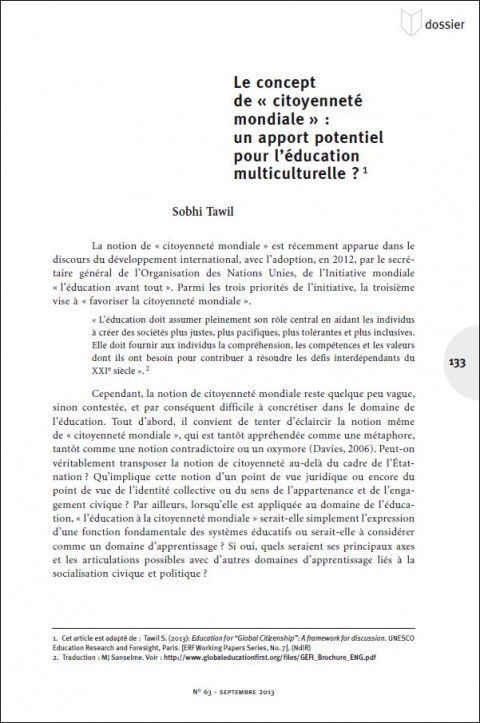 Does the Concept of ‘Global Citizenship’ Have the Potential to Input in Multicultural Education? Année de publication: 2013 Auteur: Sobhi Tawil Auteur institutionnel: Revue internationale d’éducation de Sèvres One of the three priorities of the Global Education First Initiative launched in 2012 by the United Nations is fostering global citizenship. However, this concept remains vague if left unchallenged, and as a result is difficult to implement in the field of education. It may be true that the growing globalisation and multiculturalism of contemporary societies is gradually transforming the concept and traditional role of citizenship, the legal reality of citizenship and its practises, but they still remain largely rooted in the idea of Nation-State. This article attempts to clarify the concept of global citizenship, its possible application in the field of citizenship education and its potential contribution to the enrichment of multicultural education. El concepto de “ciudadanía mundial” : ¿una posible aportación para la educación multicultural ? Année de publication: 2013 Auteur: Sobhi Tawil Auteur institutionnel: Revue internationale d’éducation de Sèvres Entre las tres prioridades de la iniciativa mundial “la educación ante todo” (Education first) lanzada en 2012 por las Naciones Unidas, podemos encontrar la idea según la cual conviene “favorecer la ciudadanía mundial”. Sin embargo, esta noción es de las más imprecisas, si no discutida y, por tanto, difícil de concretizar en el campo de la educación. Si no cabe duda de que la mundialización y la creciente multiculturalidad de las sociedades contemporáneas transforman paulatinamente la concepción y la práctica tradicional de la ciudadanía, la realidad jurídica de la ciudadanía así como su práctica, quedan establecidas fundamentalmente a nivel del Estado-Nación. Este artículo procura aclarar la noción de “ciudadanía mundial”, su posible aplicación en el dominio de la educación a la ciudadanía y su contribución potencial al enriquecimiento de la educación multicultural. Le concept de « citoyenneté mondiale » : un apport potentiel pour l’éducation multiculturelle ? Année de publication: 2013 Auteur: Sobhi Tawil Auteur institutionnel: Revue internationale d’éducation de Sèvres Parmi les trois priorités de l’initiative mondiale « l’éducation avant tout » (Education First) lancée en 2012 par les Nations-Unies, on trouve l’idée de « favoriser la citoyenneté mondiale ». Cependant, cette notion reste vague sinon contestée, et par conséquent difficile à concrétiser dans le domaine de l’éducation. S’il est vrai que la mondialisation et la multiculturalité croissante des sociétés contemporaines transforment progressivement la conception et la pratique traditionnelle de la citoyenneté, la réalité juridique de la citoyenneté, ainsi que sa pratique, restent encore largement ancrées au niveau de l’État-nation. Cet article tente de clarifier la notion de « citoyenneté mondiale », son application possible dans le domaine de l’éducation à la citoyenneté et sa contribution potentielle à l’enrichissement de l’éducation multiculturelle.