
Ressources
Explorez une large gamme de ressources sur le GCED afin d’approfondir votre compréhension et de renforcer vos activités de recherche, de plaidoyer, d’enseignement et d’apprentissage.
3,790 résultats trouvés
 L’enseignement de l’histoire et les mémoires douloureuses du XXe siècle. Enquête sur les représentations enseignantes This article discusses the teaching of sensitive topics related to the memory and history of the 20th century, mainly the issues of the extermination of Jews and the wars of national liberation. The survey, conducted between 2000 and 2003 at the Academie de Versailles, highlights the specific difficulties in this teaching from primary school to secondary school, in different disciplines ‒ literature, history and philosophy. The report also leads to an analysis of the representations that are formed on these subjects, both by students and teachers. (By the author - Translation)
  Portée et limites de l'éducation à la citoyenneté démocratique Année de publication: 2007 Auteur: Charles Heimberg Auteur institutionnel: Université de Genève L’éducation à la citoyenneté démocratique est une dimension du projet éducatif de l’institution scolaire à la fois fortement proclamé et très problématique dans sa réalité quotidienne. Le fait qu’il s’agisse d’une première possibilité de prise de contact avec la notion de citoyenneté pour tous les élèves incite en tout cas la réflexion. La notion de citoyenneté est polysémique et ambiguë par les représentations dont elle fait l’objet comme par les pratiques concrètes qu’elle suscite à l’école ; elle oscille notamment entre la dimension normative de civilité, le civisme politique et participatif, et l’analyse critique de problèmes de société. Cette dimension de citoyenneté, à la fois partout et nulle part au sein de l’école, devrait faire l’objet de recherches empiriques approfondies. Elle laisse forcément ouverte l’épineuse question de savoir comment faire valoir sans prescrire.
  L'éducation à la citoyenneté Année de publication: 2008 Auteur: Audric Vitiello Auteur institutionnel: Raisons politiques Notion récente, l'éducation à la citoyenneté se présente comme une inflexion de la formation civique, visant un renouvellement de sa forme pour mieux assurer sa fonction institutionnelle d'intégration des individus au collectif. Mais, l'éducation ôtant une praxis où moyens et fins sont interdépendants, une modification des modalités de l'éducation induit logiquement celle de la finalité. De fait, l'éducation à la citoyenneté s'indexe à une conception originale du politique pensé non plus comme lieu, mais comme moment spécifique dédié à la régulation de tout collectif. Le mécanisme d'abstraction civique perdure, mais il s'effectue à partir des situations concrètes dans lesquelles l'individu est inscrit, et par une réflexion à fondement dialogique. Se dessine alors une forme de démocratie générale et dialogique, où le politique est déconcentré et démultiplié mais où la décision prise en commun après délibération reste le mode de structuration privilégié du collectif. Mais la démocratie procédurale et dialogique a des limites, dans la mesure où elle suppose d'être fondée dans un corpus substantiel de valeurs qui lui confère sa légitimité.
  Citoyenneté des enfants et des adolescents Année de publication: 2018 Auteur: Stéphanie Gaudet Auteur institutionnel: Lien social et Politiques Chacune des contributions de ce numéro révèle clairement un ou plusieurs de ces défis selon différences échelles d’analyse. La première partie du numéro porte sur les normativités et les représentations sociales de la citoyenneté enfantine et adolescente véhiculées par les instruments de politiques publiques en France et au Québec. La deuxième section porte sur les institutions qui répondent directement des politiques publiques et qui ont pour mandat de socialiser et d’éduquer les enfants et les adolescents aux pratiques de citoyenneté démocratique. La troisième section de ce numéro présente deux contributions qui rendent compte de l’agencéité (agency) des jeunes et de leurs pratiques citoyennes, c’est-à-dire leur capacité à développer des intentions politiques et à les mettre en action les uns avec les autres. Ce terme se distingue de celui d’agentivité qui est utilisé davantage en sciences cognitives et s’intéresse plus spécifiquement aux mécanismes de l’action individuelle (Glossaire, 2009). Finalement, nous terminons le numéro par des analyses à l’échelle des quartiers et des organisations jeunesse. On y voit comment les intervenants de première ligne, et leurs organisations locales, négocient différentes visions de l’éducation citoyenne, allant de l’éducation à la civilité jusqu’à l’intervention démocratique. Ces échelles d’analyse nous permettent d’observer les représentations de la citoyenneté en fonction des rapports de classe et d’ethnicité. Quand les mémoires déstabilisent l’école. Mémoire de la Shoah et enseignement This work is based primarily on the subject of the Holocaust, but it attempts to define cross-cutting issues in the category of teaching “sensitive” subjects, assuming we can build a common paradigm. To do this, it brings together the perspectives of historians, philosophers, teachers and participating witnesses, inviting us to return to the fundamental questions underlying the act of transmission. Each contribution brings us to reflect on what it is we are trying to transmit, and suggests a systematic exploration of the difficulties inherent in these transmissions: the magnitude and complexity of the historical problem, the extreme moral and political exigencies, the intricate intermingling of memory, the historian’s work, and civic commitment. What to do with negative commemorations? We cannot forget, repent, deny or trivialize. We can only question our modern societies and their ambivalence. (By the author - Translation)
 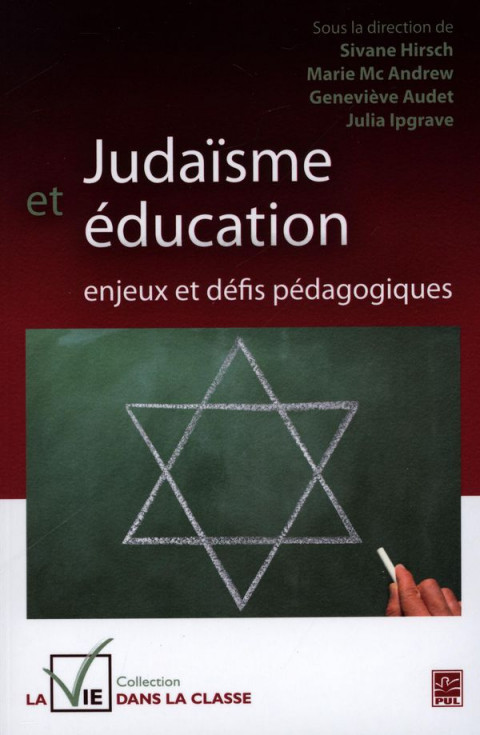 Judaïsme et éducation : enjeux et défis pédagogiques The question of relations between ethnic groups defined by different markers, including religion, is more than ever necessary in our plural societies. This original work focuses on the role of education in the dynamics of relations between the Jewish community and fellow citizens of all origins in Quebec, Canada and in other countries. Indeed, while the Jewish communities are often well established in their host societies, they often remain little known to the population and especially of the majority groups. The authors address three issues that may challenge the stakeholder community and school, but also the general public interested in "living together" and its challenges : Education on Jewish communities in public schools; Education on the Holocaust and innovative practices in this regard; Moving Jewish schools and their impact. (By the publisher - Translation) Du bist anders? – Eine Online-Ausstellung über Jugendliche in der Zeit des Nationalsozialismus This website takes an online inventory of young Jewish, roma or righteous children/teenagers who were persecuted during World War two. / Ce site prend un inventaire en ligne des jeunes, roma ou justes enfants / adolescents juifs qui ont été persécutés pendant la Seconde Guerre mondiale. Vancouver Holocaust Education Centre The Vancouver Holocaust Centre Society was founded in 1983 by survivors of the Holocaust. The founders’ goal was to leave a permanent legacy in the form of the Vancouver Holocaust Education Centre devoted to the Holocaust and based on anti-racism education. Online, teachers have access to practical guides for teachers and activities with discovery kits for primary and secondary pupils.
  Holocaust Education in Ontario High Schools: An antidote to racism? The premise underpinning this article is that if the Holocaust is taught well, it can help to promote anti-racist goals. The need to realize the Holocaust's anti-racist potential is self-evident, but is arguably greatest where conventional anti-racism (aimed at enhancing the life chances of visible minorities) is under threat. Such a situation currently exists in Ontario, where the right wing Progressive Conservative party was elected to office in June 1995. The uncertain future of anti-racism in the province provides the background to this article. It examines the teaching of the Holocaust in Ontario high schools and reports the findings of a survey carried out among history staff in May 1998. Various ways are suggested in which the teachers involved (and others elsewhere) might alter their approach to the Holocaust in order to strengthen its contribution to anti-racist education. (By the author)
  Confronting the Holocaust in Religious Education Studies of Holocaust education in secondary schools have tended to focus on how the subject is taught as part of the history curriculum. Comparatively little work of either a theoretical or an empirical nature has looked at how the subject is handled in other curricular areas. Religious education is a case in point, for the field is marked both by a dearth of literature on appropriate content and by a virtual absence of research on teachers' practices. The need to address these lacunae provides the rationale for the article. In relation to content, two concerns dominate the discussion. The first is that the Holocaust may be portrayed as an act of religious intolerance; the second is that students may be offered a diluted or distorted account of the part played by Christianity. The empirical core of the article surveys the practices of 28 teachers of religious education in connection with both concerns. It also contains a content analysis of how textbooks used by the teachers treat the attempted annihilation of European Jewry. The article concludes with a discussion of the policy implications of the findings. (By the author)