
Ressources
Explorez une large gamme de ressources sur le GCED afin d’approfondir votre compréhension et de renforcer vos activités de recherche, de plaidoyer, d’enseignement et d’apprentissage.
2,781 résultats trouvés
 Modern Context and Education Choice of Multi-culture Année de publication: 2019 Auteur: Yuanmei | Sun Jieyuan Auteur institutionnel: Contemporary Education and Culture Multi-culture is a generic term for diverse cultures existing in a society, country or nation, which is a nation that reflexes differences in value standards, thoughts and ideas, and behaviors and actions among varied people. Multi-culture, in modern context, is to face cultural differences hold that different groups of people have basic rights and that people with different classes and cultures should all be accepted and understood, and highlight the main role, relatively and complementary of all quality, education fairness, a balanced education as well as educational dynamism. Therefore, we should create multicultural teachers. Besides, we should implement multicultural courses and positively foster more multicultural teaching, adopt diverse assessment and evaluation methods and promote appropriate and efficient multicultural education, thus addressing the problems of unbalanced and inadequate educational development, creation more dynamic education environment and delivering more fair and quality education. 多元文化的现代语境与教育选择 Année de publication: 2019 Auteur: Yuanmei | Sun Jieyuan Auteur institutionnel: Contemporary Education and Culture 多元文化指在一个社会、国家或民族中所存在的多种文化的总称,反映了人类不同群体之间价值规范、思 想观念乃至行为方式上的差异。现代意义上的多元文化正视文化差异,坚持不同团体都拥有基本的权利,不 同 阶 层、 不同文化的人都应被接受、被理解,强调文化的主体性、相对性与互补性。现代多元文化教育具有积极的价值,有助 于提升教育质量、促进教育公平、推进教育均衡、增强教育活力。因此,需要通过创建多元文化校园环境、深入开发 多元文化课程、自觉培养多元文化教师、积极实施多元文化教学、采取多样化的考核评价等方式,积极推进合理有效 的多元文化教育,以促进教育发展不平衡不充分问题的解决,创造充满活力的教育和提供公平优质的教育。
  Review on the Localization of Multicultural Education Theory in China Année de publication: 2019 Auteur: Xu Kefeng | Hupaio Auteur institutionnel: Contemporary Education and Culture According to the quantitative statistics and content analysis of the literature, the localization of the multicultural education theory in China has gone through three stages: the main achievement is the translation and introduction of the western multicultural education thought; the second stage is the high-speed growth period, the main achievement is the multicultural education theory. At present, it is in the third stage and the growth rate of literature slows down, which means that new theoretical breakthroughs are being sought in this field. 我国多元文化教育理论本土化之路回顾 Année de publication: 2019 Auteur: Xu Kefeng | Hupaio Auteur institutionnel: Contemporary Education and Culture 根据对文献的量化统计与内容分析,我国多元文化教育理论的本土化历程经历了三个阶段:第 一 阶 段 萌 芽 期,主要成就是对西方多元文化教育思想的翻译和介绍;第二阶段为高速增长期,主要成就是多元一体教育理论的提 出;目前处在第三阶段,文献增长速度减缓,意味着这一领域正在寻求新的理论突破。
  한국사회 인종차별을 말하다: 2018. 7. 20 ~ 21 인종차별 보고대회 자료집 Année de publication: 2018 Auteur institutionnel: UN인종차별철폐협약 한국심의대응 시민사회 공동사무국 | 서울지방변호사회 2018년 7월 20일부터 21일까지 개최되었던 토론회 인종차별보고대회의 자료집으로 1966년 UN총회 결의로 선포된 인종차별철폐협약(The Committee on the Elimination of Racial Discrimination, CERD)과 관련하여 경과보고와 현재까지 남아 있는 한국사회 내의 인종차별의 원인과 현황을 다루고 있다. 1부 : 한국사회와 인종차별을 말하다 - 한국사회와 인종차별 역사와 배경2부 : 현실을 말하다 - 국가는 인종차별 강화에 어떻게 기여하고 있는가?3부 : 인종차별의 선긋기는 어디에서 교차되는가?4부 : 미래를 말하다 - 미래를 향한 제언
  Fostering national and global citizenship: an example from South Africa (Social Studies and the Young Learner, vol 21, no. 1, september/october 2008) Année de publication: 2008 Auteur: Omiunota Nelly Ukpokodu Auteur institutionnel: National Council for the Social Studies Multicultural and global scholars urge that we prepare the young for national and global democratic citizenship given the increasing interdependence and challenging realities for today. Young people desire to be a part of the solution to global problems, but they must be educated about what those problems are and how solutions can be arrived at. As has been seen in the U.S. presidential campaign, young people care about their communities, country, and planet, and they are volunteering and voting at record rates. We must take responsibility to plant the seeds of critical citizenship if we are to foster a more sustainable, peaceful, just, and prosperous world. Educator Sheldon Berman sums it up by writing: It is important for teachers to tell young people about the success stories of others, students who have reclaimed forests, cleaned up rivers, improved their school environment, helped the homeless. They need to hear about the Mother Teresas and the Martin Luther Kings, of course, but also about the people who live down the street who are doing what they can to improve the neighbourhood and about the many organizations that make a difference in our communities. We must put students in touch with these people and organizations so that they can see how deeply people care about their world and how worthwhile it is to participate in creating change.
 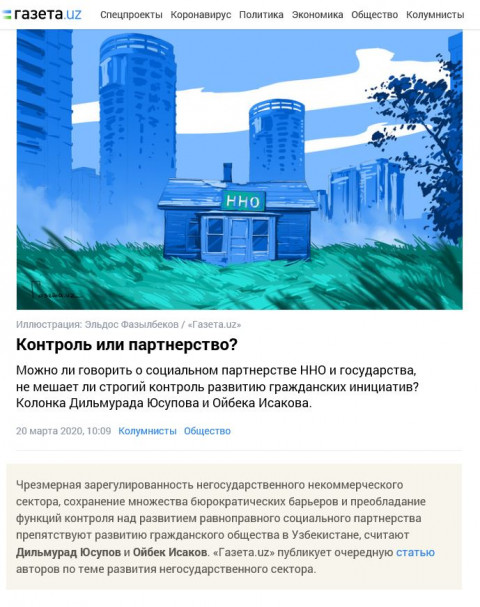 Контроль или партнерство? Année de publication: 2020 Auteur: Dilmurod Yusupov | Oybek Isakov Чрезмерная зарегулированность негосударственного некоммерческого сектора, сохранение множества бюрократических барьеров и преобладание функций контроля над развитием равноправного социального партнерства препятствуют развитию гражданского общества в Узбекистане, считают авторы статьи. Control or Partnership? Année de publication: 2020 Auteur: Dilmurod Yusupov | Oybek Isakov Excessive regulation of the non-governmental non-profit sector, the preservation of many bureaucratic barriers and the predominance of the functions of control over the development of equal social partnership hinder the development of civil society in Uzbekistan, the authors of the article say.
 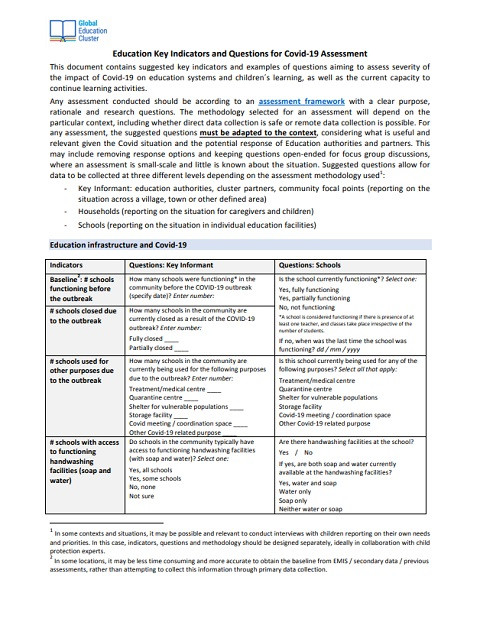 Education Key Indicators and Questions for Covid-19 Assessment Année de publication: 2020 Auteur institutionnel: Global Education Cluster This document contains suggested key indicators and examples of questions aiming to acess severity of the impact of Covid-19 on education systems and children’s learning, as well as the current capacity to continue learning activities.
 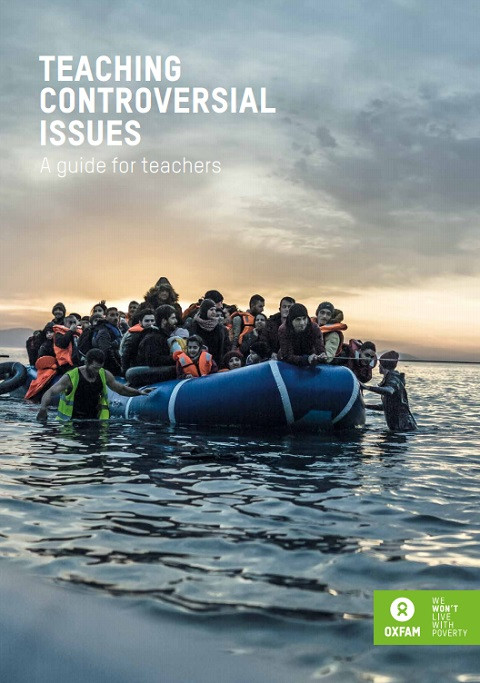 Teaching Controversial Issues: A Guide for Teachers Année de publication: 2018 Auteur institutionnel: Oxfam GB This revised and updated version of Oxfam’s popular guide recognises the changes in social and political contexts in recent years and seeks to support educators in their discussions with young people in this complex environment. In increasingly divisive and polarised times, the need for young people to feel confident in tackling controversial issues is more pressing than ever. Advances in technology and the rise of social media mean that it is more important than ever for young people to think critically to become effective global citizens.This guide explores:• What controversial issues are.• Reasons for teaching controversial issues.• The value of a global citizenship education approach.• Guidance and classroom strategies for handling and exploring controversial issues.• Some practical activities for teaching controversial issues.