
Ressources
Explorez une large gamme de ressources sur le GCED afin d’approfondir votre compréhension et de renforcer vos activités de recherche, de plaidoyer, d’enseignement et d’apprentissage.
2,162 résultats trouvés
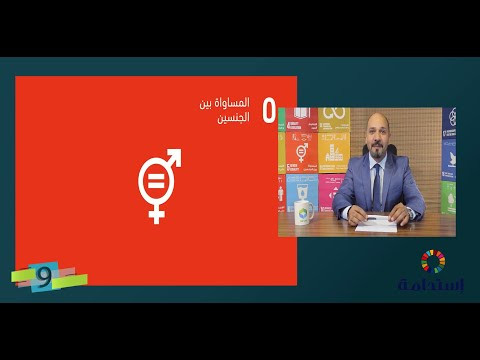 Sustainability: Gender Equality Année de publication: 2019 Auteur institutionnel: CSR Egypt This video deals with the concept of the fifth goal of the sustainable development goals (gender equality) and that women have a fundamental role to achieve the goals of sustainable development, and that is why they must be given the opportunity and support to obtain all their rights and effective participation in the advancement of Arab societies. الاستدامة: المساواة بين الجنسين Année de publication: 2019 Auteur institutionnel: CSR Egypt الفيديو يتطرق لمفهوم الهدف الخامس من اهداف التنمية المستدامة (المساواة بين الجنسين) و ان المرأة لها دور اساسى لتحقيق اهداف التنمية المستدامة و لذلك يجب ان يتم اتاحة الفرصة لها و دعمها للحصول على كافة حقوقها و مشاركتها الفعاله للنهوض بالمجتمعات العربية.
 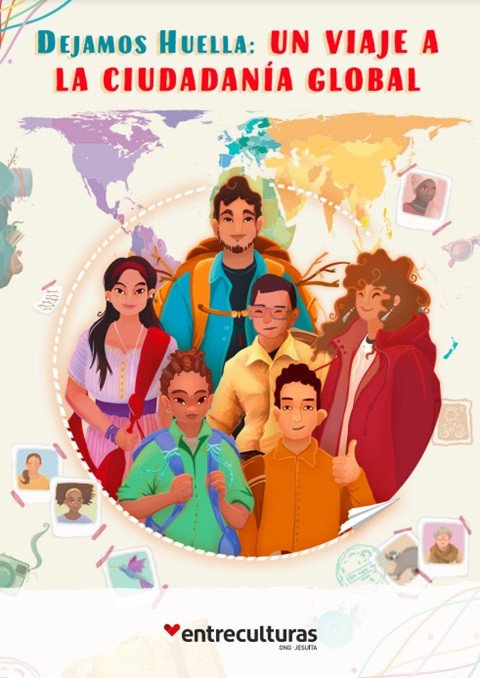 We Leave Our Mark: A Journey to Global Citizenship Année de publication: 2024 Auteur institutionnel: Entreculturas With this educational guide, students will be actively involved in exploring global and local issues with the aim of training agents of change in their own communities. They will take an educational journey through different themes (destinations) of Global Citizenship, such as gender equality, environmental protection, interculturality, inclusion, democratic participation, social justice and culture of peace. Each destination includes activities, games and practical exercises designed to raise students' awareness of the corresponding topic, using participatory dynamics such as games, puzzles, videos, and interactive simulations. Dejamos huella: Un viaje a la ciudadanía Global Année de publication: 2024 Auteur institutionnel: Entreculturas Con esta guía educativa el alumnado se verá involucrado activamente en la exploración de problemas globales y locales con el objetivo de formar agentes de cambio en sus propias comunidades. Realizarán viaje didáctico por diferentes temáticas (destinos) de Ciudadanía Global, como la igualdad de género, la protección del medio ambiente, la interculturalidad, la inclusión, la participación democrática, la justicia social y la cultura de paz. Cada destino incluye actividades, juegos y ejercicios prácticos diseñados para sensibilizar al alumnado sobre el tema correspondiente, utilizando dinámicas participativas como juegos, acertijos, vídeos, y simulaciones interactivas.
 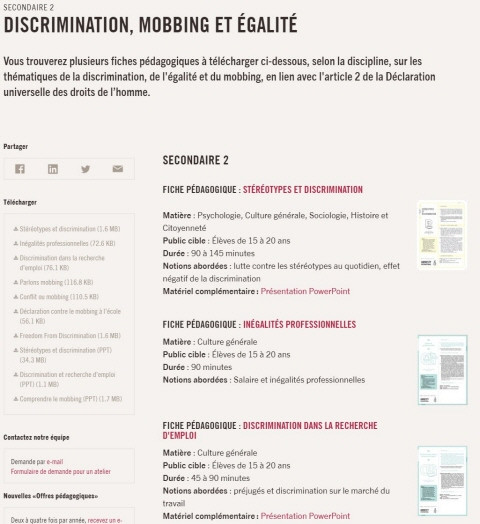 Discrimination, Mobbing and Equality Auteur institutionnel: Amnesty International. Swiss Section These 7 education sheets(Stereotypes and Discrimination, Occupational Inequalities, Discrimination in Job Searching, Let’s Talk about Mobbing!, Conflict or Mobbing?, Declaration against Mobbing at School, Freedom from Discrimination) cover the themes of discrimination, equality and mobbing(conflictual relations in the workplace, both between colleagues and between superiors and subordinates), in relation to article 2 of the Universal Declaration of Human Rights. Discrimination, mobbing et égalité Auteur institutionnel: Amnesty International. Swiss Section Ces 7 fiches pédagogiques(Stéréotypes et discrimination, Inégalités professionnelles, Discrimination dans la recherche d'emploi, Parlons mobbing!, Conflit ou mobbing? Déclaration contre le mobbing à l'école, Freedom from discrimination) portent sur les thématiques de la discrimination, de l'égalité et du mobbing (relation conflictuelle sur le lieu de travail, aussi bien entre collègues qu'entre supérieurs et subordonnés), en lien avec l'article 2 de la Déclaration universelle des droits de l’homme.
 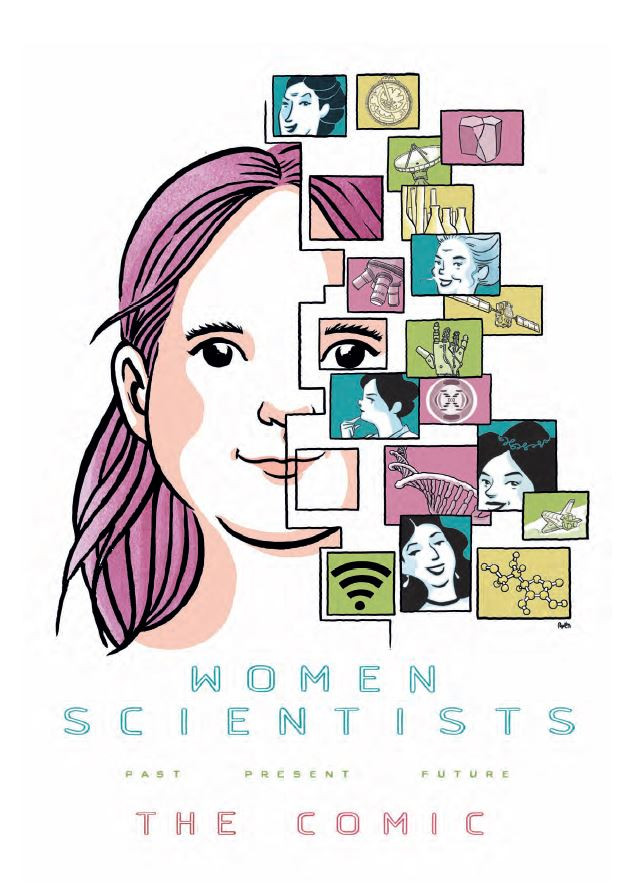 Women Scientists: Past, Present and Future Année de publication: 2019 Auteur: Raquel Gu | Francisco Vega Narváez Auteur institutionnel: ONCE Foundation This comic is the adaptation of the play Women scientists: past, present and future, an original idea by Francisco Vega Narváez with an original script by Isabel Fernández Delgado, Clara Grima Ruiz, maría José Jiménez Rodríguez, Adela muñoz Páez, maría del Carmen Romero Ternero and Francisco Vega Narváez. Both in the play and in the comic, female references are presented in the world of science so that girls do not feel that something is foreign to them simply because they are women and also so that boys have those same references. Achievements in science are made by people, it doesn't matter if they are women or men, their age, nationality... Científicas: pasado, presente y futuro Année de publication: 2019 Auteur: Raquel Gu | Francisco Vega Narváez Auteur institutionnel: ONCE Foundation Este cómic es la Adaptación de la obra de teatro Científicas: pasado, presente y futuro, una Idea original de Francisco Vega Narváez con Guion original de Isabel Fernández Delgado, Clara Grima Ruiz, maría José Jiménez Rodríguez, Adela muñoz Páez, maría del Carmen Romero Ternero y Francisco Vega Narváez. Tanto en la obra como en el cómic se presentan referentes femeninos en el mundo de la ciencia para que las niñas no sientan que algo les es ajeno por el mero hecho de ser mujeres y también para que los niños tengan esos mismos referentes. Los logros en ciencia los hacen personas, da igual que sean mujeres u hombres, su edad, nacionalidad..
 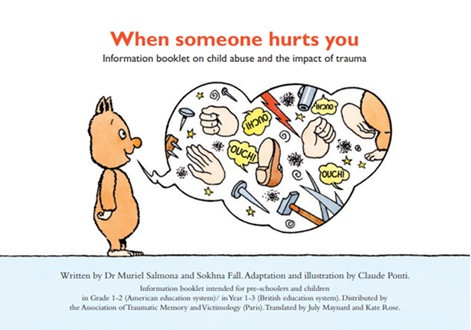 When Someone Hurts You: Information Booklet on Child Abuse and the Impact of Trauma Année de publication: 2022 Auteur: Muriel Salmona | Sokhna Fall Auteur institutionnel: UNICEF France | French Association for Traumatic Memory and Victimology This educational booklet is designed to help young children from kindergarten to Third grade to identify their feelings of unease following a situation of violence or threat of violence (physical, moral or sexual), understand the causes and consequences, and give advice on how to protect themselves and seek help. Quand on te fait du mal: Information sur les violences et leurs conséquences Année de publication: 2022 Auteur: Muriel Salmona | Sokhna Fall Auteur institutionnel: UNICEF France | French Association for Traumatic Memory and Victimology Ce livret pédagogique permet d’aider les plus petits de la maternelle au CE2, à identifier leur mal-être suite à une situation de violence ou menaces de violences (physiques, morales, sexuelles…), en comprendre les causes et les conséquences et donne des conseils pour apprendre à se protéger et demander de l’aide.